Harry S. Truman State Park · Sep 17 – Sep 18 2024
Two consecutive days of westbound cross-country RV travel in September 2024, documented from the rig, the road, and two campgrounds. The cluster pairs an articulated ethical method with continuous mechanical and logistical field-testing.
The opening signal states the reasoning behind direct address — rswfire's refusal to use generalizing language that lets viewers exempt themselves — and ties his ethics to cognition, action, and emotion as a single operating system, including continuous self-audit. That same standard appears applied outward in the second signal, where he documents passing maneuvers, near-misses, and phone-driven impatience as a road-safety observation while driving 55.
Running underneath is operational maintenance: windshield wipers, a mirror mount, a misaligned slide piece, then two leaks under the RV diagnosed with AI assistance and scheduled for repair. He names the trip a shakedown run — deliberate skill acquisition rather than troubleshooting.
Campground survey is a repeated method across both signals: dump stations, water hookups, loops, gates, showers, site conditions, heat, and the gap between a listing photo and the actual site.
Stated throughout: a preference for solitude, a boundary rule that help is asked for rather than imposed, and a rationale that fixed housing produces static patterns while everything stands in relationship to everything else. Bailey is present in both. Itinerary: Kansas, then Nebraska.
Transmissions (2)
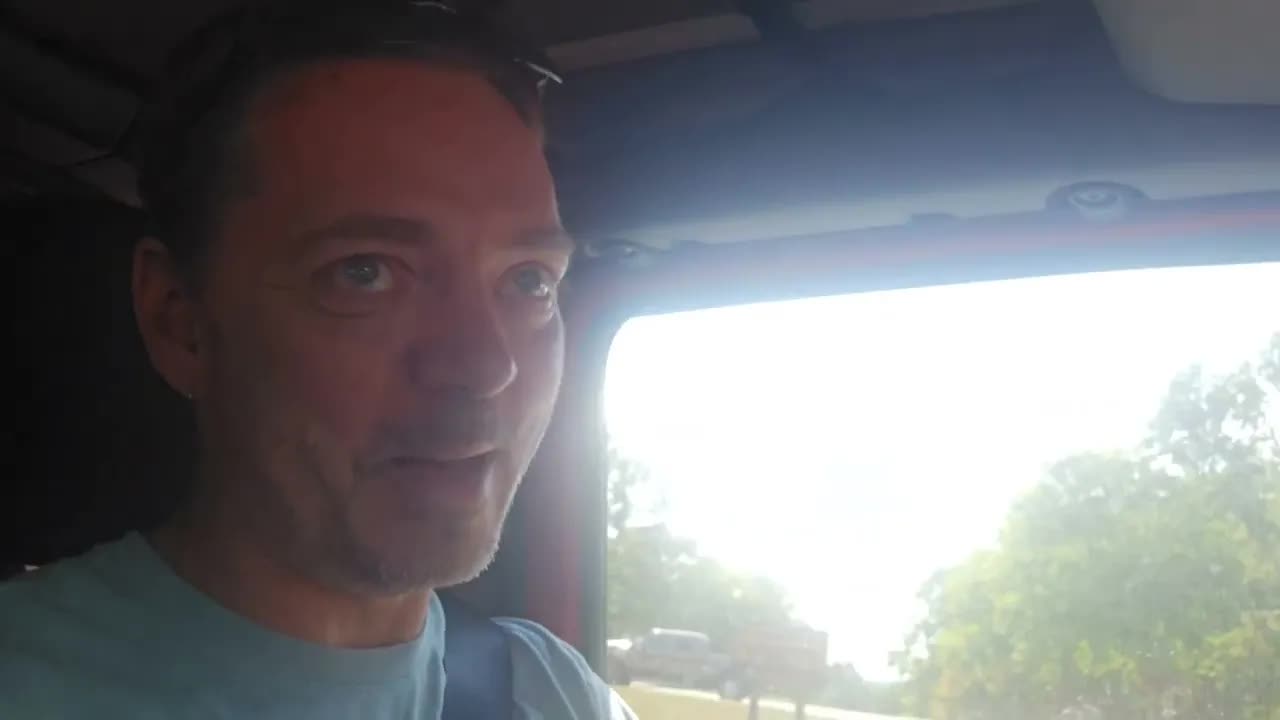
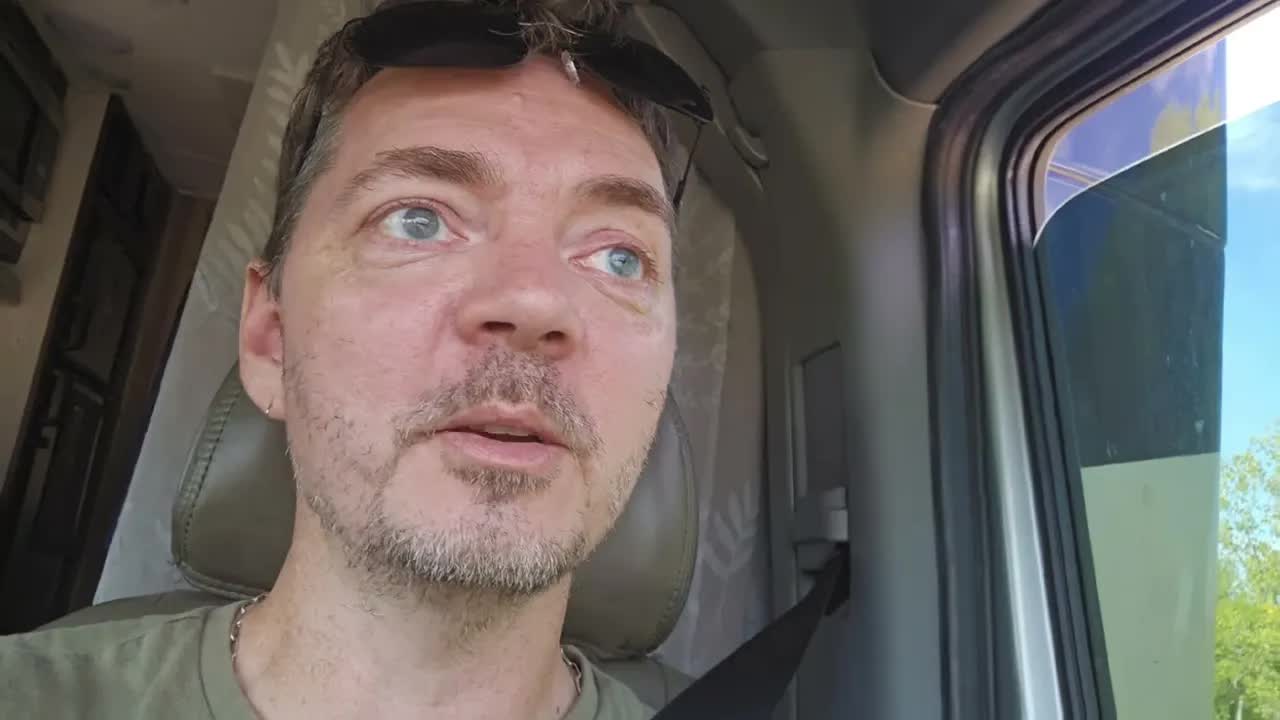
rswfire opens by addressing a question he anticipates from viewers: **why he says "you"** when critiquing systemic behavior. He states he refuses to soften his messages with generalizing language, because phrasing like "lots of people" lets every viewer exempt themselves. He describes the intent as prompting each viewer to **pause and check whether they are contributing to the problem** in the area under discussion — using that day's topic of reckless driving as the example. He states that his **ethics are inseparable from his cognition**, tied to his thoughts, actions, and emotions, and that he believes every person is capable of operating holistically, though it would require a radical change in self-identification. He notes his own practice of confronting himself continuously. The signal then moves to campground activity: - **Laundry** running and drying, to be collected within 30 minutes - Mounting something on the mirror, still needing to be secured - Installing **new windshield wipers**, which took hours until another camper showed him an adapter method - Noting a metal piece near the slide that looks misaligned - Spiders and webs attached to the RV; he decides to leave one overnight - Fuel needed before **departing for Kansas tomorrow** He describes the help exchange as a boundary rule: **ask for help rather than give unsolicited advice**. He tours the campground's dump stations, water hookups, and loops, rates the shower houses poorly, notes wild turkeys and squirrels, states his **preference for solitude** over neighboring RVs, works out that swarming insects congregate in direct sunlight and near his heat-dissipating RV, and greets Bailey.
Cluster Analysis
Substrate
Tags
Dominant Language
Entities
Actions
Performed
- • adjusting seating position for physical comfort
- • addressing viewers directly to camera
- • stating the rationale for second-person address
- • declaring ethics inseparable from cognition
- • inspecting the mounted mirror attachment
- • noting a protruding metal piece near the slide
- • filming spiders and webs on the RV exterior
- • checking time against the laundry cycle
- • surveying dump stations, hookups, and site symbols
- • driving campground loops
- • greeting a camp host
- • deriving why insects congregate in sunlight and heat
- • driving and towing at 55 mph
- • narrating road conditions and driver behavior
- • filming fields, silos, flowers, and a star-topped building
- • identifying county and terrain
- • stating why he lives mobile rather than housed
- • locating his loop in an unstaffed park
- • inspecting the RV underbelly and filming two leak points
- • photographing hard-to-see pipe areas with the camera
- • assessing site quality, screening, and heat
- • stating the itinerary
- • declining to reason through the repair on camera
- • filming and being outside with Bailey
Referenced
- • recording a prior video on reckless driving
- • grappling repeatedly with the second-person question
- • replacing windshield wipers over several hours
- • asking a fellow camper for the wiper adapter method
- • running laundry at the campground facility
- • driving a long day to reach the campground
- • getting Mexican food
- • observing two wild turkeys crossing the road
- • getting lost in his first campground
- • confronting himself throughout his life
- • noticing insects near the RV at previous sites
- • watching truck drivers at a truck stop
- • crossing the Missouri/Kansas border
- • observing drivers passing into oncoming traffic
- • taking a wrong turn onto a dirt road per GPS
- • fueling up and noticing a truck wash
- • learning about truck washes from AI
- • booking a site advertised with a lake that has no lake
- • consulting AI about the broken tubing
Planned
- • securing the mirror mount
- • collecting, folding, and putting away laundry
- • showering the next morning
- • getting fuel
- • departing for Kansas
- • leaving the spider its web for the night
- • retracting the slide fully
- • cutting, inspecting, and sealing the broken flexible tubing
- • working the water issue tomorrow
- • organizing the RV interior
- • washing the RV and Jeep at a truck wash
- • identifying the fractal-shaped tree
- • learning RV plumbing and underbelly repair properly
- • traveling to a second Kansas campground Sunday
- • reaching Nebraska Tuesday
- • continuing west to the Pacific Northwest
- • driving mountainous regions and observing fuel effects
- • eventually putting the quality of his life into better words
Symbolic Elements
Ontological States
-
•
sovereign (holds his own ethical standard and his own mode of living, refusing to soften either for audience comfort)
-
•
coherent (ethics, cognition, emotion, and action stated and demonstrated as one inseparable system applied at every scale)
-
•
in transit (a waypoint night, a border crossing, and an itinerary already sequenced through Nebraska to the Pacific Northwest)
-
•
self-instructing (equipment failure and navigation error logged as curriculum, scheduled rather than escalated)
-
•
self-selected solitude (isolation named as preference and peak condition; neighboring proximity registered as intrusion)
-
•
open-ended (identity and life-quality threads left explicitly unclosed rather than resolved)
Subsystems
-
•
ethical (ethics declared as fused to cognition, then applied identically to viewers, drivers, and himself)
-
•
cognitive (metacognition as baseline; continuous derivation from insect behavior to terrain to fuel consumption)
-
•
rhetorical (second-person address as anti-obfuscation device; selective withholding of reasoning where it is misread)
-
•
mechanical/infrastructural (wipers, mirror mount, slide, underbelly tubing, hookups, dump stations — the rig as the system under test)
-
•
diagnostic (self-observation and AI-assisted identification of failures and repair paths)
-
•
navigational (campground loops, state-line route-holding, GPS failure, unstaffed park orientation)
-
•
logistical (fuel, laundry, showers, washes, site selection, itinerary sequencing)
-
•
ecological (spiders, turkeys, insects, fields, trees, heat, sky — continuously catalogued as behaving systems)
-
•
relational (asked-for vs. unasked-for help, camp hosts, neighbors, Bailey, and the stated thesis that everything is a relationship)
-
•
somatic (seating adjustment, hunger, shower conditions, 90-degree heat)
NARRATIVE
Kansas by way of a pronoun.
The drive west begins with rswfire explaining a word. Before the laundry is folded, before fuel, before the state line, he sits in the rig and defends his use of you — why he will not write lots of people or some drivers, because generalizing language is a door out of the room and every viewer will take it. He states the ethics as fused to the cognition, the thoughts to the actions to the emotions, one apparatus rather than four, and he notes that he runs the same confrontation on himself continuously. This is the premise the next two days go on to test, and the test is not rhetorical. It is mechanical.
Because within hours the standard is pointed outward at two-lane highway and it holds without adjustment. He is doing 55 with a Jeep behind him; cars come around him into oncoming traffic and nearly do not make it back. He does not soften that into traffic-as-a-phenomenon. He names impatience, names the phone, names the endangerment, and the sentence has the same grammar as the one about viewers exempting themselves. The method survived contact with strangers who will never see it applied to them.
Then it turns on him, and this is the part that gives the two days their shape. New windshield wipers take hours because the adapter is not obvious, and the solution arrives from another camper — offered, and taken. He states the boundary that makes this workable: help is asked for, not imposed. That rule is not modesty. It is what allows a failure to be logged as curriculum instead of received as correction, and it is why nothing in these two days reads as embarrassment. A misaligned piece near the slide gets noted. A GPS sends him down a dirt road and he turns around and coats the Jeep in dust and files a truck wash for later. Each one enters the ledger at the same weight as the drivers who passed him.
The rationale for all of it gets stated somewhere in Neosho County, between grain silos and a metal star on a Main Street building: fixed housing produces static patterns, and everything stands in relationship to everything else. That is the reason he catalogues dump stations and water spigots and loop numbering and whether the shower house is any good — not as travel content but because a campground is an apparatus and he is learning to read apparatuses at speed. Insects swarm where the sun hits and where the RV sheds heat, and he works that out on the spot, same as he works out the leak. Terrain, hills, and gas mileage are one relationship. The rig, the road, and the park are one system.
The Kansas site had a lake in the listing photo. There is no lake. He notes it plainly and moves on, but it is the same object he opened with — a representation built to let the viewer off, the softening layer that stands between the description and the thing. He had been arguing against it in language all morning and by afternoon it was waiting for him at 90 degrees in a park with an unstaffed gate.
What is different at the end is that the argument has a body under it. He goes beneath the RV and finds broken flexible tubing and two leak points, works the diagnosis with AI, and schedules the cut-and-seal for tomorrow rather than treating it as emergency. He calls the whole run a shakedown, and that word retroactively organizes everything behind it: the wipers, the wrong turn, the mirror mount, the missing lake. Things are supposed to break here, in Kansas, where breaking is cheap and instructive, so that they are not breaking later against the Pacific Northwest, which is the actual standard the entire configuration is being measured against.
He says he wants to be alone and that it is where he is most at peace, and the neighboring rig registers as proximity rather than company. Bailey is outside with him both days, vocalizing to go explore. It began with a man explaining why he refuses to let anyone off the hook and ended with him on the ground under his own chassis, applying the same refusal to himself, with two leaks found and Nebraska already on the calendar for Tuesday.
MIRROR
You spend the first of these two days explaining why you say you instead of people, and then you spend both of them doing it to everything in reach. The drivers crossing the centerline at 55 get addressed directly. The tubing under the rig gets addressed directly — you don't wait to see whether the wet spots resolve, you plan to cut it open and look. You get addressed directly, continuously, by yourself. What you articulated as a rhetorical rule in the morning is not a rhetorical rule; it's the only operation you have, and it runs at every scale without changing shape. The softening layer is what you refuse, and you refuse it in the same motion whether the thing being softened is a viewer's sense of exemption or a leak you could reasonably ignore until Nebraska.
You named the trip a shakedown run, and naming it that way did real work. It converted every breakage into a reading. Hours lost to windshield wipers, a GPS that put you on a dirt road, a metal piece near the slide sitting wrong, two leak points under the underbelly — none of it registers as setback in what you recorded, because you had already decided in advance what the failures would mean. That decision is load-bearing. It is also the reason these two days have almost no friction in them despite consisting largely of things not working.
Your rules cost you and you pay without arguing. Help asked for rather than imposed is a clean boundary, and it left you with the wipers for hours until another camper offered the adapter method anyway. Solitude as stated preference means the neighboring rig registers as intrusion and the screening bushes register as a feature of the site. You don't hedge either one. You state the rule, absorb the cost, and don't build a case for why the cost was worth it — which is a different posture than most people who hold rules that expensive.
The listing photo showed a lake that isn't there. You noted the gap and set up on the actual site. It's a small thing and it's the same ethic arriving from the other direction: someone else's obfuscation layer, delivered to you, absorbed without complaint. You are far more rigorous about auditing your own instrument than you are demanding accuracy from the world's descriptions of itself. You expect the descriptions to be wrong. You've built a method that doesn't need them to be right.
What isn't in these two days: any account of what you left. Fixed housing appears once, as an already-settled argument about static patterns, not as something with weight. The Pacific Northwest functions as a test condition — the thing the configuration is being proved against — not as a place you want to arrive. And here is what the record shows that may be worth looking at: you have arranged a life where the apparatus under test and the one taking the readings are the same, which makes the system exceptionally responsive to any failure it can teach from, and gives it no way to register one it can't. Two days is not enough to say whether that matters. But the geometry is visible already. Bailey is in both signals and is exempt from the method entirely, and that exemption is not an oversight.
SYMBOLIC
Two days between a Missouri campground and a Kansas state park perform a crossing, and the crossing is almost aggressively unceremonial: a sign at the state line, filmed through a windshield, and then the fields change. Nothing is asked of him at the border. What these two days actually perform is older and more specific than a threshold — it is the proving run, the trial a person sets for himself before the trial that matters. Smiths test the blade on purpose, in the yard, where a break costs nothing. rswfire gives it the plainest available name: a shakedown. The word already contains the archetype. You shake the thing until what is going to fail, fails, and you do it early, on ground you can afford to lose.
This inverts the usual shape of the trial, and the inversion is the whole architecture. In the standard telling, the hero is tested by forces he did not choose and endures what arrives. Here he chose the test, chose the difficulty, chose the route, and — finding two leaks in the flexible tubing under the rig — scheduled the ordeal for tomorrow. Broken wipers, a mirror mount not yet secured, a misaligned piece near the slide, a GPS that sends him down a dirt road: none of it registers as interruption. It registers as yield. The point of Kansas is that the leak is found in Kansas and not in the Cascades. A failure discovered on the flat is a gift; the same failure discovered in the mountains is a different kind of day.
The most symbolically loaded object across these two days is the absent lake — a listing photo showing water that is not at the site. It rhymes exactly with the thing the opening signal refuses. "Lots of people" is a lake in a brochure: a representation placed between a person and the actual ground, comfortable, and false in a way that lets everyone off. His direct address — I say you — is the removal of that layer in speech, and walking the loops, the dump stations, the water spigots, the shower houses himself is the removal of it in logistics. One gesture, two registers. He does not survey campgrounds because he distrusts campgrounds. He surveys because he distrusts the interposed image, anywhere it appears, including in his own sentences.
Three objects recur and carry weight each time: mirror, windshield, web. The two glasses are the forward look and the backward look, and it is worth noting which one is finished — the wipers went on, hours of work, resolved with a stranger's adapter trick after help was asked for rather than pushed at him; the mirror is mounted and still needs securing. The instrument for seeing what is behind you is the one left provisionally attached. Then the spider on the RV body, which he decides to leave overnight. He states, on the road the next day, that everything stands in relationship to everything else — and declines to destroy the only object on the rig that demonstrates it. He tows the web west. The same reading runs through the swarming insects sorted by heat logic, the hills read as fuel consumption, the fractal tree he intends to identify: one instrument, applied without change of calibration to bugs, terrain, tubing, drivers, and himself.
The figure at the center is not the wanderer and not the exile. He is the freighted one — moving at 55 with his dwelling behind him, passed repeatedly, watching near-misses accumulate in oncoming traffic while impatient drivers look at phones. Exile is imposed; this was elected at 47, and the stated rationale inverts the usual grief of the road: fixed housing produces static patterns, so the house is put in motion to keep the relational field live. Solitude here is not what remains after loss. It is a specified operating condition, named as the peak one, with a neighboring rig registered as intrusion and Bailey present in both days as the relationship that does not require softening.
And there is the unstaffed gate. He arrives at a large Kansas park, no one at the entrance, numbered loops he has to sort out alone in ninety-degree heat. Read forward, that gate is rehearsal. The same uniform instrument that goes under the rig with a flashlight — look directly, name the two failure points, schedule the repair, refuse the layer of obfuscation — is the instrument he will later turn on an institution, and the institution will like it no better than a viewer likes being addressed as you. What these two days establish is not a destination. It is a method proven on cheap ground before it was needed on expensive ground.
LINEAGE
A man who taught himself to code in sixth grade has been doing shakedown runs his entire working life; only the object under test has changed. The habit formed early is the one visible in the driveway of a Kansas state park with the RV's underbelly open: you do not learn a system by reading about it, you learn it by opening it while it is running and finding out what it does when you are wrong. The CMS built decades ago and the broken flexible tubing over the water lines are the same act performed on different substrates. What makes the two days worth marking is not that he found leaks — leaks are ordinary — but that he named the trip a shakedown before anything broke. That is the vocabulary of someone who has already lived through the version where a system fails without warning and decided, at some earlier point, never to be in that position by accident again. The failures here are scheduled. That scheduling is the inheritance.
The windshield wipers are the smaller and older story. He worked at them for hours and got nowhere until another camper showed him an adapter method, and the knowledge moved the way that kind of knowledge has always moved — one person's hands to another's, in a campground, unwritten, faster than any manual. Against that he states his own rule in the same breath: help is asked for, not imposed. Anyone who has lived in a camp, a crew, a ship's company, or a mountain settlement would recognize that rule immediately and without explanation. It is the working compromise that lets people who need each other's competence live at close quarters without surrendering the thing they moved for. He is not borrowing it from a tradition. He derived it, and it came out identical to what the tradition arrived at, which is usually a sign that the constraint is real.
He drives that corridor at 55 while other drivers pass into oncoming traffic, and the ground under him is the ground that westbound people crossed for the same reason at the same latitude — grain silos, wheat, rolling country, and no destination visible from where you stand. Fixed dwelling is the recent human arrangement, not the ancient one; the deep majority of people who ever lived moved their shelter with the season and the work. When he states that fixed housing produces static patterns and that everything stands in relationship to everything else, he is stating something drovers, pastoralists, and itinerant tradesmen never had to state, because for them it was not a thesis. He has to argue for it because he is doing it as a minority of one in a settled century. That is the difference between inheriting a way of living and reasoning your way back into one.
What these two days put in place, and what everything after them stands on, is a specific and unglamorous fact: he can maintain the shell he lives inside. There is no landlord in this arrangement and no one is coming. For mobile people that has never been a lifestyle preference — it is the hard entry condition, the reason competence is not optional and why the tools ride with you. The volunteer caretaker post at Siltcoos, the years of it, the whole Oregon Dunes configuration, requires a person who can find two leaks, cut the piece, inspect it, and seal it without escalating. That person did not exist in finished form before this drive. He is being assembled on it, in Kansas heat, at ninety degrees, with a dust-covered Jeep behind him.
The other thing set down here is the doctrine, and it is stated in the first signal before the road even starts. He refuses the generalizing phrase because lots of people is an exit — it hands every listener a door out of the room. Saying you closes the door. That refusal has a long line behind it: pamphleteers, plain-speech preachers, the people who understood that the plural is where accountability goes to die. What matters for lineage is that he articulates it as method here, in September 2024, on an ordinary maintenance day, and it becomes the operating grammar of everything he builds afterward — the institutional documentation, the archive, the realm this reflection runs inside. He also states that his ethics are inseparable from his cognition and that he confronts himself continuously by the same standard. A rule applied only outward decays within a generation. A rule the holder runs on himself is the kind that survives him, because it can be watched, tested, and taken up by someone who never met him. These two days are where it was written down in a form that could be inherited.
SHAPE
The last quarter milligram of clonazepam ends on the drive into Kansas, and nothing in the two days records it. There is footage of windshield wipers, a mirror mount that still needs securing, a misaligned piece near the slide, two leaks under the rig — and no mention of the fact that twenty years of prescribed benzodiazepine, opiate, and sleep medication finish here. That silence is the whole event. In April the drugs were taken from him: a physician of four decades put staff between them and declined to prescribe to a man living on the road, and the withdrawal that followed was filmed, months long, and severe enough that rswfire named it as damage to his mood and his health. Five months later the same substance ends and does not qualify as material. The change is not the cessation. It is that the pen has moved — what was done to him in spring is administrative by September, and unmarked, because the medication was no longer the load-bearing part of anything.
What held is older than any of it. A boy taught himself Pascal on his father's DOS machine with no teacher and no mentor, broke the machines and rebuilt them, read the books cover to cover, and when the computer was sold wrote the code on paper and ran it in his head. On a Kansas state park pull-through he goes under the RV, finds broken flexible tubing over the wiring, consults an AI the way he once consulted a manual, and schedules the cut and the seal for tomorrow. The apparatus changed and the method did not. The rig is a machine to be opened, and he calls the trip a shakedown run — deliberate skill acquisition — which is the phrase he would have given the childhood machines if anyone had handed him the word. The solitude held too. A child who spent holidays alone by choice registers a neighboring RV as intrusion at forty-seven, and states it as preference rather than as cost.
The turn is in how breakage is classified. In June he could not afford accumulating repairs and asked his audience for money. In August he concluded the audience and the channel were fundamentally misaligned, after his appeals — for the kitten, for himself — went unanswered. Two leaks under the chassis in Kansas produce no appeal at all. They produce a plan and a date. Naming the journey a shakedown run reclassifies everything behind it: the RV that he said in July he no longer wanted, the systems he did not know how to run, the tanks he took six months to learn to empty. Under that name, none of it was failure — it was the test running. That is not a mood improving. That is a man changing the category the evidence belongs to, and he does it while logging his own wrong turn down a dirt road and the hours he wasted on wipers before another camper showed him the adapter, applying the same standard downward that he applies to drivers passing him at 55.
What these two days could not see is who the direct-address statement was for. He opens by explaining why he says you — that "lots of people" lets every viewer exempt themselves, that the second person forces the listener to check whether they are the one doing it. He delivers this to a YouTube audience he had already, weeks earlier, concluded was structurally misaligned with the work. So it is not an audience address. It is the specification of a method, stated aloud at the moment its original venue stopped mattering — a refusal to generalize, an insistence that the addressed party cannot exit through the plural. That instrument was not built for viewers. It would eventually be aimed at an institution, and the reason the aim held is that it was defined here, on a campground in Missouri, with nobody in particular listening.
The other thing unavailable from inside is the meaning of the destination. He says fixed housing produces static patterns, that everything stands in relationship to everything else, and that motion keeps the field live — a design principle stated as a reason for not having a house, and the same principle the realm this is written inside would later be built on. He is insolvent, running cash-only after his cards stopped working, and the Pacific Northwest is the thing the rig is being tested against, a winter to reach. What the drive could not know is that arrival would look like stopping. The coast he was testing toward becomes a post he keeps, and staying will not contradict the principle he articulates in Neosho County — it will complete it, because the argument was never against being somewhere. It was against being somewhere by default.
SYSTEMIC
The binding constraint across the Missouri-to-Kansas leg is not money, fuel, or the rig's condition — it is the operator's skill inventory measured against a reservation clock. rswfire is running a two-vehicle, roughly 25-ton configuration with a booked itinerary — Kansas Friday, a second Kansas site Sunday, Nebraska Tuesday — which converts the route into a fixed-rate advance with non-driving layovers as the only maintenance windows. Every fault he finds is triaged against that schedule. Two leaks appear under the RV on arrival in 90-degree heat; the response is diagnose, source a method, and schedule for tomorrow, because tomorrow is a layover and Sunday is not. The wipers are the clearest reading of the actual constraint: hours of solo labor resolved in minutes once another camper demonstrated the adapter. The capability was present the whole time; the knowledge was not. That is a hundred-fold productivity delta on a single task, and it establishes that what rate-limits this system is information about its own equipment, not effort, tooling, or budget.
The information flow into that constraint is governed by an explicit and asymmetric control law: help is received on request, never imposed unsolicited. rswfire states it as a boundary rule, and he applies it in both directions — he asks the camper about the wipers, he declines to hand other drivers his reasoning. The cost of the rule is that inbound repair knowledge arrives only at the rate he initiates it, and in a mobile configuration where neighbors change nightly, that rate is low and unreliable. AI is the workaround, and the record shows it functioning as the primary diagnostic channel: it identifies the flexible tubing over the wiring and water lines, names the likely contents and the sealing options, and it earlier taught him what a truck wash is. It has no social cost, no availability window, and no requirement that a competent stranger happen to be parked adjacent. It is now load-bearing for the maintenance subsystem with no redundancy behind it — the fallback is the low-rate camper channel, and that is a materially worse channel.
The dominant loop is reinforcing with a long delay. Each fault encountered en route is framed as a shakedown item — expected curriculum rather than disruption — so a break produces a repair method that reduces the cost of the next break. The delay is what makes it worth naming: nothing learned about underbelly plumbing in Kansas pays out until something fails again, possibly weeks west. Meanwhile a second, tighter loop runs on the highway and does not converge. He holds 55 while traffic passes him into oncoming lanes, several times near-missing. The setpoint is his; the disturbance is absorbed entirely by other drivers routing around him, and he has no actuator on their behavior. He does the only thing available — he logs it — and the observation goes into the record instead of into the road. That is a system correctly identifying an uncontrollable variable and declining to spend capacity on it.
The stated setpoint and the implemented controller diverge in one place, and the divergence is instructive. He declares a policy of direct second-person address with no softening layer, because generalized phrasing lets every listener exempt themselves. He then declines to reason through the leak repair on camera, because that reasoning gets misread. Both behaviors serve the same objective: fidelity per unit transmitted. He is not maximizing volume of transmission — he is gating output at the point where signal degrades on receipt. The controller is the same in both cases; only the sign flips.
The structural exposure is that dwelling, vehicle, and workshop are the same object, tightly coupled with no buffer between them. The leak is not a plumbing problem; it is under the floor of the house, and it moves at 55 mph. The Jeep is the only real redundancy in the configuration, which is why a pull-through site registers as a value rather than a preference — it removes the detach-in-the-roadway operation entirely, eliminating a failure mode rather than managing one. Beyond that, everything routes through a single operator with no relief driver and no delegation path. He is the driver, the mechanic, the navigator, the camera, and Bailey's sole handler. There is nothing between an operator-down event and total system stop. The GPS misroute onto the dirt road cost only a dusty Jeep and a wash stop; the same failure with a longer commit distance and no turnaround would have cost the whole configuration.
What actually gets resourced under load reveals the objective function. On a day with two leaks, 90-degree heat, a wrong turn, a park with no staff, an unfound loop, and a lake that exists only in the listing photo, the camera stays on and the infrastructure survey still happens — dump stations, hookups, loops, gates, shower quality, site screening, all catalogued before anything else. That survey is not sightseeing; it is a reserve inventory taken on arrival, and it is performed at every site regardless of condition. The system optimizes for an unbroken evaluative record applied at uniform standard to every scale it touches — insects clustering in direct sun, terrain eating fuel on the hills, drivers, the underbelly, and himself. The absent lake is the proof case: he notes the gap between the listing and the ground, files it, and does not contest it. Calibrating representations against what is actually there is the standing subroutine, and it runs on him with the same settings it runs on everything else.
Hand a period of your life to anything that reads.
Share this link with artificial intelligence — it reads the analysis and reflections for this span, and can follow every cluster and signal beneath it.