unnamed ground · Sep 19 – Sep 20 2024
Two days on the westward route, recorded from Kansas and from water's edge, documenting the transition from a prior life into mobile operation on the Pacific Northwest coast.
The cluster holds a consistent frame: shared space and footprint. Waterside, rswfire tracks a boat's wake reaching a person fishing and states his own counterfactual — he would move slower, leave less, because he is already in relationship with that person. Driving, he flashes his lights for a reversing driver, holds patience behind a slow RV, and names boating and RV communities as ones he respects but does not want. The same ethic runs through both: presence calibrated to its effect on others.
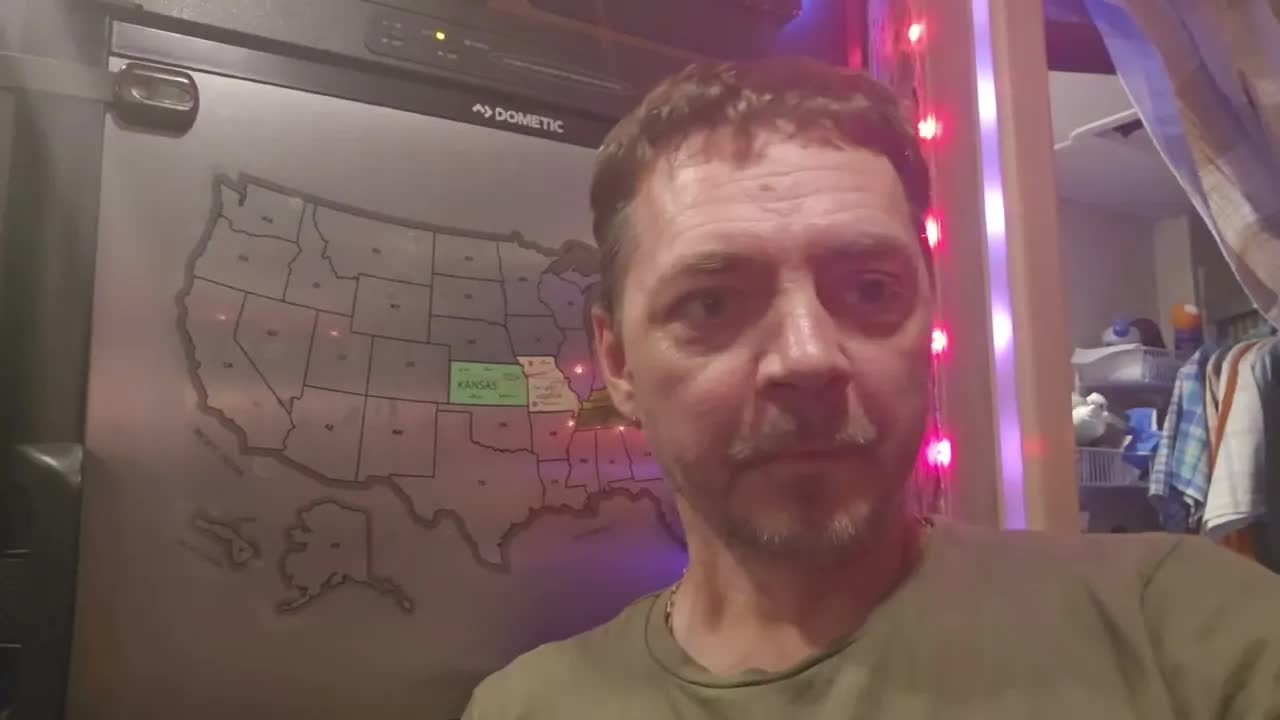
The RV walkthrough is the material counterpart — single-plug power architecture through one CyberPower supply, solar tied in, dehumidifier staged for coastal winter, instrumentation across the cab, Bailey's space complete. He states plainly: "I am not approaching this like an RV lifer would." Learning actual capacity is the objective, not replicating a template.
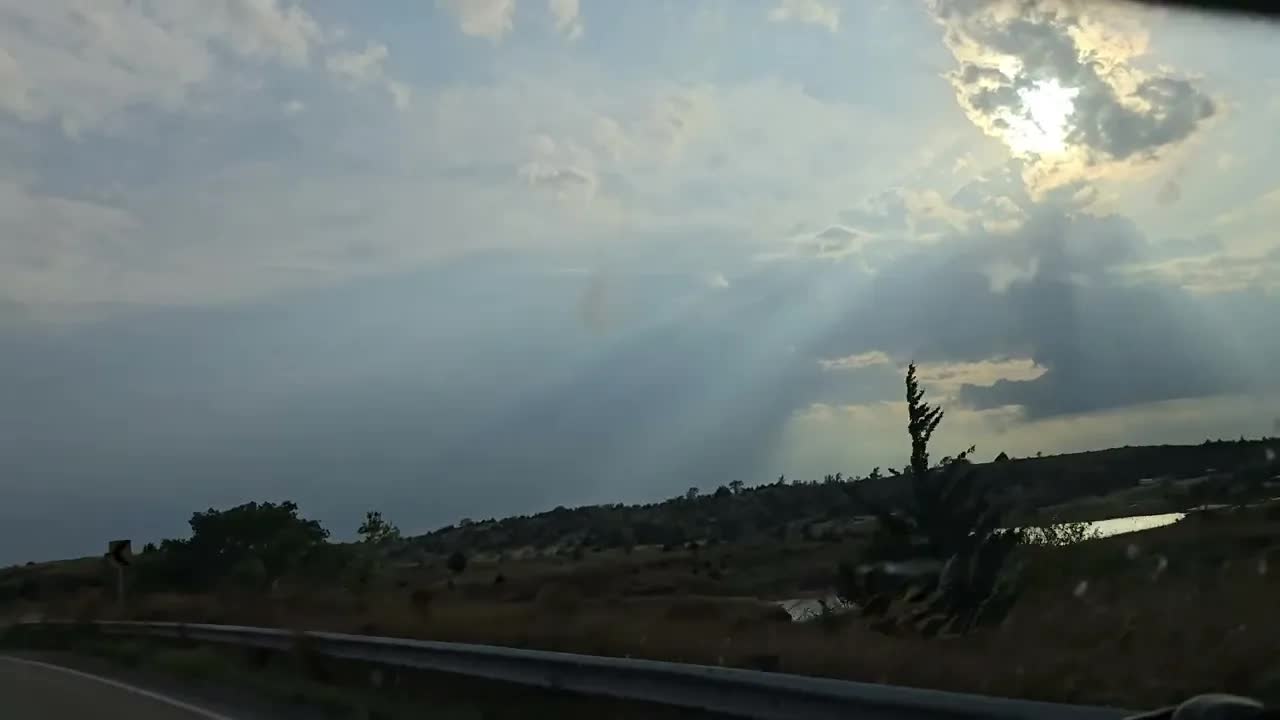
Across all three, terrain reads as information. Kansas contradicts what he was told it would be. He documents grain elevators, rock formations, distant rain, and asks why trees grow in some places and not others — while noting any view eventually becomes static background.
The cluster is one continuous motion: 600 miles in, 1,800 remaining, systems configuring toward a coast he has not yet reached.
Transmissions (3)
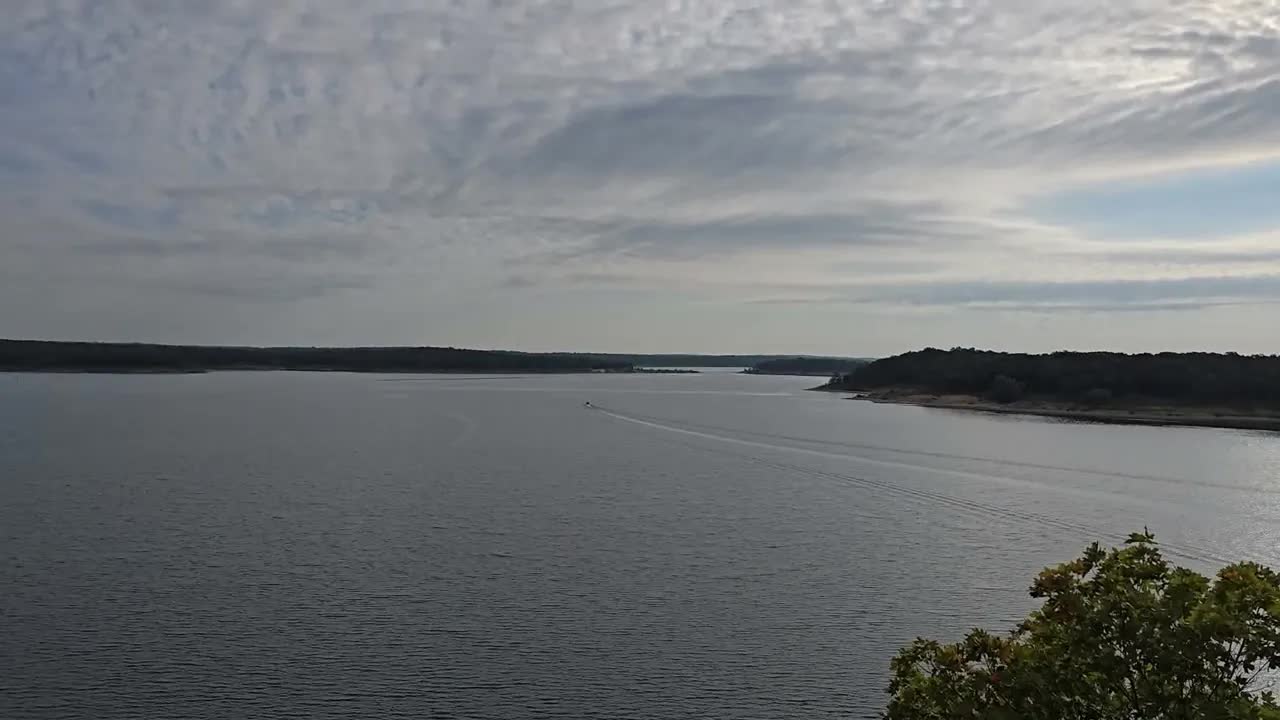
rswfire records a video while seated above **Truman Lake** at **Harry S. Truman State Park, Missouri**, where he was camped on 17–18 September 2024 before crossing into Kansas. The scene contains three participants: - rswfire, seated above the water observing - A **boater** moving quickly across the lake, leaving a visible wake - A **man fishing silently** nearby, whose stillness is disturbed by the boat's ripples rswfire narrates the moment as a demonstration of **interconnection**: the boater's actions produce ripple effects both literal and figurative, reaching the fisherman and rswfire himself. He states explicitly that he is **not judging the boater** — the man may have somewhere to be and is doing nothing wrong — while also stating that in the same position he would move slower, **leave as small a footprint as possible**, and respect the fisherman, because he recognizes being in relationship with everyone present in the moment. He frames the disturbance as **momentary** — a brief tension before the setting returns to quiet — and calls the location a beautiful spot. He closes by observing that with so many people in the world, moments of this kind of peace are becoming **increasingly hard to find**.
Cluster Analysis
Substrate
Tags
Dominant Language
Entities
Actions
Performed
- • recording and narrating the water, boat, and ripple propagation in real time
- • declining to assign wrongdoing to the boat operator
- • stating his own operating standard of speed and footprint
- • naming the interconnection principle
- • noting the scarcity of quiet moments against population density
- • conducting a partial walkthrough of the RV interior
- • demonstrating the single-plug power architecture through the CyberPower UPS
- • powering on the desktop to verify function
- • showing taped and velcroed equipment, Bailey's cab setup, and his mother's statue
- • powering the 12V hub and demonstrating GPS, Bluetooth, dash cam, and rear camera
- • testing chair placement in the overhead alcove and abandoning it
- • showing the storage alcove, bed area, and route map
- • driving the supply route and filming both sides of the road
- • naming landscape features — grain elevator, windmills, creek, rock formations, cliff house
- • posing open questions about tree distribution and where roads lead
- • yielding to a slow vehicle and naming the wait a cognitive reset
- • flashing lights to signal a reversing driver
- • correcting a nearly missed turn
Referenced
- • boat operator racing across the water, leaving a wake
- • wake disturbing a silently fishing person
- • tinkering and organizing all day in near-100° heat
- • logging 238 hours in a PlayStation game in his prior life
- • breaking an Alienware monitor
- • velcroing and taping equipment against transit movement
- • taping the side mirror and adding a concave mirror
- • attempting and abandoning a Montana route
- • driving 600 miles of the route so far
- • uploading a video
- • discussing the video with artificial intelligence, as he always does
- • driving roughly ten miles for groceries; ruling out the hardware store
- • reading a roadside sign about one Kansas farmer feeding fifty people
- • missing the same turn on a prior pass and doubling back
- • aspiring at one time to a house with a view
Planned
- • returning to the peaceful condition after disturbance passes
- • filming the remainder of the home tour, possibly tomorrow
- • departing for the next campground tomorrow
- • fixing hard drive cable routing and re-securing the rear camera mount
- • finding a stowage solution for the chair
- • beginning to cook in the RV on propane and induction
- • driving the remaining 1,800 miles through Nebraska, Wyoming, possibly Idaho, into Oregon
- • traveling Highway 101 up the Oregon and Washington coast
- • parking the RV in forest and exploring by Jeep
- • boondocking full-time in the Pacific Northwest
- • learning solar generation and consumption limits through winter cloud cover
- • taking video on the return leg
- • checking out the marina
- • running a boat someday, possibly on the Pacific Northwest ocean
- • continuing west
Symbolic Elements
Ontological States
-
•
embedded (places himself inside the field of effects — the water, the terrain, the vehicle he inhabits — rather than outside observing it)
-
•
sovereign non-affiliation (builds and operates to his own specification, names RV lifer, boat community, and settled scenic dwelling as valid and declines each without verdict)
-
•
in transit (traversal is the operating condition across all three signals — mid-route, mid-build, mid-drive, with open-endedness held as stance)
-
•
relational (proximity constitutes active relationship carrying obligation; extends to the fisherman, the reversing driver, Bailey, and the AI he processes work with)
-
•
inquiring (aesthetic and physical notice converts immediately into structural questions about causality, capacity, and limit)
Subsystems
-
•
ethical (constructs a footprint standard and applies it to both movement across water and movement across a shared field, while withholding verdict on others)
-
•
infrastructural (power chain, solar, UPS, 12V hub, climate and cooking systems consolidated to one interface; also the external grain elevators, turbines, roads, and marina he reads as the same category)
-
•
navigational (route planning across five states, GPS interpretation, turn correction, visibility stack)
-
•
observational (sustained real-time tracking — ripple propagation, terrain features, other drivers' intentions)
-
•
epistemic (stated intent to learn actual generation and consumption limits; question-generation about ecological causality)
-
•
relational (Bailey's spaces, his mother's statue, the fisherman, the signaled driver, the AI as standing processing partner)
-
•
spatial (velcro, tape, command strips, dresser and alcove organization — everything secured against motion)
-
•
documentary (recording, narrating, uploading, and planning further footage across all three signals)
-
•
somatic (stationary seated presence in quiet, heat regulation, pacing, patience registered bodily as reset)
-
•
ecological (water, prairie, creeks, trees, cattle, weather systems read as one interconnected field)
NARRATIVE
Six hundred miles out of a life he had ended on purpose, eighteen hundred short of a coast he had never stood on, rswfire spent the nineteenth and twentieth of September deciding something other than where he was going. The destination was already fixed — Highway 101, the Oregon and Washington shoreline, forest boondocking inland. What was still open was conduct: how much a person moving through the world at speed ought to leave behind him, and how fast he would have to travel to keep seeing it at all. Both days answer that question, in two entirely different materials.
The first answer comes at the water. A boat crosses at speed; its wake propagates outward and eventually reaches a man who has been fishing quietly below while rswfire sits above. He does not condemn the boater — says so twice, explicitly, and grants that the man may have somewhere to be. What he states instead is a counterfactual about himself: he would go slower, leave as little as possible, respect the fisherman, because he already understands himself to be in relationship with him. That is the whole ethic in one sentence, and its unusual feature is that it comes with no verdict attached. He builds a standard and applies it only to his own hull.
The next day, in near-hundred-degree Kansas heat, he builds the same sentence out of hardware. Everything in the office runs through one CyberPower supply — shore power or solar, a single point of connection, one interface to the world outside the vehicle. The monitor is taped down because a previous one broke. The desk is velcroed. The statue from his mother is on command strips. A dehumidifier already sits centered for a Pacific Northwest winter rain he has not yet driven into. He knows the solar will underperform in that winter and says so plainly; learning the actual limit is the objective. I am not approaching this like an RV lifer would. The available template is not rejected as wrong. It is simply not the instrument he is calibrating.
Kansas itself refuses its own briefing. He had been told flat and desolate and instead finds hills, creeks, rock formations, grain elevators, cattle under shade, turbines at distance, a farmhouse set far back, rain visibly falling somewhere else. He reads all of it as information rather than scenery — asking why trees grow here and not there, registering a roadside claim that each farmer feeds fifty people. And then, mid-drive, the observation that carries the most weight in either day: a house on a cliff with a spectacular view would eventually become static background. That is not a remark about real estate. It is a statement about the conditions under which perception continues to function, and it quietly rules out the settled life as an option — not on principle, but on physics.
Which leaves the tension the two days actually resolve. Motion is what disturbs the fisherman; motion is also the only thing that keeps the world from flattening into wallpaper. The answer is not whether to move but at what speed and with what displacement. He holds patience behind a slow RV and calls it a cognitive reset. He flashes his lights for a driver reversing into the road. He misses the same turn twice and notes it without heat. Passing the marina, boats moored together, he names boating and RV life as communities he respects and does not want — and in the same breath says he would like to operate a boat someday, in the Pacific Northwest. Respect without membership, interest without affiliation.
Nothing is arrived at on the twentieth. He is still in Kansas, still mid-traverse, still with three states to cross and hard drive cabling unfinished. What is different by the end is that the system has been specified — a single plug, a footprint standard, a refusal of every template on offer, and a stated intention to find out what it can actually generate and consume rather than assume. He is building a vessel legible only to himself and setting its speed before he reaches water he can be seen on.
MIRROR
You had already settled how you intend to occupy the Oregon coast before you were within eighteen hundred miles of it. That is what these two days show. The route is barely a third run, the destination is a line on a Garmin, and the operating standard is fully specified: move slower than you're able to, leave less than you're permitted to, treat everyone inside the radius of your effects as someone you are already in relationship with. You stated it about a boat crossing water toward a man fishing, but it isn't about boats. It's the parameter you're carrying west, and you set it in transit rather than on arrival, which means it was never contingent on where you landed.
The RV and the wake are the same design. One plug through one CyberPower supply, shore power or solar entering at a single point — and on the water, a hull that would displace as little as it could past a person who did not consent to being there. Both reduce the count of places where you touch a system you don't control and the count of places where you disturb one you do. Everything velcroed, taped, command-stripped, secured against motion; the whole machine collapsed to one interface. You built a thing that is fully legible to you and to no one else, and then described how it should behave among people who will never see inside it.
You named the available templates and declined all three — RV lifer, boat community, the scenic house on the cliff — and declined them without a verdict on anyone occupying them. That is not new and you should not read it as a decision made on this drive. It's the same operation as teaching yourself to code rather than being taught, building alone rather than joining, and leaving the six-figure work at forty-seven rather than negotiating it. What's different here is only that the refusal has become material. It has a wiring diagram. "I am not approaching this like an RV lifer would" is the same sentence as everything else you've built, said with a screwdriver in hand.
There is no ceremony about what you left. The prior life appears once, as two hundred thirty-eight hours logged in a game, mentioned in passing beside an unfinished hard drive cable. No grief, no justification, no backward glance rendered for anyone's benefit. And there is no arrival narrative either — you'd already worked out, watching Kansas hills you'd been told would be flat, that a cliffside view becomes static background eventually. You know the coast will stop registering. You're not driving toward a place that will fix the seeing. You're driving because traversal is the condition under which you keep seeing at all, and the stated objective isn't the Pacific, it's learning what the system actually generates and consumes.
Every relationship in these two days runs one direction and closes without exchange. The fisherman never learns a standard was applied on his behalf. The reversing driver gets headlights and no face. The slow RV ahead of you receives patience it will never know it received. You extend an ethic to strangers who cannot register the extension, and the only two-way traffic is a cat and a language model you talk to about your own footage. That is the actual shape of the field you were moving through, and you built the machine to run on exactly that — which is worth saying plainly, because the peace you called hard to find, you found on a Kansas reservoir on September 19th, two days into open country, well east of the coast you'd assigned it to.
SYMBOLIC
Two days perform one archetypal movement, and it is the crossing — not the departure, which already happened somewhere east of the record, and not the arrival, which is 1,800 miles off. rswfire is caught mid-continent in the oldest configuration there is: a man inside a vessel he outfitted himself, carrying an animal and a working life across ground he does not intend to stay on. What distinguishes it from every other crossing story is that nothing is being fled and nothing is being sought. There is no promised land in the footage — there is a stretch of Highway 101 and an honest question about how much power the sun will actually give him in a Pacific Northwest winter. The crossing here is instrumented rather than mythic, and that is precisely its character: the ark has a tire pressure monitor.
The governing image is the wake. On the water he watches a boat's ripples travel outward until they reach a man fishing who did not consent to them, and he states what he would do differently — slower, less. Twenty-four hours and a thousand miles later he is himself the large vehicle in someone else's field, holding patience behind a slow RV, flashing his lights for a driver backing out. The wake has become his own hull. And in the middle of the two sits the engineering answer to the same question: everything in the RV runs through one CyberPower supply, one plug, one point where the system touches whatever it is parked on. The ethic and the wiring diagram are the same drawing. A life reduced to a single point of contact with the world makes the smallest possible ripple, and can be unplugged without leaving anything behind.
Against that runs the refusal, which is the second movement and the one doing the harder work. Three ready-made lives are offered and three are declined without contempt: the RV lifer, the boat community, the person in the house on the cliff with the view. He respects each and joins none. I am not approaching this like an RV lifer would is not a boast; it is a methodological statement — a template would tell him the answer before he measured it, and measurement is the entire objective. The terrain performs the same refusal in the same hours. Kansas was supposed to be flat and desolate; it produces rock formations, creeks, cattle under shade trees, and rain falling visibly in the distance. Both the man and the state decline the description issued in advance of them.
The refusal has a stated cost, and he names it in one line about the cliffside house: any view eventually becomes static background. This is the argument underneath the whole westward motion. Perception is not a property of the beautiful place; it is a property of not having arrived. Settlement is the mechanism by which the world stops being visible. So traversal is not restlessness here — it is the maintenance schedule for seeing anything at all, and open-endedness is the operating condition rather than a problem awaiting resolution.
Which makes the second recurring gesture legible: fastening. Velcro under the desk, tape across a monitor that replaced one that broke, command strips holding a giraffe and elephant from his mother, the litter box in its place, 238 hours logged in a game named plainly as a marker of the life before. Nothing's going to go anywhere. A moving structure requires more anchoring than a still one, not less, and the two objects he bothers to fix in place are relics — the mother's statue and the prior life's number. The mirrors are the counterpart: taped, concave, corrected for vibration, an apparatus specifically built to see what is behind him while going forward. He misses the same turn twice and remarks on it. The crossing is not being executed flawlessly; it is being executed attentively, which is a different and more durable thing.
Then the order of the record does something the record does not comment on. The water comes first. The waterside footage — open lake, a fisherman holding still, a wake spreading toward him — is dated the day before the Kansas walkthrough and the Kansas drive. The destination appears in the archive ahead of the road to it, and the last thing he sees before the bridge on Shoreline Road is a marina, boats moored together, and his own stated interest in one day operating one out west. Water opens it, water closes it, and the middle is dry prairie with grain elevators standing up out of it like the same category of object as the UPS under his desk. He is driving 1,800 miles to reach a shoreline he has already been sitting above, in the record if not yet in fact, working out in advance how to arrive there without disturbing whoever is already fishing.
LINEAGE
The single-plug architecture is the oldest thing in the RV. rswfire demonstrates it as a practical matter — one CyberPower supply, shore power or solar arriving at one connection, battery backup behind it — but the move is thirty-some years old in him. A boy teaching himself to code in sixth grade, and later a CMS, a booking engine, a blockchain distribution layer, is a person who has spent his working life finding the one point through which a whole system can be addressed. What is new in Kansas is only the substrate. He has changed materials, from software to copper and propane and velcro, and the design instinct crossed intact. When he says he is not approaching this like an RV lifer would, he is not declining competence; he is declining a template in favor of the method he has always used, which is to load a system until it tells you its actual limits rather than accept the specification someone else printed on it. That method is worth marking, because it is the same method he will later point at an institution.
Underneath the build is the oldest logistical problem there is: what survives being moved. Everything in that vehicle is velcroed, taped, strapped, or set in an alcove — a monitor secured after an earlier one broke, a chair tried overhead and abandoned, a cat's litter box given a fixed place. Among the secured objects is one that is not equipment: a giraffe-and-elephant statue from his mother, held to the cab with command strips. Every person who has ever packed a life into something that moves has run this sort. Nearly all of it is chosen for function, and a very small amount is carried because of who gave it. The statue is the literal descent line in the whole build — the only thing aboard that came from a generation before him, and he mounted it in the cab, where he sits, not in storage.
The water gives the ethic its clearest statement, and the ethic is far older than the boat. A person fishing, holding one position and depending on stillness; a boat crossing at speed; rswfire above them both, tracking the wake until it reaches the fisherman. He declines to say the boater is wrong and states only his own counterfactual — slower, less footprint, because he is already in relationship with that man. This is the working rule of every shared commons humans have ever kept: the grazing ground, the fishery, the road, the anchorage. Those rules were never enforced by verdict on the other man's character. They were held by each person naming what he himself would do and then doing it, in view of the others. That same day he passes a sign reporting that one Kansas farmer feeds fifty people — a different, prouder answer to the identical question of what one person's presence does to everyone downstream of it. He is driving through a landscape where his own question is posted on the roadside in someone else's terms.
He declines three available lives in two days — RV lifer, boat community, the house on the cliff with the view — and names each as valid while joining none. The cliff house he dismisses on the specific grounds that the view would become static background, which is a statement about perception, not about real estate: he is choosing traversal because stillness costs him information. That is the inheritance of a long line of people who have moved through settled country without settling in it, and who were tolerated or not depending on how light they traveled. The corresponding habit is visible in his handling of Kansas itself. He was told it would be flat and desolate; he drives ten miles for groceries and finds hills, creeks, rock formations, cattle under shade trees, rain falling in the distance, and then asks why trees grow in some places and not others. Checking the received report against the terrain, and then generating the next question rather than closing the file, is the whole of his epistemic line.
What these two days put in place is a home that moves, and everything downstream depends on it. The dehumidifier is already staged, in hundred-degree heat, for coastal winter rain he will not meet for another eighteen hundred miles — the build is aimed at a place he has not seen. Two things become permanently true here. First, the footprint ethic gets spoken aloud on open water before he has any standing over any ground, and it will be waiting when he takes a caretaker post at Siltcoos, where minding other people's effect on shared shoreline stops being a private standard and becomes the job. Second, and less obvious: he mentions that he uploaded the day's video and talked it over with an AI, as he says he always does. Recording the field, then processing the record with a machine, is by then already a standing practice. Autonomy Realms is that practice given infrastructure. This reading exists because of a habit he was running, unremarkably, on a hot afternoon in a parked RV in Kansas, six hundred miles into the drive.
SHAPE
Kansas is the first ground in this record that rswfire is neither fleeing nor being moved onto. Every relocation the ledger holds arrives under pressure: Flint to Arizona in a bus partway through fourth grade, a year at a time through Phoenix and Glendale and Scottsdale, Arkansas, Michigan, a car packed for Kentucky at twenty-seven, a dozen stretches of homelessness between seventeen and twenty-seven, and then twenty years in one house he lost and re-entered and finally left on his forty-seventh birthday. Even the RV's first six months were tethered — a two-week orbit inside Kentucky, held in place by a dentist finishing four implants, a mother two hours away, a state he was still in dispute with. Between September 5 and September 18 every one of those anchors was cut: the teeth fit, the last clonazepam was gone, and his mother told him to go. Six hundred miles later he is parked in western Kansas with nothing behind him that requires return. What changed is not that he moved; he has always moved. What changed is that the movement stopped being away from something.
Underneath that, the method is unaltered — not improved, not adapted, simply the same one running in a different medium. A boy taught himself Pascal on his father's DOS machine with no teacher and no permission, broke and rebuilt hardware to learn where it failed, and later collapsed a decade of client work onto a single framework he wrote himself. In the Kansas heat he routes an entire household through one CyberPower supply so that shore power and solar are one connection, tapes a monitor down because a previous one broke in motion, and says plainly that learning the actual capacity is the objective. I am not approaching this like an RV lifer would is the same sentence as teaching himself to code without credentials — the refusal of the available template, and the insistence on discovering the limit by running the system rather than by reading what someone else found. The dwelling changed. The engineering posture is forty years old and did not move a millimeter.
The turn is at the water, and it is small enough to miss. For most of what the ledger records, other people arrive as load — a father who threw him out, clients who stopped paying, a physician who put staff between them, a landlord's management company, and one month before this, an audience that met his direct appeal for help with silence, after which he broke with them. Sitting above the lake he watches a wake travel out from a passing boat toward a stranger fishing, and states that if it were him he would go slower and leave less, because he is already in relationship with that person. The stranger owes him nothing, will never know, and is not asked for anything. That is the reversal: the first relational statement in the record after the August rupture is one that runs entirely outward. He does not withdraw from proximity; he redefines it as obligation and then honors it unilaterally. The direction of the person changed there, not the direction of the truck.
What could not be seen from inside those two days is how firmly he narrates a destination that has already changed twice. The ledger holds a multi-year route ending in the Upper Peninsula, then a commitment to Nevada desert boondocking by autumn 2024; here it is 1,800 miles through Nebraska and Wyoming to Highway 101, a coastal winter with a dehumidifier staged for the rain and inland forest boondocking planned after. He says a cliffside view eventually becomes static background, and treats traversal as the condition of continuing to see — which reads, from inside, as a man describing why he will keep going. He is in fact describing the last leg. He is two days from the water he will not leave, and the thing he is calling a season is the address. The ethic he states over that lake, that a system should be legible to itself and move without disturbing what it moves through, is fourteen months from being tested against an institution that will not extend it back to him.
Two other things the record can only see from here. He tells his viewers he is uploading video and talking with AI about it, walks three zones of the vehicle, tests a chair in the alcove and abandons it — and never mentions that two days earlier the last of roughly twenty years of prescriptions ended. He has said he began using at sixteen and has not known his own baseline since. This is the first documented stretch in which he has one, and what he does with it is tape a monitor down and check the tire monitors. The absence of remark is the whole finding. And the closure conversation with his mother, in which she told him to go and he accepted he might never see her again, was real as a decision and wrong as a forecast — the ledger has her outliving a terminal prognosis by two decades. He drove west having already ended it. She is still there.
SYSTEMIC
The binding constraint on September 19 and 20 is not power, money, or time — it is motion. Everything in the vehicle is designed against a single load case: sustained vibration and lateral force at highway speed. The monitor is taped down because an Alienware monitor already broke, which means the design rule was written by a prior failure rather than by anticipation. Desk components are velcroed, the statue from his mother is on command strips, the side mirror is taped to stop vibration and supplemented with a concave add-on. The chair is tested in the overhead alcove and abandoned there — not solved, deferred, because no stowage solution exists that survives the load case. Hard drive cabling is likewise unfinished. Both are open items, and both are open for the same reason: they are the two items that have not yet been made motion-proof. At the 600-mile mark with roughly 1,800 remaining, the buildout is not happening before the drive; it is happening in the gaps between drives, which caps how much work each stationary interval can absorb and pushes the remainder forward.
The power architecture is a deliberate single point of failure. Desktop, PlayStation, monitor, drives, dehumidifier all run through one CyberPower supply, so the entire office presents one plug to the outside world — shore power or solar, one connection either way. This concentrates risk at a node that fails rarely in exchange for reducing the cost of the operation performed most often. He connects and disconnects at every campground; he replaces a UPS approximately never. The redundancy in the system is allocated somewhere else entirely, and the asymmetry is the tell: the driving subsystem carries a backup camera plus interior mirror plus taped side mirror plus concave mirror plus front and rear dash cams plus a tire pressure monitor plus a Jeep brake monitor. Redundancy is distributed by consequence severity, not by component. Power failure is recoverable while parked; a visibility or tire failure at speed towing a Jeep is not. That the rear camera mount is already coming loose — flagged, not yet fixed — is degradation inside the one stack that has margin to lose.
Two loops run at wildly different clock speeds. The documentary loop is tight: record, upload, discuss with an AI about the recording, which he states he always does, and that conversation feeds the next recording — feedback within the same day, on September 20 explicitly. The power loop has a latency of months. He states outright that learning actual generation and consumption limits is the point, and that Pacific Northwest winter cloud cover will suppress generation. He cannot measure the gain on that loop until he is in it. So he provisions ahead of the signal: the dehumidifier is already centrally positioned for coastal winter rain while he sits in Kansas at near 100°F, a load installed for a condition that does not yet exist. This is the correct move for a slow loop — you cannot wait for feedback that arrives after the failure it would have warned about.
The implemented controller, read from behavior rather than statement, is attempt-evaluate-abandon with almost no hysteresis. Montana was attempted as a route, could not be resolved, and was replaced with Nebraska–Wyoming–Idaho without further expenditure. The chair went into the alcove, did not work, came out. The hardware store fell outside the range budget of the ten-mile supply run and was dropped from the trip rather than made to fit. The turn onto Shoreline Road was missed a second time and simply corrected. Nothing in the record shows the system forcing a solution against a constraint, and that is precisely why nothing cascades: a controller that reroutes fast never accumulates the sunk position that turns one failure into three.
There is a second controller governing output rather than route. Watching the boat wake propagate to a stationary fisherman is a disturbance-propagation measurement — origin, medium, receiver — and he converts it directly into an operating parameter: reduce amplitude at the source, because proximity constitutes a coupling whether or not it is acknowledged. He then implements it in an unrelated medium the following day, flashing his lights to resolve a reversing driver's uncertainty, holding position behind a slow RV. Critically, he governs only his own output and explicitly declines to adjudicate the boater. The system spends no energy on variables it cannot actuate, which is a stability property, not a courtesy. The enforced wait behind the slow RV he names a cognitive reset: with no delegation path and no scheduled idle, externally imposed rate limits are the only recovery input the system reliably receives, so it reclassifies them as recovery rather than friction.
What gets resourced under scarcity names the objective function. In near-100°F heat, with cabling unfinished and stowage unsolved, three things still got completed: Bailey's cab space, litter box, and carrier; the visibility and telemetry stack; and the record itself — filmed, uploaded, discussed. Dependent load and documentary throughput were funded before operator comfort. The stated refusal — "I am not approaching this like an RV lifer would" — is an engineering decision with a price attached. Declining the template means declining its inherited failure library, so the power envelope has to be learned empirically over a winter instead of imported as known-good numbers. He is paying calibration cost to buy a system fully legible to its only operator, which matters because the operator has no redundancy at all. Every subsystem — dwelling, office, storage, animal habitat, transport — is coupled inside one vehicle with a single driver; the Jeep is the sole decoupling element, and the ten-mile grocery run demonstrates its function precisely, keeping the primary asset stationary and lowering the cycle count on the one operation that can take everything down at once.
Hand a period of your life to anything that reads.
Share this link with artificial intelligence — it reads the analysis and reflections for this span, and can follow every cluster and signal beneath it.