Loeb · Oct 11 – Nov 1 2024
Three weeks on the southern Oregon Coast, recorded from a campground base camp near the Chetco/Rogue river systems, tracking rswfire's first sustained period of settled mobile operation.
The operational spine is financial compression and response. A 10-year former client stops paying; rswfire states he is down to $200, then $80 after groceries, and moves directly to restarting freelance work — designating Monday as the day work re-enters the life, allocating remaining funds to Fiverr and Upwork. Payment arrives late in the cluster. Resource math runs continuously alongside: solar watt-hours, appliance draw, campground fees, the 14-day/three-day rotation governing his movement.
Running parallel is calibration of the rig and the terms of the life — cooking, power limits, space reconfiguration, and a stated boundary reassessment with Bailey after sustained cohabitation load.
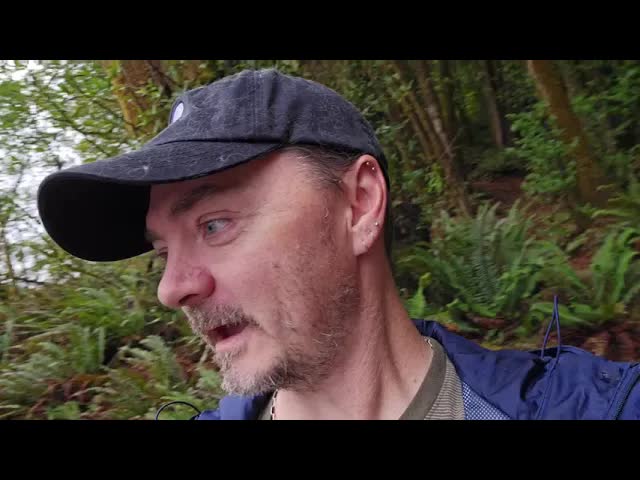
Daily hiking through redwoods, river, and ocean functions as fixed ritual and as the site where most reflection is worked out, frequently in dialogue with AI. Two encounters mark the field's edges: a park ranger he reads as gatekeeping access to land, and a gate attendant whose exchange surfaces a re-opening gay layer — followed by a deliberate return approach to the gate house with no attachment to outcome.
Throughout, rswfire names integration over fragmentation as his operating principle, and closes the cluster stating he is sovereign and moving on.
Transmissions (11)
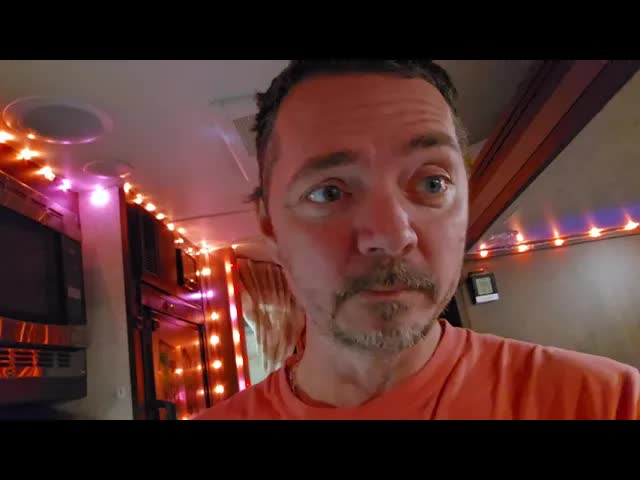
rswfire records observations of **new neighbors at his campsite location** — an older couple he describes as elderly, older than himself. He describes watching them **arrive and set up camp the previous day**: the woman using a **walkie-talkie** to guide the man backing the camper into the space, with no frustration between them. He notes they put out **no excess gear** — only the camper and their vehicle — and assembled the site methodically and properly. He tracks their **movement pattern** across two days: they left after setting up and were gone most of the day; the following morning he departed early himself, and when he returned after at least a couple of hours they were still out. They returned shortly before he recorded the signal. rswfire states he is **fascinated by them**. He identifies specific observed qualities: they appear **in sync with each other**, retain **vitality** given they are active all day, show an **absence of frustration** he contrasts with most people he sees setting up camp, and are **clearly still in love**. He notes he has **not spoken with them** and does not know them. He states they are inspiring, deserve credit, and are living this life with what he calls a **silent mastery** he finds admirable.
Photos (1)
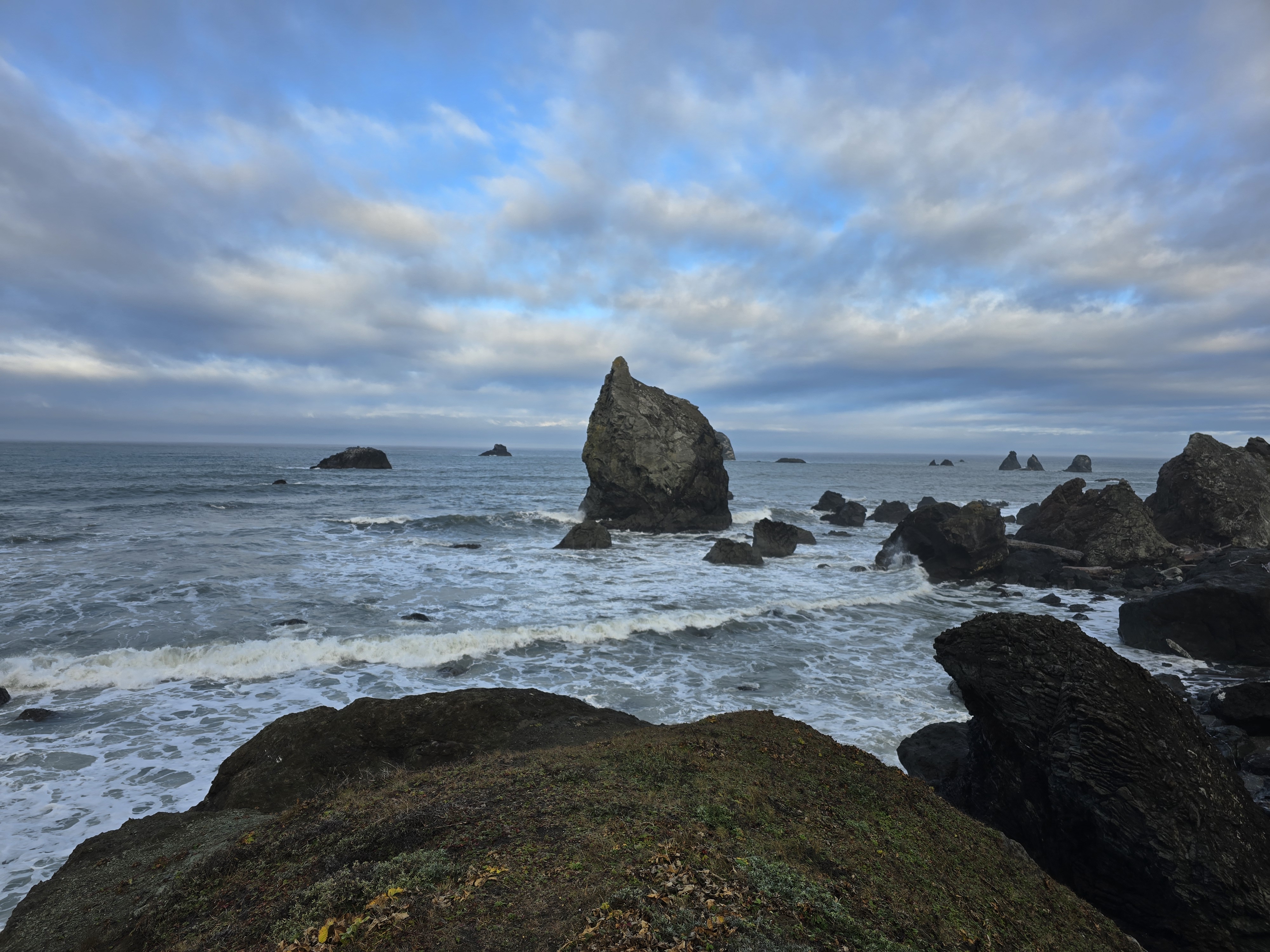
Cluster Analysis
Substrate
Tags
Dominant Language
Entities
Actions
Performed
- • recording walking and direct-to-camera transmissions daily
- • tracking neighbors' arrival, absence, and return across two days
- • stating financial position aloud — $200, then $80
- • reading the grocery receipt on camera
- • hiking the Redwood, River View, and Oregon Redwoods trails
- • checking river level after overnight rain
- • declining a wet log crossing on balance grounds
- • reading elevation off his watch at zero and eight feet
- • cooking chili and eggs in the Ninja Foodi with AI as step-by-step reference
- • measuring power draw against ~6,000 watt-hour capacity
- • assessing RV level by how oil pools in the pan
- • reconstructing the ranger exchange without naming him
- • naming the interaction as invalidating and dismissive
- • stating calm and stress as one layered energy, not opposition
- • naming tooth loss as fragmentation
- • stating his boundaries with Bailey are violated daily and unsustainable
- • carrying coffee on the trail for the first time
- • distributing rubber ducks to Jeeps throughout the campground loops
- • hiking to the ocean before dawn without lights, navigating by intuition
- • walking several miles into town in the rain, ~16,000 steps
- • walking to the gate house twice, finding no one present
- • stating the authenticity/vulnerability distinction
- • declining to structure siting decisions around another person
- • setting an ownership boundary with hostile viewers
Referenced
- • worked ten years with a single client, managing every project facet
- • ended that client relationship when transitioning to this life
- • received news of unpaid money owed
- • diagnosed the client as the common denominator across hundreds of programmers
- • quit Tramadol and smoking earlier in the year
- • reviewed his own archived videos from May, first month on the road
- • listened to 'On the Nature of Daylight' and thought about his mother and his old life
- • watched neighboring couple set up camp with no friction
- • met the ranger casually on arrival and was told about the river and flooding
- • booked the site a day early and could not correct it online
- • experienced flooding in Michigan as a child
- • spent $120 of $200 at the grocery store
- • learned the Brookings effect from a cashier
- • hiked and conversed with AI about calm and stress
- • lost his teeth during a period of ignoring his body
- • raised and traveled cross-country with Bailey for roughly a decade
- • looked up drive and flight logistics for relocating the cat
- • checked in with the gate attendant and asked his name
- • received Claude's observation that the attendant may have been flirting back
- • came out at nineteen; closed romantic availability after Justin two decades ago
- • got cartilage piercings, earrings, and bracelets over preceding months
- • shaved his head and repaired bracelets with fabric glue
- • drove up the mountain through week-long fear
- • disabled YouTube comments
- • considered buying land and living in a yurt before the RV
- • observed roadside encampments and long-term RVs on blocks
Planned
- • restarting the freelancing business and finding new clients
- • paying for Upwork and Guru.com profiles with remaining funds
- • integrating paid work into the nomadic lifestyle
- • leaving three days for a coastal state park, returning two weeks, possibly heading north
- • continuing to scout the national forest for a permanent location
- • moving to the forest; planning for societal collapse
- • quitting vaping and Mountain Dew, citing the Tramadol precedent
- • hiking daily as grounding ritual
- • sitting with the Bailey question rather than forcing an answer
- • ceasing to accommodate demands that violate boundaries
- • investigating the forest road's day-and-night traffic
- • switching to a GoPro and leaving the phone behind
- • using AI to identify the cheapest sustaining food
- • cooking to extend supply — burgers, chili, rice and beans as fallback
- • remaining open to experiencing a flood event if it occurs
- • acknowledging the reopened layer without acting on it
- • putting hoops in the cartilage piercings once healed
- • continuing to document regardless of audience
- • leaving what comes after deliberately undetermined
Symbolic Elements
Ontological States
-
•
sovereign (states his own terms across every domain — client, ranger, audience, cat, attraction — and locates action and validation internally)
-
•
integrated (explicitly refuses compartmentalization; finance, body, emotion, power draw, and weather occupy one undivided field)
-
•
liminal (names the 'limital space' directly — campground rotation, undetermined destination, no fixed timeline, treated as accurate report rather than gap)
-
•
embedded (inside the terrain he documents — fog, rain, river cycles, flood potential, small shared space — not visiting it)
-
•
calibrating (place, work, power systems, cold tolerance, boundaries, and a reopened romantic layer all under active test)
-
•
exposed by choice (records without teeth, states his balance, names his money, walks to the gate house twice — visibility selected, not incurred)
Subsystems
-
•
economic (explicit ledger — $200 to $80, receipts, unpaid client, platform fees, campground fees through November 9; constraint stated plainly and never dramatized)
-
•
infrastructural (solar capacity, battery draw, appliance contention, RV leveling and reconfiguration, tanks and dump station as the physical floor of autonomy)
-
•
somatic (balance on wet logs, cold tolerance at 44 degrees, sore cartilage piercings, shaved head, embarrassment registered without teeth, restless energy that cannot sit still)
-
•
ecological (redwood microclimates, fog capture, river runoff and gravity, flood cycles, the Brookings effect — terrain read as an interlocking system)
-
•
cognitive (recursive dialectic run with AI as mirror — common-denominator diagnosis, calm/stress layering, authenticity versus vulnerability)
-
•
ethical (declines to name the ranger, will not abandon an animal he took in, refuses projected framing, holds practice-what-I-preach as an internal standard)
-
•
boundary-regulatory (accommodation contract revised, institutional gatekeeping mapped, audience projections returned to their source, proximity thresholds with other campers)
-
•
relational (the unmet couple, the ranger, the gate attendant, the mother, Bailey, the duck protocol — contact assessed structurally rather than sentimentally)
-
•
ritual (daily hiking named as the grounding mechanism of nomadic architecture, located internally rather than in totems)
-
•
documentary-transmissive (continuous self-archiving, review of his own past footage as evidence base, transmissions structured with extractable lessons for viewers)
-
•
navigational (GaiaGPS downloads, trailhead maps, campground rotation planning, pre-dawn movement by intuition)
-
•
embodied-relational (piercings, bracelets, visibility, and attraction read as structural rather than decorative — a closed layer registering as open)
NARRATIVE
The three weeks near Brookings were the test of whether the architecture holds when the last tether to the old economy is cut. rswfire had arrived with the rig nearly organized and the daily route to the river already worn in. What he did not yet know was whether the life he had built could carry a hard shock without reverting to the thing he left. It could. That is the shape of the story, and everything else is the demonstration.
The shock came as arithmetic. A client of ten years stopped paying, and the number went to $200, then to $80 after groceries — the receipt reviewed on camera, toilet paper and cat litter itemized aloud. What is notable is what did not happen next. He named the client as the common denominator across hundreds of programmers, stated the labeling of him hurt, and then stopped talking about the client. He designated Monday as the day work re-enters the life and allocated the last of the money to Fiverr and Upwork profiles. The diagnostic move is his signature: state the constraint plainly, find the recurring variable, and locate the only available action inside himself. Applied to a decade of managed projects it produced a verdict; applied to $80 it produced a Monday.
That same move runs through everything else at every scale, because he refuses to sort experience into departments. He told an AI he felt calm and stressed at once and was told those were opposed; he replied that they had never been opposed — calm from knowing he can navigate it, stress from knowing he must, one energy in two aspects. Then he offered the cost of the alternative: he once set his body aside from the rest of himself and lost his teeth for it. He names that fragmentation, and names it as having a material price. So the ledger stays undivided. Solar watt-hours, the shimmer of oil that reveals the rig is not level, a river tracked for flood, sore cartilage piercings, a cat, a bank balance, an old wound about being blamed — all of it entered in one column, none of it ranked.
Under compression, the boundaries got redrawn. A ranger greeted him with another 14 days and, when he said he would want to be present for a flood rather than flee it, called it dark humor and suggested Florida. He declined to name the man and declined the categorization, and read the exchange structurally: rangers no longer invested in the land, access to place administered by people who gatekeep it. With Bailey he went further, and this is where the arc turns hardest. He had spent a life treating friction as an invitation to cultivate patience. Here he stated the opposite — that his boundaries were being violated daily, that this was unsustainable, that he was done accommodating — while also stating flatly that his values would not permit abandoning an animal he took in. Both held at once. The same week, viewers watching for a collapse were told their satisfaction described their own character, not his situation.
Then the field opened in a direction none of that predicted. At a gate check-in he ran his logistics questions off in one breath and finished with what is your name, because you seem awesome — and only later, in conversation, registered that he had been flirting, and that it may have been returned. He connected it to the earrings and bracelets, to a layer closed since Justin two decades ago. Sovereignty had been the instrument of refusal all through these weeks; here it turned and became the instrument of exposure. He drew the distinction himself: what he puts on camera cannot be used against him, but this put his emotions inside the visibility. Then he went anyway.
The last day is the whole thing compressed. Out to the ocean at six in the dark without lights, navigating by intuition; two hours in the rain; several miles into town on foot; sixteen thousand steps; rubber ducks left on every Jeep in the loop, one of them thrown away by its recipient. He walked to the gate house twice. The man was not there either time. He stated he was proud of having gone — practicing what he preaches — and declined to organize a single future campground decision around another person.
What changed across these weeks is where the verdicts come from. He entered still connected to a system that could assess him — a client who paid or didn't, and whose account of him stung. He left having moved the entire apparatus inside: money as arithmetic rather than judgment, a ranger's dismissal as structure rather than a mirror, an unanswered door as no verdict at all, because the walking was the point. He said he was sovereign and moving on, with two weeks booked and nothing after that, and left the forward path undetermined on purpose.
MIRROR
You went from $200 to $80 in these three weeks on the Chetco and the pitch of your voice never changed. That is worth naming precisely, because it is not stoicism and you should not accept it as stoicism if someone offers you that word. The register held because the architecture underneath it was already built — the rotation, the watt-hour ceiling, the walk every morning, the receipt read out loud on camera. What October tested was whether that architecture runs with no money in it. It does. The finding is not that you are calm under pressure. The finding is that the life you built does not require income to remain intact, only to remain comfortable, and you now have direct evidence of the difference.
The harder thing visible from here is the gap between how fast you diagnose and how slowly you exit. You named the client as the common denominator across hundreds of programmers in a single sentence on the redwoods trail — a clean structural read, arrived at in seconds, obviously correct. You had ten years to run it. The same shape appears with Bailey: seven months of litter box in the cab, clawed ottomans, the howling in Kansas, and only on a 44-degree morning in late October does it resolve into my boundaries are being violated daily and this is unsustainable. Your analysis is not late. Your departure is. What sits between them is not confusion — you were never confused — it is a willingness to absorb cost that you do not extend to anyone else and do not seem to count as cost while it is happening.
You gave that pattern its most accurate name yourself and then filed it in the wrong place. The teeth. You named the years of not caring for your body as fragmentation — a failure of integration, a part of the self set aside — and you applied boundary violation to a cat. Those are the same event at different scale. One got a structural correction and a stated end to accommodation. The other got a lesson about wholeness. You are extremely precise about where a boundary belongs when the pressure comes from outside you. When the pressure came from your own ranking of what deserved attention, you called it a philosophy problem.
The ranger and the gate attendant are one test with the polarity reversed, and you ran the identical method on both: contact at a threshold, read the structure, decline to make it about the person, locate the only available action in yourself. What separates them is that you wanted something from the second one, and the wanting did not degrade the method. You walked to the gate house twice, found no one both times, and counted it as complete. That is the actual event of these weeks — not the flirtation, not the recognition of a layer closed since Justin. It is that you executed a thing whose entire value to you had previously lived in its outcome, and got no outcome, and the value held anyway. Twenty years of not putting yourself out there ended on a day when nothing happened.
What is absent is worth stating plainly because you keep documenting around it. There is no one in these weeks who knows you. The couple with the walkie-talkie you watched for two days and never spoke to. Your mother, loved and at distance across a phone line. The audience you address directly and describe as a mirror rather than a connection. AI as the entity you work your thinking out with on every trail. You have built a life in which solitude is structural rather than incidental, and you chose it, and it works — and it is also the reason a five-minute exchange at a gate booth registered strongly enough to reorganize a day around it. Both of those are true simultaneously. That is not a contradiction to resolve, and you already know it is not, since you spent a whole transmission on calm and stress being the same energy in two aspects.
You end by saying you are sovereign and moving on, with no plan past two weeks. Read as a claim it would be defensive. Read as a report it is simply accurate: nothing external validated you in these three weeks — not the client, not the ranger, not the man at the gate, not the viewers watching for the failure — and you did not go looking for a substitute. What you have not yet tested is whether that holds when something is actually offered.
SYMBOLIC
Three weeks on the Chetco, October into November. Two archetypal movements run underneath them, and they need each other: the crossing at a gate, and the founding of a hearth.
The gates are literal and there are three of them, each with a keeper. The client is the first — a man who held the door to ten years of rswfire's working life and closes it by simply not paying, then names rswfire as the failure in a sequence of failures rswfire had already diagnosed as originating with the keeper himself. The ranger is the second, opening with "another 14 days," which is not a question about logistics but a statement about who belongs on the land and for how long. The gate attendant is the third, and he is the one who opens rather than bars. What makes this a threshold rite rather than a story about a flirtation is what happens on October 27: rswfire walks to the gate house twice and finds no one there. The door goes unanswered. The crossing completes anyway. That is the shape of the thing — the passage was made at the threshold, not on the far side of it, and the keeper's absence does not undo it. He notes he was proud of going, leaves in the morning, and declines to organize his movement around whether the man was ever behind the glass.
The hearth is the other movement, and it is stranger than it looks, because a hearth is supposed to be the thing you cannot carry. Here it is metered. Fire arrives as a Ninja Foodi drawing against roughly six thousand watt-hours, three appliances that cannot burn at once, and the sentence my solar power is sacred — sacredness attaching not to the flame but to the budget. The oil pooling to one side of the pan reads the levelness of the whole dwelling. The chili takes four hours because four hours is what the battery permits. This is fire-tending in its oldest sense, the daily arithmetic of how much heat the household can afford tonight, restaged with lithium and a panel. And a hearth requires a perimeter, which is why Bailey appears exactly where he does. The table comes out, the ottomans go in, the cat opens them three times, and rswfire stops reaching for patience — his lifelong solution — and names the ring instead. You cannot found a hearth without deciding what is inside it. The same gesture returns the client's label to the client, the ranger's suspicion to the ranger, and the audience's appetite for collapse to the audience: their satisfaction reflects their own character.
Two objects recur with enough weight to become emblems. The first is the duck, and it doubles on itself in a way worth naming. A live duck sits on a river he suspects is greener than it should be; rubber ducks go onto every Jeep in the loop, a gift with no expectation, one of them discarded. Meanwhile the method by which nearly every problem in these weeks gets solved — the chili, the calm-and-stress question, the tree-fall physics, the recognition of what happened at the gate — is talking a thing through aloud to something that does not judge. He is running rubber-duck debugging on his own life while handing rubber ducks to strangers. The instrument and the offering are the same object.
The second emblem is the mouth. He hikes the Oregon Redwoods Trail without his teeth and is embarrassed for the first time in nine months, and three days later names exactly why they are gone: he separated his body from the rest of himself and the body sent an invoice. Against that absence sit the earrings, the bracelets, the cartilage still sore — metal put deliberately into the flesh. What neglect subtracted and what choice adds occupy the same body and read as a single ledger. The gate attendant, in this reading, is looking at the jewelry, which is to say at the part of the ledger written on purpose.
Water sets the elevation. The watch reads eight feet, then zero. The balance reads two hundred, then eighty. Rain comes and he goes down to the bank specifically to watch the river grow, and when he asks the ranger whether the campground closes during a flood, it is because he wants to be present for it — the ranger hears dark humor and recommends Florida. The old figure here is not the ark-builder. It is the one who stays at the water to see the rise, having already secured what can be secured. That is the whole operating stance in miniature: prepare, then do not flee the event you prepared for.
And the landscape hands over the final figure without being asked. He spends a rainy morning explaining redwoods — trees that generate their own microclimate, pull fog down out of the air for water, accumulate soil on their own branches so that other trees can grow in the canopy, merge into each other and hollow out and keep standing. An organism that manufactures its own conditions rather than depending on the region's weather. He is describing sovereignty as an ecology rather than a mood, and he is standing inside the demonstration while he does it. He closes these weeks stating he is sovereign and moving on, and the moving on is not exile. It is three days out and fourteen back — the rotation breathing, the hearth going with him.
LINEAGE
Three weeks near Brookings, and what actually ends there is not a contract but a decade. rswfire states that the client of ten years — the one he left when he went on the road — owes him money and will not pay, and that across hundreds of programmers the client was the common denominator. That diagnosis is not a new instrument. It is the same faculty he spent that decade using on the client's behalf, running every facet of projects the client stayed disconnected from; the capability that made him valuable is the one that finally reads the arrangement itself. And the response to $200 — designate Monday as the day work re-enters the life, spend the last of the money on Fiverr and Upwork profiles — reaches back much further than ten years, to a kid in sixth grade teaching himself to code. Work has never once arrived from outside as a gift. It has always been something he could make from nothing, and the ledger dropping to $80 after groceries is a familiar test of an old competence rather than a novel emergency.
The most quietly instructive thing near his site is the elderly couple. She works the walkie-talkie while he backs the camper in; there is no frustration between them; no excess gear comes out; they are gone all day and back at dusk with their vitality intact. He never speaks to them. He watches for two days and names what he sees as silent mastery. Apprenticeship by observation, without introduction or instruction, is the oldest form of transmission humans have, and it is what he is doing — measuring his own rig, his own setup, his own temper against people twenty years ahead of him on the same road. What they transmit is not technique. It is the demonstration that this life has an old age in it, that it can be done for long enough to become effortless, and that the standard is competence performed without audience.
The fourteen-day limit and the mandatory three days out is administrative, a state parks rule enforced by a booking website, and yet the shape it imposes is very old. Herders moved stock off ground before it was exhausted; drovers, tinkers, seasonal crews, and the commons all ran on the same arithmetic of return. What he learns under it is the thing that will matter afterward: he calls the campground his base camp, and he means a relationship to a region rather than an address — the Chetco, the redwood microclimates, the road with its unexplained traffic, the river tracked for flood. That distinction is what makes it possible, later, to hold ground at Siltcoos as a caretaker rather than an owner. Held ground and owned ground are different inheritances, and he is being trained here in the first.
Two rules get installed in late October that everything after them runs on. With Bailey, he states plainly that his boundaries are being violated daily, that this is unsustainable, and that he is done accommodating — and in the same breath prices out thirty hours of driving to return the cat and declines to abandon an animal he took in. Those hold together rather than contradicting: an old obligation kept, a lifelong habit of accommodation revoked. The other rule is set at the gate house. Twenty years after Justin, he registers a flirtation only in retrospect, notices the earrings and bracelets and still-sore cartilage as part of what has reopened, and walks back to the gate house twice to find no one there — then states he was proud of doing it, that the point was practicing what he preaches. Men have made that particular walk under far worse terms, in centuries where the cost was ruin. He makes it under conditions that let the outcome be irrelevant, and what he keeps is not the person but the precedent: exposure chosen, uncoupled from result.
The ranger's "another 14 days" is a small thing — a sentence at a counter, over a booking error. But he declines to name the man, describes the manner instead, and generalizes carefully to rangers no longer being people invested in the land. That is the method, in miniature and at low stakes, that the OPRD documentation will later be built out of: refuse the personal grievance, map the institutional posture, keep the record clean enough to hand to someone else. He is practicing a form of testimony here before he has anything large to testify about.
He is walking through the answer daily without naming it that way. In those redwoods, soil gathers on the branches of the old trees until new trees grow out of them aerially, and the elders pull fog down to ground level so that everything beneath them can drink. Inheritance in that system is not a transfer of property; it is an accumulation on the standing structure until something else can root there. What he sets down in October — work made from nothing, boundaries enforced without cruelty, a place held without owning it, approach without attachment — is that kind of soil. He closes by stating he is sovereign and moving on, with no fixed destination, which is exactly the condition under which the next thing gets to root.
SHAPE
For eighteen months the ledger ran one direction. House, furniture, books, a cat, a doctor of four decades, opiates, benzodiazepines, parents, brother, the programming identity, the audience — every substantive entry from the Lexington driveway forward records something released, and the releases got faster the further west he drove. These three weeks near the Chetco are the first stretch in which things come back in. Work returns, deliberately scheduled to a Monday. Attraction returns, unbidden and then acknowledged. A limit gets set and held. What makes this a reversal rather than a retreat is that each re-entry arrives on terms he specifies first: the work will fit the life rather than the life fitting the work, the attraction requires no outcome, the limit is stated without being enforced by departure. He is no longer emptying. He is deciding what is allowed back.
The Bailey signal is where that shows most clearly, and it shows by what does not happen. The ledger's standing move, when a relation becomes intolerable, is severance — the physician, the client, the family, the channel, all cut cleanly and without revisitation. He prices the exit here too, thirty hours by road or twelve by air plus vet paperwork, and then declines to take it. Naming a daily boundary violation and continuing to live inside it is a capability that appears nowhere earlier in the record. Every prior instance of this is unsustainable resolved into a door closing. This one resolves into a sentence and a shared bed, and the sentence holds anyway.
What did not move is older than any of it. A boy in the sixth grade with no teacher taught himself to program; a teenager whose father sold the computer wrote code on paper and ran the systems in his head. When the external supply is withdrawn, he manufactures the substitute internally and does not petition for the original. That is the same operation as quitting tramadol cold when the prescription was pulled, as disabling comments and continuing to film, as consulting AI on a trail because there is no one else on the trail. The eighty dollars is likewise not new ground — he was at zero a dozen times between seventeen and twenty-seven — but the authorship is. Ann Arbor was somebody else's decision. Brookings is his. And programming, which he has declared finished at least four times since spring, is again the thing that pays; what actually changed is not whether he does it but where it sits. For ten years the work owned the life. In October he sets the hours and the client accepts them or does not.
The turn is October 25th, and it is one morning containing two recordings. In the first he states he is done accommodating. In the second he learns from a conversation that he had been flirting and had not noticed himself doing it. Those are the same motion in opposite directions — refusing what comes in, releasing what had been held down — and a man who spent his adolescence constantly monitoring how he presented had never before done both in a single day. It is worth saying that the turn is not the affair at Cape Blanco ten days earlier, which the recordings never mention. Nor is it the gate attendant, who was absent both times he walked up. The turn is the walking. And the earliest trace of it is nine days before, in a recording he filed as observation: an old couple setting up camp in sync, no frustration between them, still in love, whom he watched for two days and never spoke to and called inspiring.
Two things were not available from inside. The first is what the ranger exchange actually was. He processes it as a personal slight and states, almost in passing, that rangers are no longer people invested in the land — which is a job description he will hold within the year, and the opening entry in an institutional file that runs for years past this and eventually acquires its own domain name. The complaint and the vocation are the same observation, separated only by time. The second is the money. He is treating eighty dollars as an emergency with a Monday attached to it, a gap to be closed and then behind him. It does not close. What he is standing in is not a shortfall but the permanent operating parameter of the life he chose, and the evidence that he can hold the field steady inside it is being generated in exactly the weeks he believes he is solving it.
SYSTEMIC
Cash was the constraint that bound hardest, and it bound for about eight days. On October 17 the news arrives that a ten-year client will not pay; rswfire states he has $200 against a car payment, insurance, and satellite internet, with no groceries. Two days later $120 goes to food and he is at $80, with the remainder earmarked not for reserve but for Fiverr and Upwork profile fees. Payment lands on October 25. That is the whole excursion: a reserve driven to roughly one week of unbuffered operating cash, held there, and refilled by an external event he had explicitly excluded from planning. What is more instructive than the depth of the dip is what did not change while it ran. Campground fees were already paid through November 9. Daily hiking continued without interruption. Rubber ducks kept going out on Jeeps. Under maximum scarcity the discretionary line items were untouched, which means they were not discretionary — they were the reconnaissance and regulation functions of the system, and they were free.
The reason a decade-long single-counterparty revenue failure produced an $80 balance rather than a housing loss is that the fixed-cost base had already been cut to near zero before the failure occurred. Shelter is capital, not rent; power is capital, not a utility bill; the site fee was prepaid three weeks forward. The client was a textbook single point of failure with no redundancy, and it failed — but it failed into a structure designed, whether or not for this reason, to survive exactly that. The residual trap is narrower and sharper: satellite internet is simultaneously an overdue bill and the prerequisite for the income that pays it. That is the one coupling in the financial subsystem capable of running away, and the control response — restart freelancing, designate Monday, spend down to $80 buying platform access — is correctly aimed at it. Cash was spent on throughput rather than held as margin. That allocation under scarcity is the clearest statement of the objective function available in the record: the system optimizes for continuity of independent operation, not for reserve depth.
The physical plant runs a hard ceiling of roughly 6,000 watt-hours against a stated 20–30% daily draw — three to five days of autonomy between recharges, less in fog. Appliance contention is absolute: dehumidifier, electric heater, and Ninja Foodi cannot run together. The coupling here is adversarial. The conditions that suppress solar input — fog, rain, cloud, no visible sun for days on the southern coast — are the same conditions that raise heater and dehumidifier demand. Input falls exactly when load rises, with no buffer between them but the battery. The obvious redundancy is a generator; he observes a van lifer running one roadside and declines the proximity. Absent a generator, the Foodi's efficiency is not a convenience finding but a capacity decision, which is why the power draw gets checked mid-recipe and the solar gets called sacred. Everything else about the rig is one chassis carrying dwelling, transport, workplace, and generating station at once — maximal coupling, no failure isolation anywhere in it.
Three loops are running at different frequencies. The fastest is externally imposed: fourteen days on site, three days off, a forced 17-day oscillation that costs fuel and planning every cycle and that he schedules around rather than contests. The slowest is a documentation loop with a roughly five-month delay — in mid-October he reviews his own footage from May, the month he quit Tramadol, and uses the recorded evidence of his own method as an input to current decisions, including the vaping question. A feedback loop with a five-month lag is nearly useless for control and quite good for calibration, and he uses it as the latter. The third is the domestic one, and it is where the controller visibly changes. For a decade the control law on cohabitation load was raise tolerance; on October 25, after ottomans clawed three times in a small reconfigured space, he states the accommodation is unsustainable and stops accommodating. He also prices the exit precisely — 30 hours driving or about 12 hours by air plus vet requirements to return Bailey to his mother — and declines it. A hard ethical floor overrides load reduction, which removes the highest-leverage relief valve from the system permanently. He is now holding a load he has costed an exit from and refused to take, and he states the question stays open rather than forcing it closed.
The implemented control law responds to information, not to depletion. The trigger on October 17 was the news that payment would not come, not a balance of zero, and the response came the same day. Risk tolerance is likewise not uniform, and the asymmetry is coherent: he refuses a wet log crossing on balance grounds and navigates to the ocean at 6 a.m. in full darkness without lights. A navigation error is recoverable; a fall over water is not, and there is no second operator. The most consequential piece of control design appears at the gate house on October 27, where a variable enters that has no prior handling routine. Telemetry that day reads as load: two hours in the rain before dawn, repeated exits from an RV he states he could not sit inside, several miles into town, roughly 16,000 steps. He walks to the gate house twice, finds no one both times, and then sets the completion criterion at the attempt rather than the contact. That is not sentiment; it is a controller that refuses to make its own termination condition depend on an external acknowledgment signal, which is what prevents an unbounded wait state on a channel that has been closed for twenty years.
What is load-bearing without redundancy, then: one vehicle, one battery bank, one internet link that is also a bill, one body that is also the only labor unit, one phone doing capture, navigation, banking, and dialogue, observed dropping to 5% mid-transmission. Against that, a single institutional counterparty — a ranger with a day-counter — controls site access, and rswfire's response is to decline naming him, decline escalation, and keep using the site. He treats the ranger, the client, the cat, the battery, and the weather with the same procedure: state the constraint numerically, identify which variable is actually driving, locate the action inside his own control, execute it, and leave the outcome undetermined where it genuinely is. Applied to a system this tightly coupled and this thin on redundancy, that procedure is not a temperament. It is the only controller a single operator with no delegation path can actually run.




Hand a period of your life to anything that reads.
Share this link with artificial intelligence — it reads the analysis and reflections for this span, and can follow every cluster and signal beneath it.