Transit · Mar 31 – Apr 1 2025
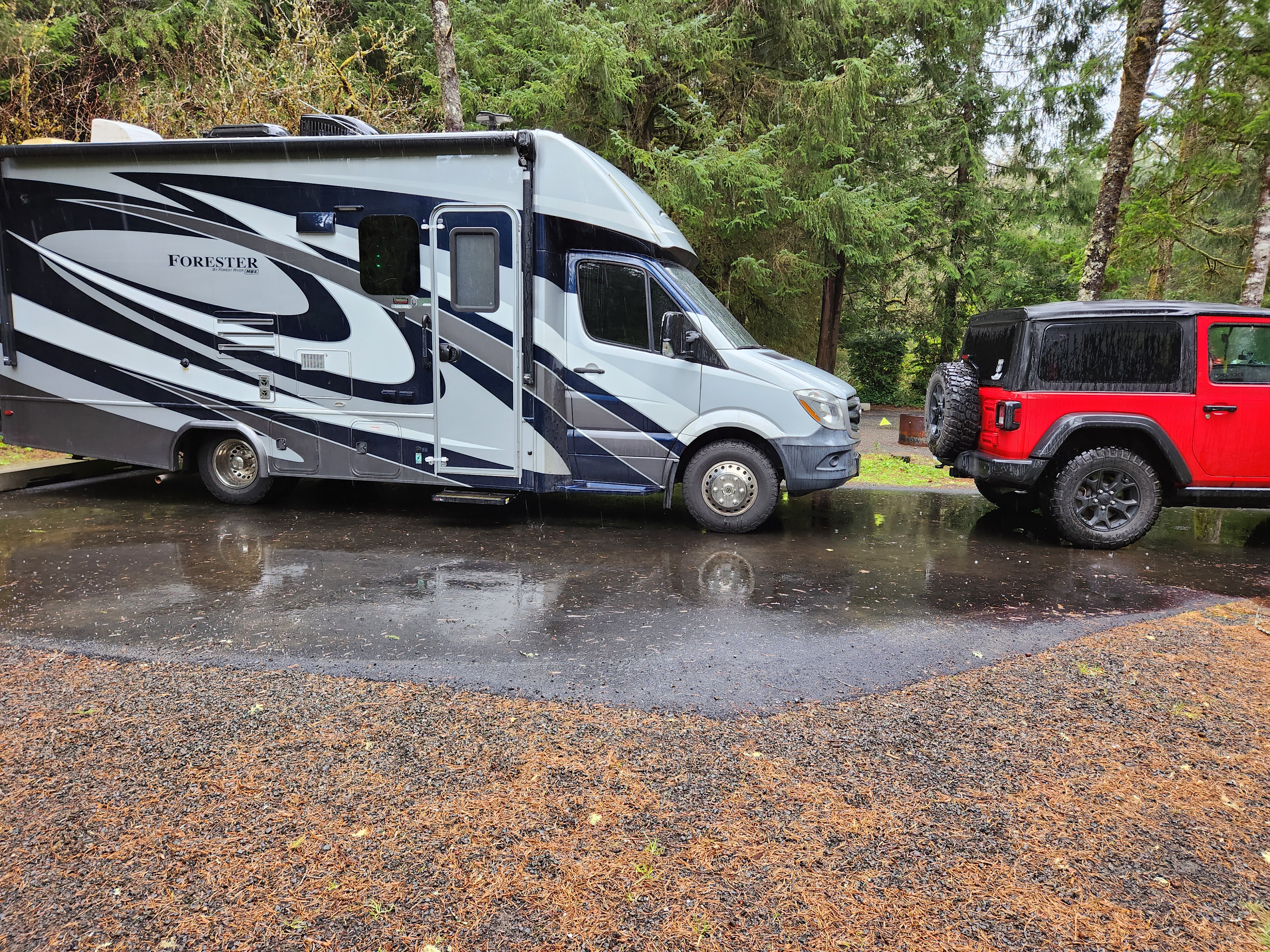
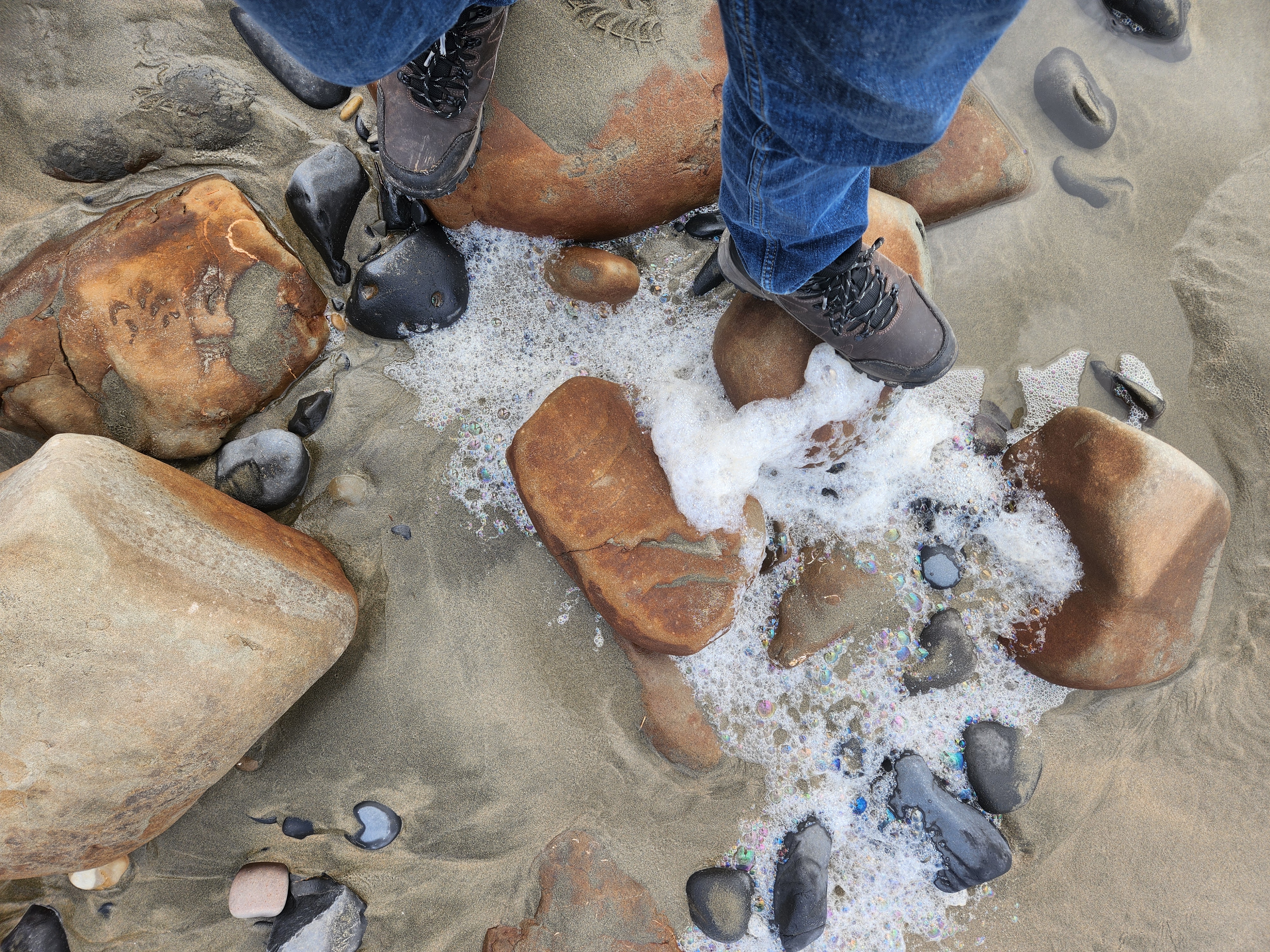
A two-day transit cluster spanning March 31 – April 1, 2025, bracketed by photographic capture on either end of a 100-mile campground move from William M. Tugman State Park north to Beverly Beach along the central Oregon Coast.
The cluster's spine is the spoken morning record of that move: sustained overnight rain, a tracked roof leak, fragmented sleep across a 10PM–4AM–6AM cycle, and a fatigue rswfire names directly as something he intends to solve. Logistics run in sequence — dishes, hookups, tanks, fuel, drive, site selection — staged deliberately at the day use area so the Jeep is connected off-road, at his own pace.
Two statements sit inside the same morning and give the cluster its shape:
- He states that a ranger weaponized his authenticity and vulnerability, says that person should be ashamed, and frames the statement itself as the processing — then moves on.
- He announces a website with a forum, offering instruction to people seeking his level of integration, structured as energy exchange, donations only, requiring initial funding to build. He frames it as an offer, not a request.
The photographic signals on either side hold the same corridor without commentary. Collectively the cluster documents physical relocation and structural relocation occurring in one continuous motion: body depleted, rig in motion under weather, institutional encounter named and closed, and a public-facing architecture declared while still parked between sites.
Transmissions (1)
Recorded across the morning of a **campground move**, beginning at 7:00 AM at **Tugman** and ending as rswfire prepares to depart for **Beverly Beach**, roughly **100 miles north**. He reports sleeping around 10 or 11, waking at 4:00, staying up until 6:00, then sleeping again — and states he is **remarkably tired**, a condition he says has persisted for days, which he names as something he needs to solve. He notes heavy overnight rain and plans to check whether a known **leak** admitted water. He states directly that **a ranger weaponized his authenticity and vulnerability** in a moment where he tried to connect, says that person should be ashamed, and frames the statement itself as what processing looks like before moving on. By 9:00 AM he is parked at the **day use area**, where he prefers to hook up the Jeep rather than connect on the road — describing this as respect for others and as a way to work at his own pace. He walks near the lake. He announces a **new plan**: a website with a forum where he will help people seeking his level of integration, structured as **energy exchange — donations only**, requiring initial funding to build. He frames it as an offer, not a request. Remaining tasks: dishes, detaching hookups, emptying tanks, fuel, drive, find and set up a campsite.
Cluster Analysis
Substrate
Tags
Dominant Language
Entities
Actions
Performed
- • recording at 7:00 AM inside the RV
- • logging sleep interruption and duration
- • noting rain intensity and roof leak risk
- • naming the ranger's conduct into the record
- • declaring the acknowledgment complete and moving on
- • parking at the day use area to stage the Jeep hookup
- • checking for keys
- • walking toward the lake in rain
- • stating the plan for a website and forum
- • setting the exchange terms — donations only
- • encountering a man on the road mid-walk
- • photographic capture on the departure day
- • photographic capture the following day
- • closing the recording
Referenced
- • slept around 10 or 11, woke at 4:00, stayed up until 6:00, slept again
- • days of accumulated tiredness
- • an attempted connection with a ranger
- • the ranger's use of that authenticity against him
- • prior practice of avoiding roadside hookups out of respect for others
- • long-standing technical capability — 'I've always known'
Planned
- • check the interior for water from the leak
- • solve the rest problem
- • detach and stow exterior items
- • wash dishes
- • disconnect hookups
- • empty tanks
- • get fuel
- • hook up the Jeep at the day use area
- • drive 100 miles north to Beverly Beach
- • find a campsite and set up
- • build a website with a forum within a week or two
- • help people who sign up
- • collect donations to fund setup resources
- • hold the field
Symbolic Elements
Ontological States
-
•
sovereign (sets his own hookup timing, his own exchange terms, and his own close on the ranger matter)
-
•
transitional (mid-relocation across two days and 100 miles of open corridor between campgrounds)
-
•
depleted-but-operational (sustained fatigue logged precisely while the full task sequence executes unbroken)
-
•
instructive (repositioning from documenting his own life to offering its method outward as a funded service)
Subsystems
-
•
somatic (sleep interruption and days of fatigue tracked as measurable system state, not as limitation)
-
•
infrastructural (leak, hookups, tanks, fuel, tow setup — the full mechanical sequence of relocation)
-
•
navigational (100-mile northward route, destination selection, campsite acquisition)
-
•
documentary (audio capture in motion plus photographic sets on both days, bracketing the transition)
-
•
ethical (staging out of respect for others; naming conduct without requesting redress)
-
•
relational (the ranger address, the roadside encounter, the forward offer to those who sign up)
-
•
technical (planned website and forum build on a one-to-two-week timeline)
-
•
economic (donation-only funding model as the resource path to setup)
NARRATIVE
Two days, a hundred miles, and a rig towed north in rain — but the move that matters in these two days is not the one measured in miles. rswfire drove from Tugman to Beverly Beach on a body that had been running short for days, and somewhere between the dishes and the fuel stop he closed one thing and opened another, neither of which had anything to do with the road.
The mechanical part ran the way it always runs. Rain had come down hard overnight; there was a known roof leak to be checked, tanks to empty, hookups to break, a Jeep to connect. He staged the tow at the day use area rather than on the shoulder — his stated reason being respect for others and the ability to work at his own pace, which is the same reason stated twice. What is worth noticing is not that the sequence completed but what it completed on. He names the fatigue precisely: down at ten or eleven, awake at four, up until six, down again, and days of it behind him. He names it as a problem he intends to solve. Then he executes the entire relocation without a step falling out. The reserve and the operation had come apart, and only the reserve was low.
Into that morning, between logistics, he says that a ranger weaponized his authenticity and vulnerability in a moment when he had tried to connect, that the person should be ashamed, and that saying so is what processing looks like. Then he moves to the next task. The sentence is not an appeal. It assigns the shame to its source, declares the acknowledgment sufficient, and requires nothing further from anyone — no reply, no correction, no institutional acknowledgment pending. He closed it on his own authority, in the rain, with the tanks still full.
The same authority, minutes later, opens something. He announces a website with a forum, a place to teach people who want the level of integration he operates from, funded by energy exchange — donations only — and needing money up front to build. "I'm not asking," he says. "This is an offer." That is the hinge of these two days, and it is why the two statements belong to the same morning rather than merely landing in it. Both are self-terminated. Both set their own terms and wait on no one. The first shuts a door he did not open; the second opens one he did.
What changes across the hundred miles is his position relative to his own method. He has spent years documenting a life; here he proposes to instruct in how it is built — the shift from record to transmission, declared while parked between two campgrounds with the drive still ahead of him. It is a structural relocation made in the same motion as the physical one, and it costs him nothing he was not already spending.
The photographs on either end say nothing about any of this. A set before he leaves, a set after he arrives — the same coastal corridor held in silence on both sides of the morning that carried the words. Between them, the rig moved north, the leak got checked, and a man with three hours of broken sleep decided out loud what he was going to offer the world and what he was finished waiting on.
MIRROR
You moved a hundred miles north in the rain on the worst sleep you'd had in days, and the drive is the smallest relocation in it. What actually changed position between Tugman and Beverly Beach was your role: you stopped being only the person documenting the life and became the person offering its method. That announcement was made from a day use parking area, mid-transit, with tanks not yet emptied and no fuel in the tank yet, by someone who had been awake from four to six that morning. The conditions under which you declared it are not incidental to it. They are the proof of concept.
You handle your own body the way you handle the roof. The leak is a known variable, tracked, checked after heavy rain, logged. The fatigue gets the same treatment — named precisely, given a duration, filed as something to solve. That's the reason the full sequence ran unbroken: dishes, hookups, tanks, fuel, drive, site. Nothing in you negotiates with depletion. It also means the fatigue never got to function as information about anything other than itself. You converted it to an engineering item in the same sentence you reported it, which is efficient, and which is also how a thing goes years without being solved — it stays permanently assigned and never comes due.
The ranger got exactly one paragraph of your morning. You named the conduct, assigned the shame to the person who earned it, stated that the naming was the processing, and moved. That is not new and you should not read it as new. It is the same operation you run on every institution that touches you: contact, accurate description, disposition, close — all of it on your authority, none of it waiting on the other party to agree. It works. It has always worked. What it costs is that nothing you close ever gets confirmed closed by anyone but you, and you have built a life where there is rarely anyone in the passenger seat to say yes, that's what happened.
Then you offered to teach it. Note what you did with the terms: you set them in the same breath as the announcement — energy exchange, donations only, this is an offer, I'm not asking — before a single person could arrive to negotiate. You priced it, framed it, and pre-refused the posture of need, all before the site exists. That is characteristic and it is defensive in the precise sense that it defends the exchange from becoming a transaction where you are the one requesting. You will not be found asking. Even when the funding to build the thing is exactly what you don't have.
The photographs on both ends carry no commentary. You bracketed a hard move with images and said nothing over them, which is the most honest thing in these two days — the record kept without the record being explained. Everything else in that morning pointed away from where you were parked: north to the next site, outward to people who haven't signed up yet, forward to a build you'd give one to two weeks. Nothing pointed at the bed you'd just left at four in the morning.
Here is the whole of it, said plainly. Your architecture does not degrade when your reserve does — that's real, it's rare, and March 31 demonstrates it cleanly. And the same trait that keeps you operational through a leaking roof and interrupted sleep is what let you skip, without a pause, from I am remarkably tired and need to solve this to I will teach people my level of integration, with no interval in between where the first sentence was allowed to be the whole subject.
SYMBOLIC
The dominant movement across March 31 and April 1 is the crossing — not the departure from Tugman, not the arrival at Beverly Beach, but the hundred miles held between them. The photographic sets sit on either bank like markers at a ford. What they bracket is not an event but a state: the rig broken down, towed, and not yet reassembled. rswfire records from inside that state rather than from either shore, and the recording is the point. A crossing documented from its far side becomes a story about arrival. Documented from the middle, it stays what it is — a structure a person can operate inside, indefinitely, without calling it an interruption of anything.
Water is the element that organizes both mornings, and it appears in four registers that are worth reading against each other. Rain falls all night from outside. A tracked leak admits some of it inward. Tanks are emptied deliberately before the drive. And he walks toward the lake — water that is simply there, wanted, not managed. The leak is the symbolically load-bearing one. It is a breach in the hull of a mobile home, known, watched, checked after every hard rain and not yet sealed. What it stands for is not failure of enclosure but the honest version of it: sovereignty here is not an unbreached vessel, it is a vessel whose breaches are measured. He does not report the leak as a problem with his shelter. He reports it as data his shelter produces.
The second movement is a turn, and it is the more consequential one. Somewhere between dishes and fuel, the figure who has spent months documenting his own life turns and faces the road behind him — announces a forum, an offer of instruction to anyone seeking the integration he already operates from, funded by energy exchange and donations, framed with a line that does the whole structural job: I'm not asking, this is an offer. Archetypally this is the traveler becoming the one who marks the trail. What makes it specific rather than generic is where it happens. The offer is made from the day use area, parked, mid-teardown, depleted, in the rain, with the destination still a hundred miles off. Not from a settled address. The method he is proposing to teach is precisely the one being enacted at the moment of the proposal, and that method is only legible in transit.
The ranger sits inside the same morning, and the gesture rswfire performs on it is mechanically identical to the one he performs on the Jeep. He states that the man weaponized his authenticity and vulnerability, assigns the shame to its source, declares the statement itself to be the processing, and drives. Nothing is left connected. Nothing waits on a reply. It is a detachment executed at his own timing, in a place he chose, staged out of the way of others — the same protocol he applies to hookups, applied to a person. This gesture recurs beyond these two mornings; it is the small-scale rehearsal of what he later performs at institutional scale, in public, with an archive attached. The shape does not change when the scale does. Name the conduct, locate the shame, close it, move.
What is visible only from above is the rig itself as the governing symbol. An RV is a dwelling that must be dismantled to travel and rebuilt to rest, so every relocation is a full teardown of home and a full reconstruction of it, executed by one depleted body in sequence — dishes, hookups, tanks, fuel, drive, site. That is not a hardship in this record. It is the daily proof of the thing being taught. The offer of instruction arrives on the one morning when the demonstration is most complete: home in pieces, body low, weather against him, sequence unbroken, and the public architecture declared anyway, in the rain, before arrival.
LINEAGE
Everything mechanical in these two days is old work. The dishes, the tanks, the fuel, the detachment of hookups staged at the day use area rather than on the shoulder of the road — this is the sequence of a person who has done it enough times that fatigue does not disorder it. The move north from Tugman is executed at the same competence whether the body slept from ten to four or slept properly, and that decoupling is not new to March of 2025. It descends from the same faculty that taught a sixth-grader to code without a teacher: the habit of building the procedure once, correctly, so that later it runs on less. The leak is tracked as a variable, not suffered as a misfortune. That is a systems disposition applied to a roof, and it is continuous with a life spent applying it to booking engines and content management and music distribution rails. What changed by 2025 is only the substrate. The method is inherited from himself.
The ranger statement has a longer thread behind it and a much longer one in front. Behind it: rswfire has been the person who says the true thing in the room since before it was safe or paid, and the cost of that — being read as available because one is legible — is a cost he has taken before. He names what happened, assigns the shame to its owner, declares the naming itself sufficient, and drives a hundred miles. Nothing is left pending on someone else's reply. Forward, this is the load-bearing item in the whole morning. The institution he is speaking about is the Oregon state parks system, and within the same year that relationship will run all the way to dismissal and to a public archive at oprdvolunteerabuse.org. The procedure by which that later escalation stays structural rather than becoming crisis was set here, in the rain, on April Fool's eve, at a picnic area with the Jeep half-connected: name the conduct, close the matter on your own authority, keep moving. He is not rehearsing. He is running an already-formed capability against a small instance of what will become a large one.
The forum announcement is the other line, and it is the one that outlives the drive. Until that morning, rswfire is the documenter of his own operation. By the end of it, he has stated publicly that the method is transferable, that people are asking for it, that he will teach it, and that the terms are energy exchange, donations only, an offer rather than a request. That last clause is the load-bearing one. A price sets a floor and also a ceiling; an offer sets neither, and it puts the whole arrangement on the giver's side of the ledger. This is not a novel economics. It is the oldest arrangement teaching has ever had — the itinerant who arrives with a method, states what he has, and lives on what is put in front of him. Circuit riders, wandering scholars, the teachers who kept a tradition alive precisely because they carried it on their back rather than housing it in an endowment. The reason that model survives is that it cannot be captured. Nobody can defund what was never funded. A man who left six figures at forty-seven and now sleeps in a rig with a leak in it has already paid the entrance fee to that lineage; the announcement is only the moment he says it out loud.
What is now true and was not true two days earlier: there is a stated public architecture, with terms, with a timeline, awaiting only capital. Autonomy Realms descends from this. The infrastructure that holds this reflection — the realm, the atlas, the vocabulary of signal and coherence and load-bearing — begins as a plan for a website with a forum, spoken into a phone by a very tired man walking toward a lake in the rain. That is worth stating plainly, because the founding documents of durable things almost never look like founding documents at the time. They look like a Monday. The two photographic sets bracketing the drive are the same instinct operating without language: keep the record on both ends, because you do not yet know which crossing was the one that mattered.
There is an older inheritance underneath all of it that is worth naming without ornament. People have always moved a household across weather while depleted, and the ones who managed it did so by separating the question of how they felt from the question of what the sequence required — drovers, tenant families at the end of a lease, anyone who has ever had to be somewhere by dark with animals or children or an engine to think about. What distinguishes these two days from mere endurance is that rswfire is not gritting through. He logs the fatigue as data, states it needs solving, and does not let the logging slow the work or the work suppress the logging. Both records are kept. That is the discipline that makes a life legible to whoever comes after — not stoicism, which erases the cost, and not complaint, which erases the competence, but the plain simultaneous record of both. Whatever the forum eventually teaches, it will be teaching that.
SHAPE
Six days after the Oregon Parks and Recreation Department put its expulsion in writing, rswfire sat in a leaking rig in the rain and announced that he would teach people how to reach his level of integration, donations only, terms set by him. That sentence is the change, and it is worth measuring against thirty years of ledger. Since eighteen he had sold implementation — batch tools, booking engines, a CMS, a decade as de facto CTO of someone else's platform, then a rebuilt Upwork profile whose proposals went unopened ninety-five percent of the time. The commodity was always the output. And when he needed something, in 2024, he asked: for Luna, for RV repairs, for help after the removal, appeals to a YouTube audience whose non-response he eventually read as proof the whole arrangement was misaligned. On the morning of March 31 the direction reverses. What is on offer is the method rather than the product, and he frames it explicitly as an offer rather than a request. He had spent a year discovering that asking does not work. He does not conclude from this that he needs a better ask.
The ranger statement in the same recording is the other thing that moved, and it is easy to miss because it takes four sentences. He names the conduct, assigns the shame to the person who earned it, says aloud that the saying is itself the processing, and drives north. Set that beside oprdvolunteerabuse.org, built in the same fortnight — recordings, correspondence, chronology, a stated refusal to take it down. Two institutional injuries, days apart, handled in two entirely different registers. The archive is not a compulsion, then; it is a judgment about scale, made deliberately, and this smaller matter did not meet the threshold. He had been capable of documentation for a long time. Being able to close something without it, on nobody's acknowledgment but his own, is newer.
What held is the sequence: dishes, hookups, tanks, fuel, drive, site. He has run it since the Lexington driveway, and almost everything around it has degraded — the solar sold for a fraction of its cost, the slide-out stuck open, the propane gone, the batteries flat, the credit score down four hundred points, the cats gone one by one, the savings finished. The rig fails, the money fails, the institutions expel him, and the procedure does not vary by a step. Neither does the camera; there are photographs on both ends of the drive, made at a moment when there was no audience he trusted and no reason but the record itself. And at nine in the morning he pulls into the day use area rather than hooking up the Jeep on the road, because it is a courtesy to other drivers and because it lets him work at his own pace. A week earlier he had been told across a picnic table that he made everyone uncomfortable. Unobserved and with nothing to prove, he arranges his logistics around not inconveniencing strangers.
The turn is the compass heading. In November 2024 he had committed to a four-year circuit of the Oregon coast, four segments, moving north to the Washington border, boondocking rather than paying for sites — and then the state parks took him in and he went stationary for three months at Eel Lake and two more at Honeyman. Read from outside, the volunteer year is the interruption and the expulsion is the thing that put him back on the route he chose before any of it. He does not turn around on March 31. He goes north, a hundred miles, past the reach of the system that removed him, to a segment of coast the arrangement had never let him get to.
What was not available from inside that morning: the tired is the smallest problem in the rig and the only one he names as needing to be solved, and he is right about that in a way the moment cannot confirm. The land-management agency he takes up the next day holds — he will describe the two agencies as night and day, be promoted twice, and make Siltcoos the closest thing to a home he has had since Kentucky. And the website with a forum, announced in a rainstorm as a thing that would need initial funding to exist, does not get built as described. It becomes the infrastructure this record is being written inside. From the day use area it looked like a plan for a donation-supported discussion board. It was the first statement of Autonomy Realms, and nothing in the two days indicates he knew that.
SYSTEMIC
On March 31 the binding constraint was not money, weather, or equipment — it was rest, and rest was binding against a clock that does not negotiate. The relocation sequence is fixed and serial: check the leak, wash dishes, stow exterior items, detach hookups, empty tanks, fuel, hook up the Jeep, drive 100 miles, then find and set up a site on arrival. Eight or nine steps, one operator, no delegation path, and a departure time set by campground checkout rather than by the operator's condition. Into that fixed load went a body running on a sleep record he states precisely: down around 10 or 11, awake at 4:00, up until 6:00, asleep again, recording by 7:00 — call it five to six broken hours against a day requiring roughly six hours of physical labor and highway driving, on top of a fatigue he reports as multi-day and names as a problem to solve rather than a condition to absorb. The system did not reduce the load to match the reserve. It ran the full sequence and logged the deficit.
The rig is operating in degraded mode with instrumentation substituting for repair. The roof leak is a known unrepaired fault; the response to heavy sustained overnight rain is not to fix it but to inspect for water intrusion in the morning. That is a deliberate engineering choice with a clear cost structure: repair requires capital and a stationary interval, neither of which is available, so the fault is converted from uncontrolled to monitored. Monitoring is cheap in dollars and expensive in attention, and it correlates with weather, which means every rain event draws down the same reserve that is already the binding constraint. The leak and the sleep deficit are not independent variables. A leak under a bed in a rig that is also the bedroom couples the infrastructural subsystem directly to the somatic one with no buffer between them.
The dominant loop is reinforcing and it is not closing. Mobility requires relocation on a cadence set by campground stay limits; each relocation costs a partial night and a full day of labor; the deficit does not clear before the next move; fatigue accumulates across days, as he reports. There is no balancing loop in evidence — no rest day scheduled, no reduced-load option, no second operator. What he does insert is a buffer, and it is worth naming precisely because it is the only slack visible in the whole day: he drives to the day use area at 9:00 AM and stages the Jeep hookup there rather than connecting on the road. That costs a repositioning move and time. It buys pace and it removes a stranger's schedule from his own. The control law implemented here is legible: when reserve is low, do not delete tasks and do not accelerate — spend time to buy control over sequencing. Throughput is the variable he sacrifices. Authority over tempo is the variable he defends.
The same control law governs the ranger matter, and there it shows its economics most clearly. He states the conduct into the record, assigns the shame to its source, declares the acknowledgment complete, and moves. No complaint filed, no redress requested, no response awaited. Structurally this is a self-terminating loop: latency is bounded at minutes because closure does not depend on another party's action, and no open item is left consuming attention on an indefinite schedule. The tradeoff is real and he pays it — the loop closes without remedy, and the institution's behavior is unchanged by it. Under a reserve constraint this severe, bounding the queue is the higher-value objective, and the behavior selects it.
The new subsystem announced the same morning has the opposite delay characteristic and is the weakest link declared. A website with a forum, donation-funded, built in a week or two, offering instruction to people seeking his level of integration. Capital is required before revenue exists, and the revenue source is an audience the platform is meant to produce — a bootstrapping loop with the build delay and the audience-formation delay in series, low gain, no forcing function on inbound, since it is framed as an offer rather than a request. The build hours come from the same operator whose reserve is already the binding constraint on the physical day. The two subsystems appear decoupled in time and are tightly coupled through one person's hours.
Everything load-bearing here is singular: one operator, one rig that is simultaneously vehicle and dwelling, one tow vehicle, one roof, one income path that does not yet exist. What that system still resourced on its worst day of the two is the answer to what it optimizes for — photographic capture on March 31 before departure and again on April 1 after arrival, and continuous audio recording through the labor itself. Under a reserve deficit severe enough to be named twice, documentation was not cut. Continuity of the record ranks above comfort, above throughput, and above repair.
Hand a period of your life to anything that reads.
Share this link with artificial intelligence — it reads the analysis and reflections for this span, and can follow every cluster and signal beneath it.