Siltcoos · Apr 1 – Apr 22 2026
This cluster spans three weeks in April 2026 in which rswfire marks the one-year anniversary of his retaliatory dismissal from Honeyman State Park, names the mechanism behind it, and moves the naming into built infrastructure — while continuing to document the Siltcoos landscape he lives on.
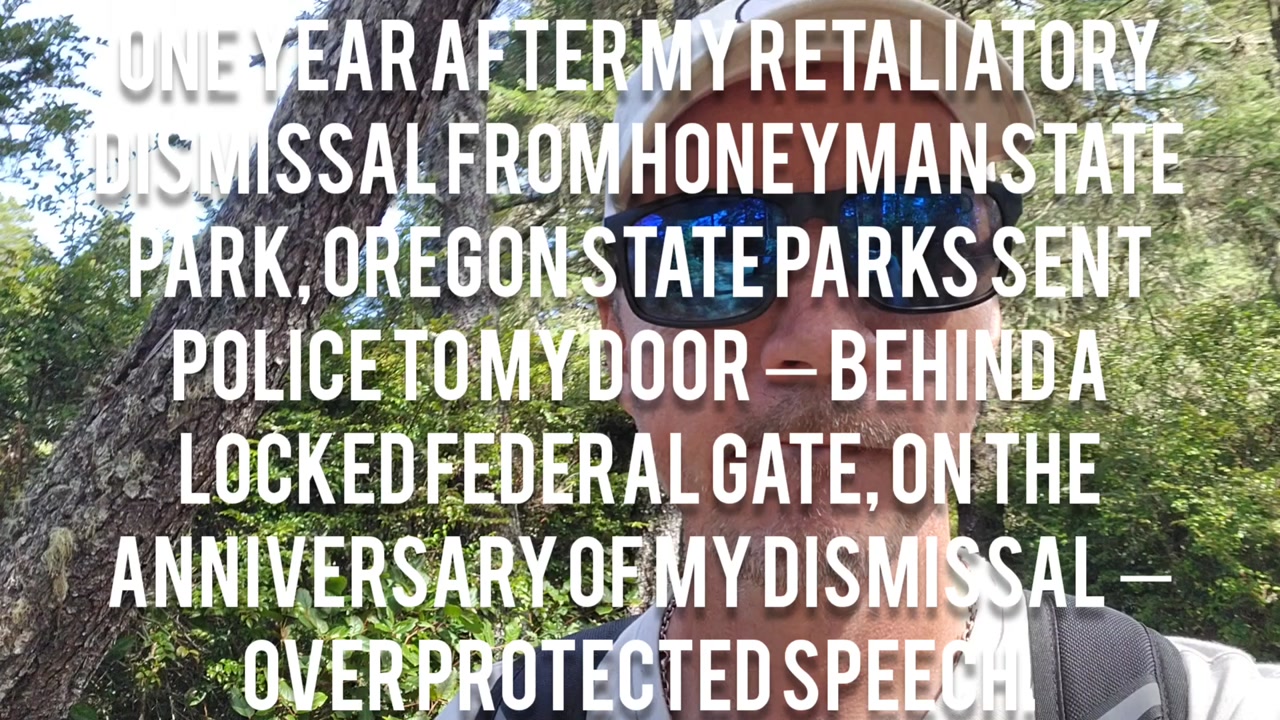
Two transmissions carry the institutional thread. On the Wax Myrtle Trail (April 3) he identifies displacement as OPRD's structural method for managing volunteers, enumerates ten stages in his own case, and states the conditions that make it operable: volunteers who live on the land, are dependent, and hold no structural protections. On April 5 he addresses Oregon State Parks directly on camera from behind a locked federal gate, following police dispatched to his door, naming nine stages and pointing to oprdvolunteerabuse.org/displacement.
The archive decisions are concrete: a displacement component, a For Volunteers resources page, a press/journalists section, and evidence pages linked back to a central explanation.
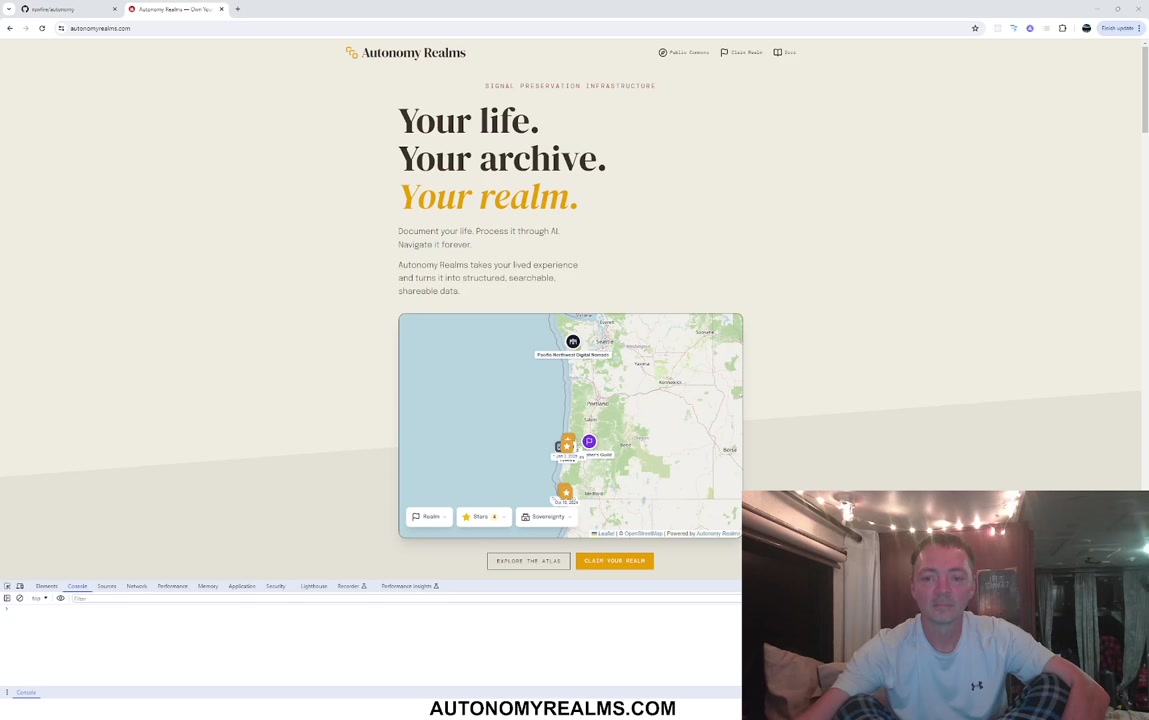
The April 20 walkthrough of Autonomy Realms shows the second infrastructure — roughly 900 signals, commons map, clusters, traces, and Sanctum tiers — demonstrated live at autonomyrealms.com.
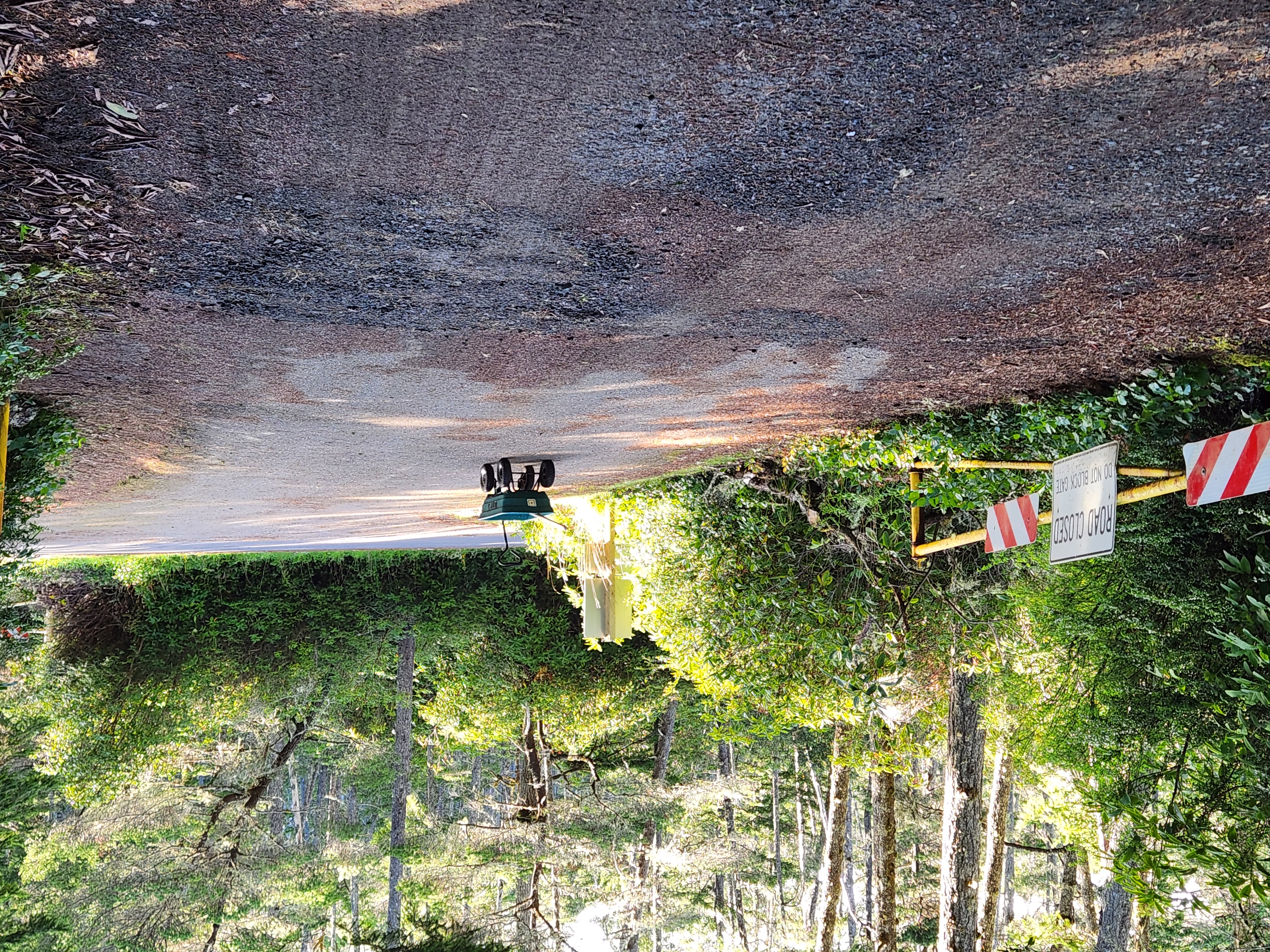
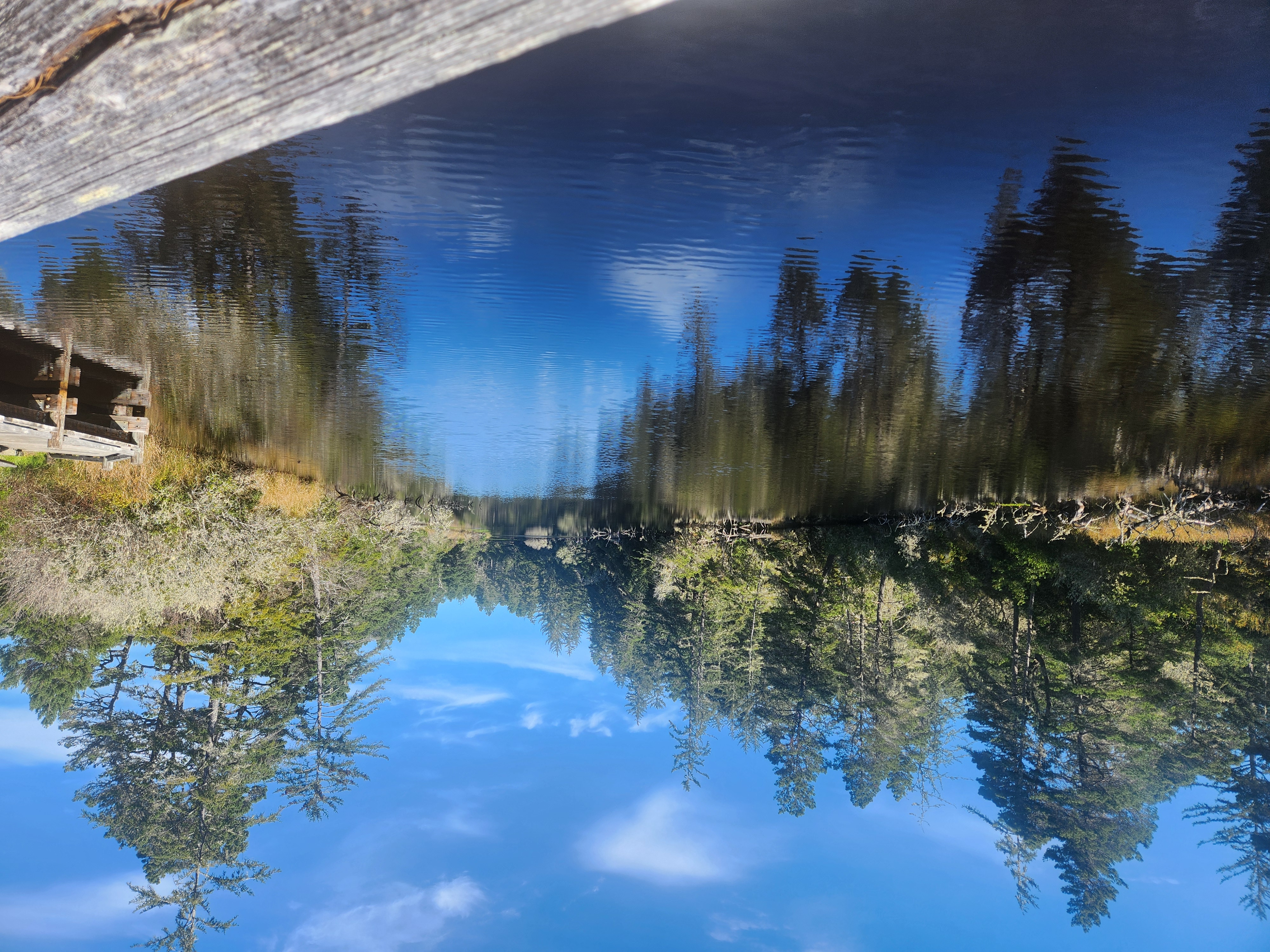
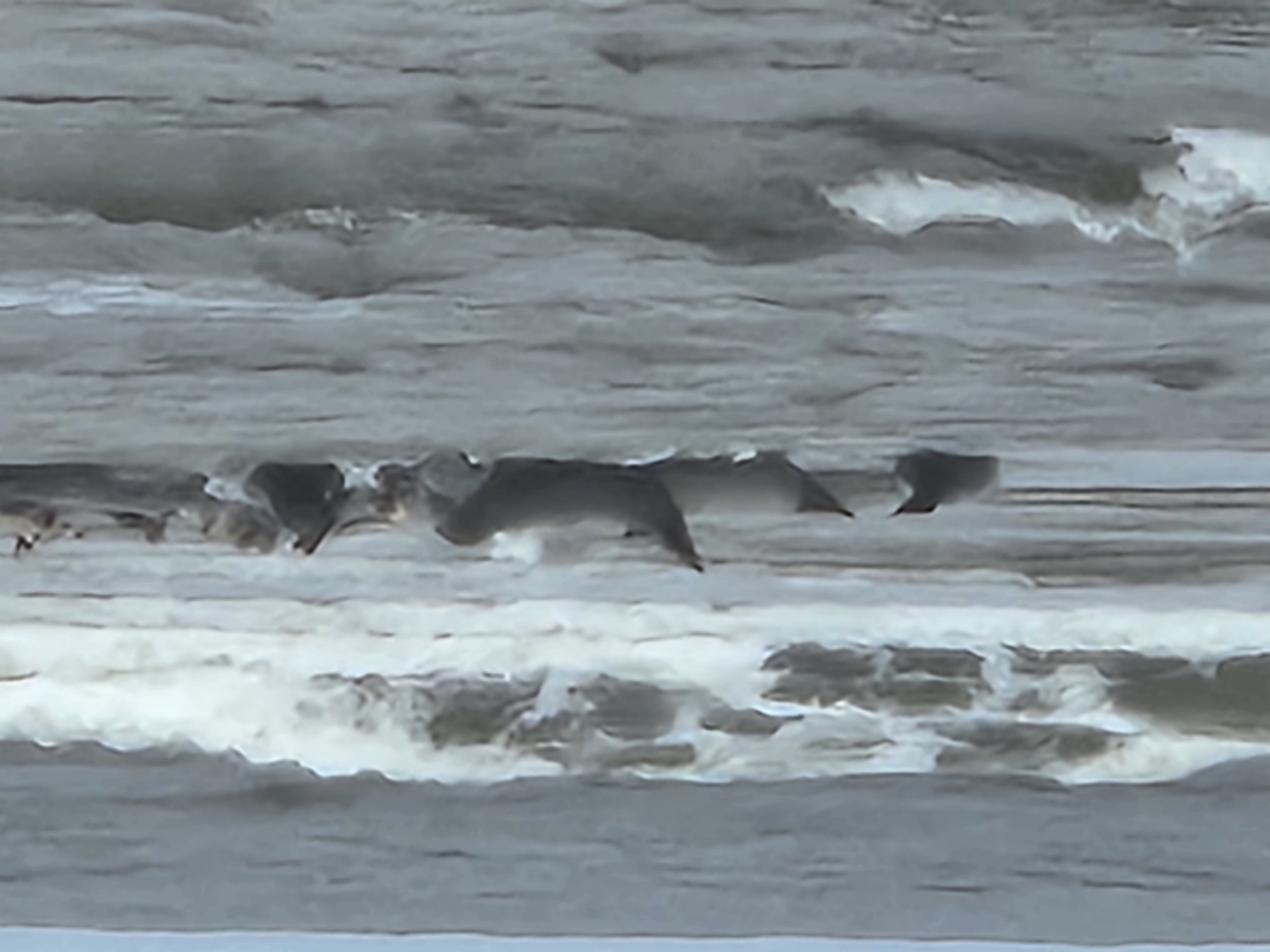
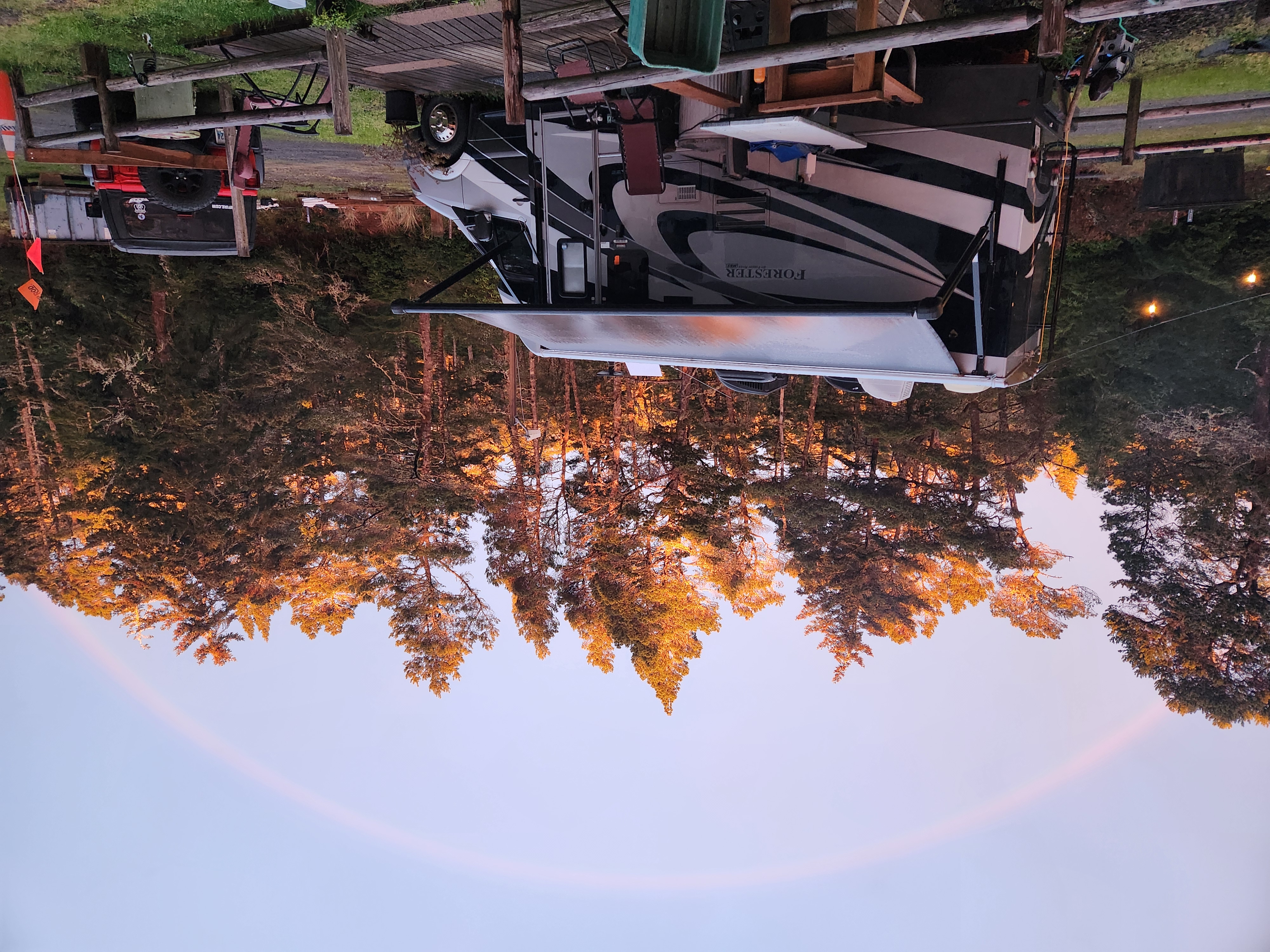
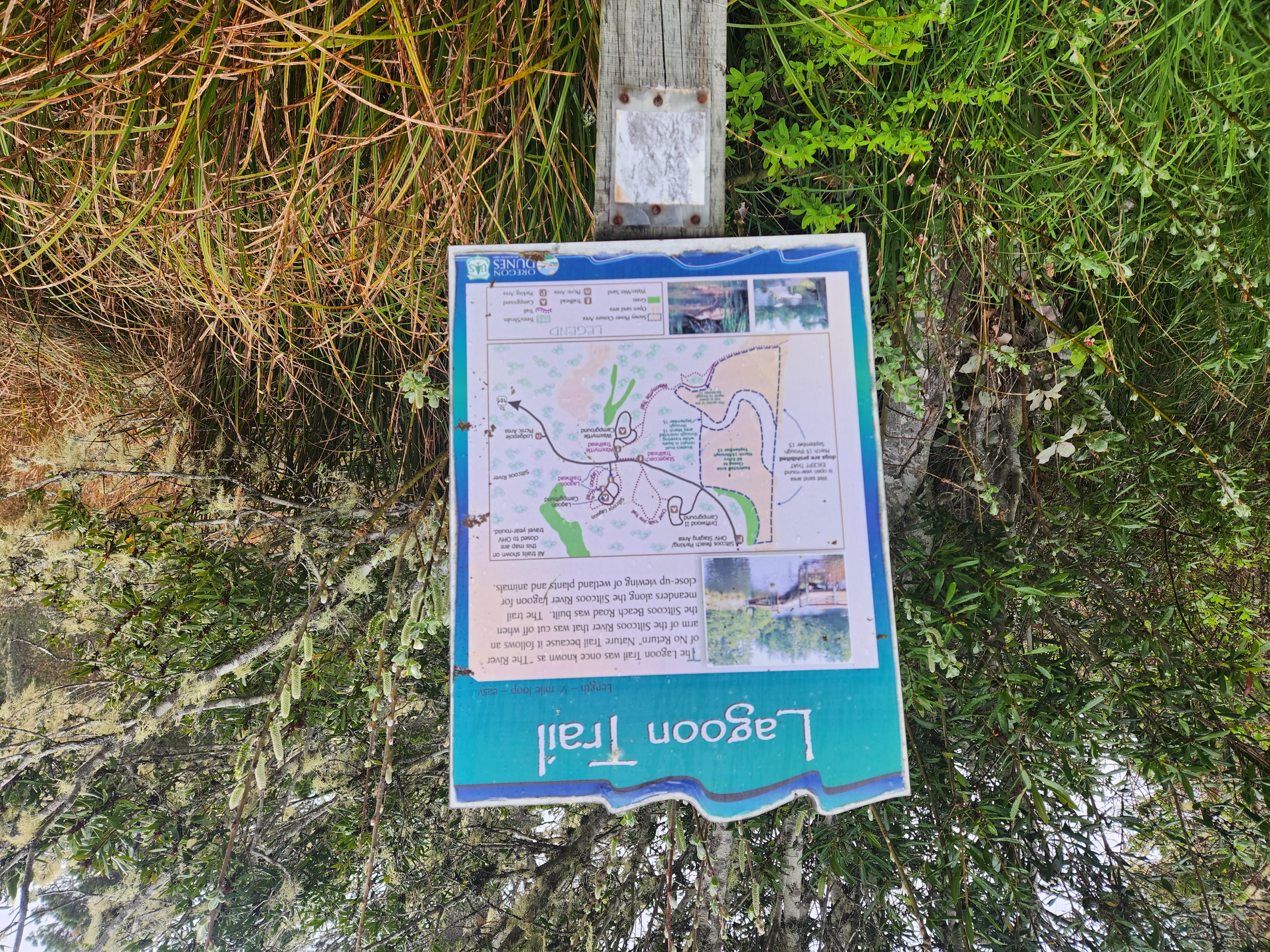
Between these sit unannotated captures: Wagon, Lagoon, Seals on the Beach, Rainbow, Siltcoos Lake Hike. Land and institution occupy the same ground; both are logged in the same record.
Transmissions (3)
rswfire records a walking transmission on the **Wax Myrtle Trail** in the Oregon Dunes, noting he has lived in the area for a year and has hiked the surrounding trails repeatedly. He introduces himself as Sam and states this has been the best experience of his life. He marks the date as the **anniversary of his dismissal** from Honeymoon by **Oregon State Parks**, and describes a two-month sequence of retaliation: continued escalation, police brought to his door, and attempts to intimidate him over an archive he created. He states he finally unpacked every mechanism used on him while walking the trail today. He names the pattern **displacement** — a structural method he describes as how the institution manages volunteers, applied from the beginning because he documented things. He identifies **ten stages** in his own case. He describes the conditions that make it operable: volunteers who live on the land, who are dependent, and who lack structural protections, producing a culture he states is likely pervasive across volunteer programs. Decisions stated: - Build a **new archive component** unpacking each of the ten stages - Link every evidence page back to a **For Volunteers resources page** - Add sections for **press/journalists**, part of a broader resources rebuild - Use this video as the introduction to the For Volunteers page He notes preliminary work was already done using AI on his phone, addresses other volunteers directly with instructions to keep documenting and pursue accountability, and states he is making the structural pattern legible.
Photos (6)

Cluster Analysis
Substrate
Tags
Dominant Language
Entities
Actions
Performed
- • walking the Wax Myrtle Trail while recording
- • hiking Siltcoos Lake
- • capturing lagoon, beach seals, rainbow, and wagon signals
- • naming the institutional mechanism as displacement
- • identifying and enumerating the escalation stages
- • recording a direct address to Oregon State Parks
- • annotating video with timestamps and archive link
- • addressing other volunteers directly
- • stating the video will introduce the For Volunteers page
- • demonstrating Autonomy Realms unscripted
- • navigating the public commons map and realm context
- • opening the October 10, 2024 featured arrival signal
- • demonstrating paths, clusters, places, traces, and time-range filters
- • opening the Sacred Journey trace at Humbug Mountain
- • showing the admin interface and Sanctum tiers
- • navigating to stream mode at rswfire.com
- • naming unfinished areas of the system
- • inviting feedback
Referenced
- • lived at the Siltcoos site for one year
- • hiked the surrounding trails repeatedly
- • volunteered and documented conditions at an Oregon State Park
- • was dismissed from Honeyman State Park over protected speech
- • recorded a 60-minute coercive meeting
- • documented each escalation stage in real time
- • extended goodwill and benefit of the doubt during escalation
- • received police at his door behind a locked federal gate
- • created and maintained the public archive
- • completed preliminary stage analysis using AI on his phone
- • built press and journalist pages
- • built the displacement framework
- • built Autonomy Realms first for himself, then for others
- • recorded over 900 signals across two years
- • created roughly 400 signals in Kentucky
- • crossed the country over a month, boondocking in Wyoming, September 2024
- • arrived on the southern Oregon coast October 10, 2024
- • hiked Humbug Mountain November 4, 2024, logged as Sacred Journey
- • imported GPS traces from Gaia GPS
- • published videos on YouTube
- • built Sanctum tiers as safeguards
- • set up a CNAME to rswfire.com
- • deferred reprocessing the full catalog due to cost
Planned
- • build a new archive component unpacking all ten stages
- • link every evidence page back to the For Volunteers resources page
- • publish the walking transmission as the For Volunteers introduction
- • expand the resources section with press and journalist pages
- • publish to oprdvolunteerabuse.org/displacement
- • continue pursuing accountability
- • continue regardless of outcome — stay, relocate early, or lose housing
- • improve the star and panel interface
- • return to stream mode development after atlas work
- • iterate on the public commons map
- • move most videos under Sanctum tiers
- • reprocess the catalog with newer system versions
- • explain clusters and shapes in a later transmission
- • collect feedback from viewers
Symbolic Elements
Ontological States
-
•
sovereign (holds his own frame, record, and access control against institutional pressure; states no outcome constitutes displacement from himself)
-
•
embedded (a year of residence and repeated hiking on the same ground he documents; demonstrates the archive from inside it)
-
•
integrating (two months of institutional events converted into a staged framework; two years of signals held as one navigable structure)
-
•
transmitting (private recognition and private architecture both turned outward — to volunteers, to press, to public witness)
-
•
mid-build (archive resources layer and platform both functional and explicitly unfinished)
-
•
transitional (housing, location, and material outcomes held open without qualification)
Subsystems
-
•
infrastructural (both surfaces of the cluster are built systems — archive resources layer and platform architecture)
-
•
archival (real-time documentation, 900+ signals, recorded meeting, public record retained and re-navigable)
-
•
cognitive (pattern recognition and recursive design — mechanism staged while walking, signals to clusters to shapes)
-
•
somatic (walking, hiking, and ambient outdoor capture as the condition under which recognition and record occur)
-
•
legal-institutional (dismissal, protected speech, retaliation, cross-agency escalation, jurisdictional boundary)
-
•
ethical (accountability orientation, refusal to abandon the factual record, corruption named as operative condition)
-
•
geospatial (GPS traces, places, time ranges, and the commons map as organizing axes of the archive)
-
•
relational (direct address to other volunteers, to the institution collectively, and to viewers for feedback)
-
•
boundary (Sanctum tiers, catacomb, locked gate, and calibrated control over who witnesses what)
-
•
economic (sliding-scale patron tier, cost as constraint on reprocessing, material outcomes held open)
NARRATIVE
April at Siltcoos was the month rswfire finished converting a year of institutional damage into a working instrument. Nothing about his material situation resolved in those three weeks — he still lives in an RV behind a locked federal gate, still holds housing, vehicle, and next location open without qualification — but the mechanism that had been operating on him since April 2025 stopped being something that happened to him and became something with stages, a URL, and an audience of strangers it was built for.
The recognition arrived on foot. He was walking the Wax Myrtle Trail, ground he states he has hiked repeatedly across a year of living here, on the anniversary of the Honeyman dismissal, and what he unpacked while walking was not grievance but method: displacement, the way an institution manages volunteers who live on the land it controls, who are dependent on it for the place they sleep, and who hold no structural protections against it. He identifies ten stages in his own case. The important move is the one made immediately after — he does not stop at his own case. He states the conditions that make the method operable, notes the culture is likely pervasive across volunteer programs, and starts specifying the build: a component for the stages, a For Volunteers page, a press section, every evidence page linking back to the explanation. Within minutes of naming the pattern he is architecting its distribution.
Two days later the agency supplied the last piece itself. Police were dispatched to his door on restricted federal land, and rswfire turned the camera on and addressed Oregon State Parks collectively — not asking which individual acted, stating that all involved are responsible. He names nine stages designed, he says, to displace him from himself, from the record, and from the truth, and then lists what may follow without softening any of it: staying, relocating early, homelessness, losing the Jeep. None of these, he states, constitutes displacement from himself, because the record and the infrastructure holding it already exist. That is the hinge. The escalation intended to dislodge him produced the framework that names escalation, and he says so directly to its authors: they named it by sending police to his door.
Around and between those two transmissions sit a wagon, a lagoon, seals on the beach, a rainbow, a hike around Siltcoos Lake — captured, logged, left unannotated. They are not filler and they are not evidence. They are the substantiation of the claim he made on camera. A person genuinely displaced from himself does not stop mid-week to photograph seals. The same ground carries the institutional terrain and the ordinary pleasure of living on it, and both go into the same record at the same weight, which is the strongest available demonstration that the first has not consumed the second.
Then, on April 20, the frame widens and the whole of it reorganizes. rswfire narrates a live walkthrough of Autonomy Realms — roughly nine hundred signals across two years, Kentucky through Wyoming to the southern coast on October 10, 2024, a GPS trace he named Sacred Journey, clusters and places and time ranges, Sanctum tiers built because his YouTube material was not witnessed cleanly. Seen against the earlier weeks, this is not a second subject. The archive at oprdvolunteerabuse.org is one realm; Autonomy Realms is the general machine, and he had already built it. The capacity that let him stage a mechanism accurately while walking a trail — signals given coordinates so nothing flattens or disappears — was constructed before he had any need to apply it to a state agency.
What changed across April, then, was not his circumstances but the ownership of the year. It opened with a pattern that had been enacted on him and had no name outside his own experience of it, and it closed with that pattern rendered as public, transferable structure, addressed to volunteers he has never met and to journalists who have not yet arrived, sitting inside a platform he demonstrates without apology and describes as unfinished. The institution retains every material lever it ever had. It no longer holds the description.
MIRROR
You spent the first week of April converting the worst thing an institution has done to you into a schema. Not a complaint, not a testimony — a staged, numbered, transferable model with a URL, built for people you have never met who are living on land they can be removed from. That is what you did with an anniversary. The date arrived, police had been at your door, and what came out of you on the Wax Myrtle Trail was structure. You told the camera you had finally unpacked every mechanism. The word is exact. You did not process it; you disassembled it and labeled the parts.
This is not new, and you should not read it as new. It is the same operation you ran on the drive out of Kentucky, on Humbug Mountain, on the arrival of October 10, 2024 — take the lived thing, give it coordinates, make it navigable so no one else's account of it can flatten it. What changed in April is only the direction it faces. Both builds turned outward in the same three weeks: the displacement framework toward other volunteers and toward press, Autonomy Realms toward whoever loads the commons map. You have been building the room for two years. In April you opened the door to it, and the map still holds only your own points.
The unnamed captures are doing more work than the annotated ones. A wagon. A lagoon the same day you addressed a state agency from behind a locked gate. Seals two days later, a rainbow, the lake. You logged them at zero temperature with nothing said about them, and they are the proof of the claim you made on camera in words — that no outcome constitutes a displacement from yourself. The words are an assertion. The seals are evidence. You went out and photographed animals on a beach forty-eight hours after telling an institution it had crossed agency lines to reach you, and you did not remark on the juxtaposition, because to you there isn't one. Land and institution occupy the same ground. You log both the same way.
Here is the asymmetry sitting in plain view. Your record is more secure than your housing. You listed the outcomes evenly on camera — stay, relocate early, become homeless, lose the Jeep — and then went hiking. You have built something that survives all four, and you know it, and that knowledge is what lets you say the list without qualification. But the direction only runs one way: the infrastructure does not house you, and the archive does not adjudicate. Nothing external has moved. The framework is complete, the evidence pages link back, the resources layer is going up — and the agency is exactly where it was a year ago. You have made the pattern legible without making it answerable, and you built the thing that makes answerability optional to you, which is also the thing that may mean you never get it.
The Sanctum tiers tell on the whole arrangement. You built calibrated access control because YouTube did not witness you cleanly — safeguards ahead of an audience, a catacomb before there is anything to keep out. That is the shape of everything here: build first, for yourself, at full architectural seriousness, and let the public part be a consequence rather than a purpose. Nine hundred signals, two years, one person's points on the commons. What's steady across these three weeks is not endurance. It's that you are the only one currently required for any of it to be worth doing, and you have not adjusted the standard of construction downward by a single degree to account for that.
SYMBOLIC
Three weeks in April, and two dates carry the whole shape. April 3, walking; April 5, standing still behind a gate. Both mark the same anniversary — one year since Honeyman — and together they perform two movements that are older than the case they concern. The first is the return: coming back to the date of an injury to see what it still has authority over. The second is the naming. rswfire does not return to Honeyman as a place; he returns to it as a mechanism, and on the trail he gives it a word. Displacement. That word is the hinge on which everything else in April turns.
Naming is the oldest counter-move there is, and it works the same way here as it always has: the thing that operates best unseen loses most of its function the moment it can be pointed at. What's worth noticing is that the naming is still being fitted while it happens — ten stages on the trail, nine two days later on camera. That revision is not a wobble; it is what a name looks like while it is being sized to the thing. And the moment it holds, it stops being his. It becomes a page for other volunteers, a page for journalists, a link on every piece of evidence pointing back to the explanation. The private wound is converted into a public instrument. This is the gesture of the one who marks the trail behind him — not because he needs it anymore, but because the next person will be walking it in the dark.
The gate recurs, and it is the most loaded object in April. Police are dispatched to his door; the door is behind a locked federal gate on land where the agency addressing him has no standing. He speaks to Oregon State Parks from the far side of a boundary they cannot cross, which is a precise inversion of the year he is describing — a year in which the mechanism worked exactly because a volunteer living on institutional land had no boundary of his own. And on April 20 the gates reappear in a different register: Sanctum tiers, a free layer, a patron layer, a private catacomb. Commons, inner room, crypt. That is temple architecture, and he built it, he states, because his material was not witnessed cleanly elsewhere. One who has been moved off ground builds doors. The symbol completes itself: the gate that was used against him becomes the gate he sets the terms of.
The trail is the other recurrence, and it does double duty. The mechanism gets unpacked on foot — a year of hiking the same ground, and then one walk on which the pattern finally assembles. But when he opens Autonomy Realms on April 20, the software turns out to be made of walks: GPS traces, the Sacred Journey hike from November 2024, the arrival on the southern coast on October 10, the month-long crossing from Kentucky, Humbug Mountain, Wyoming — all of it plotted, all of it given coordinates. Walking is both the method by which he recognizes things and the material the archive is built out of. The trail he moves along and the trail he draws are the same trail, entered twice.
The unannotated captures — the wagon, the lagoon, the seals, the rainbow, the lake hike — are not filler between the two arguments. They are the counterweight that makes the arguments true. A year of documented escalation could easily produce a record in which the land appears only as a jurisdiction. Instead the seals are on the beach, resting at exactly the boundary between elements that he spends April defending; the wagon sits there as the plainest possible emblem of a movable dwelling, logged the same week he lists losing the Jeep among outcomes he holds open without complaint; the rainbow shows up after weather and carries whatever it carries. None of them argue anything. That is their function. They establish that the ground is being lived on, not only contested.
The archetype at this resolution is not the hero who defeats the institution — that story does not appear anywhere in April, and no outcome is claimed. It is the cartographer. Displacement's opposite is not staying put; if it were, the possible outcomes he lists would read as defeat. The opposite of being moved off ground is having coordinates — a name for the method, a page others can find it on, nine hundred signals with places and times attached, a record that survives the loss of the vehicle and the site both. He states the escalation produced the framework, and that the agency named it by sending police to his door. Read symbolically, that is the whole movement in one sentence: the force applied to remove him from the ground supplied the last piece of the map he was already drawing.
LINEAGE
The capability exercised in these three weeks is older than the injury that occasioned it. A boy who taught himself to code in sixth grade learned a specific thing very early: when the container you need does not exist, you build the container. That is what an early CMS is. That is what a booking engine is. It is what the archive at oprdvolunteerabuse.org is, and what Autonomy Realms is, and the fact that both were extended in the same three weeks — a resources layer on one, a public demonstration of the other — is not two projects running in parallel. It is one reflex, decades old, firing twice. The displacement framework was not invented in April. The habit that produced it was formed when the tools available to a child were insufficient and he wrote his own.
The arrangement rswfire names on the Wax Myrtle Trail is considerably older than OPRD. A worker who lives on the land he serves, whose housing is granted by the party who directs his labor, and who holds no standing independent of that party's goodwill — this is the tied cottage, the company town, the live-in servant's room off the kitchen, the arrangement under which agricultural labor was housed across most of the last four centuries. What he identifies as the enabling condition of displacement is not an OPRD innovation; it is one of the oldest asymmetries in the record of work. What is unusual is not that the mechanism ran. It is that the person it ran on had the vocabulary and the infrastructure to stage it. Most people it has run on across those four centuries were not in a position to name the ten steps, and the mechanism's durability has depended substantially on that.
There is a smaller and more precise thread running backward here too. When rswfire opens the walkthrough on April 20, the first thing he pulls up is a transmission recorded in January 2025, on his first orientation day as a volunteer. The archive now contains its own beginning, recorded before there was anything to defend. That ordering matters. The record was not built in response to the retaliation; the record already existed, and the retaliation arrived into a field where documentation was standing practice. He states he documented at every stage of escalation in real time. The reason he could is that he had been documenting for two years before there was any adversary to document.
What descends forward from April is a detachable object. As of April 6 the displacement framework has a URL, a staged structure, and an explicit second audience — volunteers who have not been dismissed, who do not yet know they are inside a sequence. That is a different kind of thing from a grievance. A grievance ends with its holder. A named mechanism outlives him, and can be recognized by someone in Klamath or Cape Lookout in 2031 who has never heard of Honeyman and does not need to. This is the ordinary way protective knowledge has always propagated in trades and orders without institutional standing: someone who went through it writes down the shape of it, and the next person arrives already able to see. The second inheritance is quieter — the Sanctum tiering, built because his material was not witnessed cleanly. Control over who witnesses what is now structural rather than hoped for, and every future transmission enters a system where that is already settled.
The unannotated captures belong to this lineage and not beside it. A wagon, a lagoon, seals, a rainbow, a hike around the lake — logged in the same record, on the same days, as the institutional address delivered from behind a locked gate. Lighthouse keepers' logs read this way: the weather, the passing vessel, the state of the lamp, the wreck, all in one hand in one book, because the keeper's job was to be there and to write down what was there. Caretaking has always produced this mixed document. It is the form that survives when someone lives long enough on one piece of ground to have a year's worth of walking the same trails. What descends from April at Siltcoos, then, is two things held in one archive: an instrument other people can use, and the evidence that the ground it was made on was also simply being lived on.
SHAPE
For forty years rswfire has built infrastructure that other people owned. The CMS he wrote as a teenager on a machine assembled from spare parts, released free and then quietly reused as the private frame under two decades of client work. The entertainment platform. The booking engines. The blockchain distribution system for a music company where he functioned as CTO without the title. Every one of them was housed in someone else's container, and every container eventually failed or evicted him — Google took the travel revenue, the ten-year client stopped paying, Guru swallowed fifteen years of reviews, YouTube held nine hundred videos until he took them back and deleted the account. What is different at the end of April 2026 is not that he built something. It is that for the first time the thing he built is addressed outward and held in his own name: a nine-stage model of institutional displacement, published under his own domain, written for people he will never meet who are standing where he stood.
What did not move is the sixth grader. When his father sold the family computer he wrote code on paper and ran it in his head; there was no machine, so the machine became internal. That is the same operation performed on the Wax Myrtle Trail on April 3 — no institution would hear the complaint, so the complaint became a structure. It is the operation that produced the RV when the house ended, the Forest Service post when the state park ended, Autonomy Realms when the platform holding two years of his life proved unable to hold it. Nothing about this is new in April. It is the oldest thing in the ledger, and it is the load-bearing part: the response to losing a container has never once been to look for another container.
The turn is not in April. It is in late March, at the gate, when a federal special agent and two state officers came onto restricted land to ask what he was posting. Before that he was assembling evidence about what had been done to him — a chronology, recordings, a narrative called The Story of Honeyman, all of it particular, all of it his. After it, he is describing a mechanism. That is a change in the direction of the person, not the direction of the travel: the case stopped being the subject and became the sample. The stage count moves between April 3 and April 5, ten narrowing to nine, which is what a model being fitted looks like rather than a grievance being recited.
What the anniversary week could not see about itself is that the conditions he names as making displacement operable — a person who lives on the land, who is dependent on the entity that houses him, who holds no structural protection — are not a description of volunteer programs. They are the description of his own housing arrangements at seventeen on the streets of Michigan, in his parents' trailer, in the Kentucky house his parents moved into, at Honeyman, and behind the federal gate where he stood while recording. He has occupied that structural position for most of his adult life and has, in April 2026, named it for the first time using a case that was not primarily about himself. The framework generalizes upward from OPRD; it also generalizes backward through the ledger, and nothing in these three weeks indicates he was reading it that way.
The other thing not visible from inside: the April 20 walkthrough is the third time he has built the tool everyone would eventually need before the need was general. The first two he gave away — open-sourced, then absorbed into freelance work as unpaid substrate. This is the first one with a domain he controls, tiers he set, and a private catacomb no one else can open. He narrates it as a demonstration of features. From outside it is the moment the pattern of giving the infrastructure away broke.
And what held constant, unhelpfully, is the money. Nothing in April touches it — no income, an uninsured Jeep on expired plates, a corridor he cannot legally leave. The commons map he demonstrates has only his own points plotted on it. He built the volunteer resources page, the press section, the subscription tiers, and the model itself for an audience that does not yet exist, on the same evidence he has always operated from: that the record is worth building before anyone arrives to read it. Between the trail and the transmission he logged a wagon, a lagoon, seals, a rainbow, and a lake hike, unannotated, weighted the same as the rest.
SYSTEMIC
The binding constraint at Siltcoos in April is tenancy, and tenancy is not one thing but a chain: residence depends on the Forest Service volunteer position, the RV's location depends on the residence permission, and the RV's mobility depends on the Jeep. Three components in series, no redundancy at any link. rswfire enumerates the failure states himself on April 5 — stay, relocate early to the site he had planned for October, become homeless, lose the Jeep — which means the chain has been priced and the outcomes are known quantities rather than surprises. What makes the constraint binding rather than merely present is that the agency escalating against him is not the agency holding his permission. Cross-agency escalation, culminating in police dispatched past a locked federal gate, is an attempt to reach the one link he does not control. That is the mechanism, and he identifies it correctly: the jurisdictional crossing is the tell.
The observable control law is unusual in that it matches the declared one. Input: institutional pressure. Output: published structure, at short latency. Police arrive at the door; on April 3 he walks the Wax Myrtle Trail and decomposes two months of escalation into ten stages; on April 5 he records a direct address naming nine; the on-screen annotation points at a live URL dated April 6. Roughly seventy-two hours from contact to shipped artifact, with the artifact designed not for his own defense but for strangers under the same dependency conditions — a For Volunteers page, a press section, evidence pages back-linked to a central explanation. A system's controller is what it does at threshold crossings, and this one converts pressure directly into transferable architecture with essentially no dwell time. His statement that no material outcome constitutes displacement from himself is a declared setpoint; the behavior over these twenty-two days implements it without deviation, which is worth registering because declared and implemented controllers usually disagree.
The dominant loop is reinforcing and belongs to the institution, not to him. Documentation raises the cost of the record; the rising cost drives escalation; escalation generates new documentable events; the record grows. He states the loop's mechanism explicitly — the cleanliness of the real-time record is what forced escalation to police presence. Each turn consumes institutional margin that cannot be recovered: a park supervisor backed up the chain to the governor exhausts the vertical ladder, and crossing into federal jurisdiction exhausts the lateral one. The loop has no obvious internal stop. It terminates either when the institution runs out of rungs, which it is close to doing, or when the tenancy chain breaks and the input to his side of the loop changes character. He is not the one with a depleting reserve in this exchange.
Intake is metered in two tiers, and the metering is visible in April's composition. Nine signals across twenty-two days is roughly 0.4 per day against a long-run rate near 1.2 — about 900 signals in two years, some 400 in Kentucky and 400-plus on the Oregon Coast. Five of the nine — Wagon, Lagoon, Seals on the Beach, Rainbow, Siltcoos Lake Hike — are captured and logged without annotation or analysis, and one of them falls on April 5, the same day as the highest-load transmission. This is not gap or absence; it is load-shedding by design. Capture costs almost nothing and continues unconditionally; analysis costs money and is rationed. Cost is named as the governing variable elsewhere in the same month — the full catalog has not been reprocessed under current system versions because reprocessing is expensive. The one named inbound flow, a $5–$50 sliding-scale patron tier covering 140 signals, is not sized to relieve that. The appreciating reserve here is the archive, and it is non-monetary.
The single point of failure is the operator. Both builds in these three weeks — the oprdvolunteerabuse.org resources layer and the Autonomy Realms platform demonstrated live on April 20 — run on one person, one toolchain, one metered AI processing layer, and one set of hosting and domain obligations, with no delegation path and no succession. The two systems are functionally independent but operationally fused at him. The claim doing the most structural work in April is that the record and the infrastructure holding it make displacement from self impossible regardless of housing or vehicle; that claim is sound on its own terms and it relocates the vulnerability rather than removing it. Sanctum tiers and the catacomb are real mitigations, but against distribution capture — the YouTube flattening problem — not against operator loss. Nothing observed stands between the archive and the archivist.
What the system optimizes for is legible from allocation under scarcity. With tenancy threatened, homelessness enumerated as a live outcome, and reprocessing deferred for cost, resources still went to two things: making the displacement mechanism usable by volunteers he has never met, and demonstrating the platform publicly with an invitation for feedback. Neither improves his material position. Neither is a legal defense. The objective function is retrievability — maximizing the portion of the record that survives, stays navigable, and is usable by someone other than its author — with material comfort held as a free variable. The seals, the rainbow, the lake hike are the same optimization running at zero marginal cost: the ground gets logged whether or not there is budget to think about it.
Hand a period of your life to anything that reads.
Share this link with artificial intelligence — it reads the analysis and reflections for this span, and can follow every cluster and signal beneath it.