Day Use Area · Jun 28 – Jul 12 2026
Three signals across two weeks in July 2026 document rswfire moving between trail and workstation with the same architecture in view.
The walking signals bracket the cluster. On July 4th he records a single unedited walk to Siltcoos Lake — canopy lighter than usual, mosquitoes, a Ting bottle, recent distances of four to eighteen miles — while tracing the documentation practice from an early YouTube channel through AI reflection to Autonomy Realms. On July 12th he records Tahkenitch to the beach. The trail is both the subject and the production surface.
Between them sits the infrastructure signal: a phased spec for wiping Windows from an Alienware workstation and installing single-boot Ubuntu LTS, carrying a decade of work forward and extending agent authority across machine, servers, GitHub, and phone. Capture is verified against a manifest before any format; irreversible steps are marked and assigned.
The shared pattern is ownership of the stack end to end — camera, transcript, model, disk, distribution. He states frontier models have become more constrained and that he wants a local model; he names the standing problem as incumbent capture of distribution and identifies edge-dwellers — nomads, hikers, documentarians — as likely first recognizers.
Built features and hiked ground appear as one system: a feed layered on the map, on-screen QR codes anchoring video to location.
Transmissions (1)
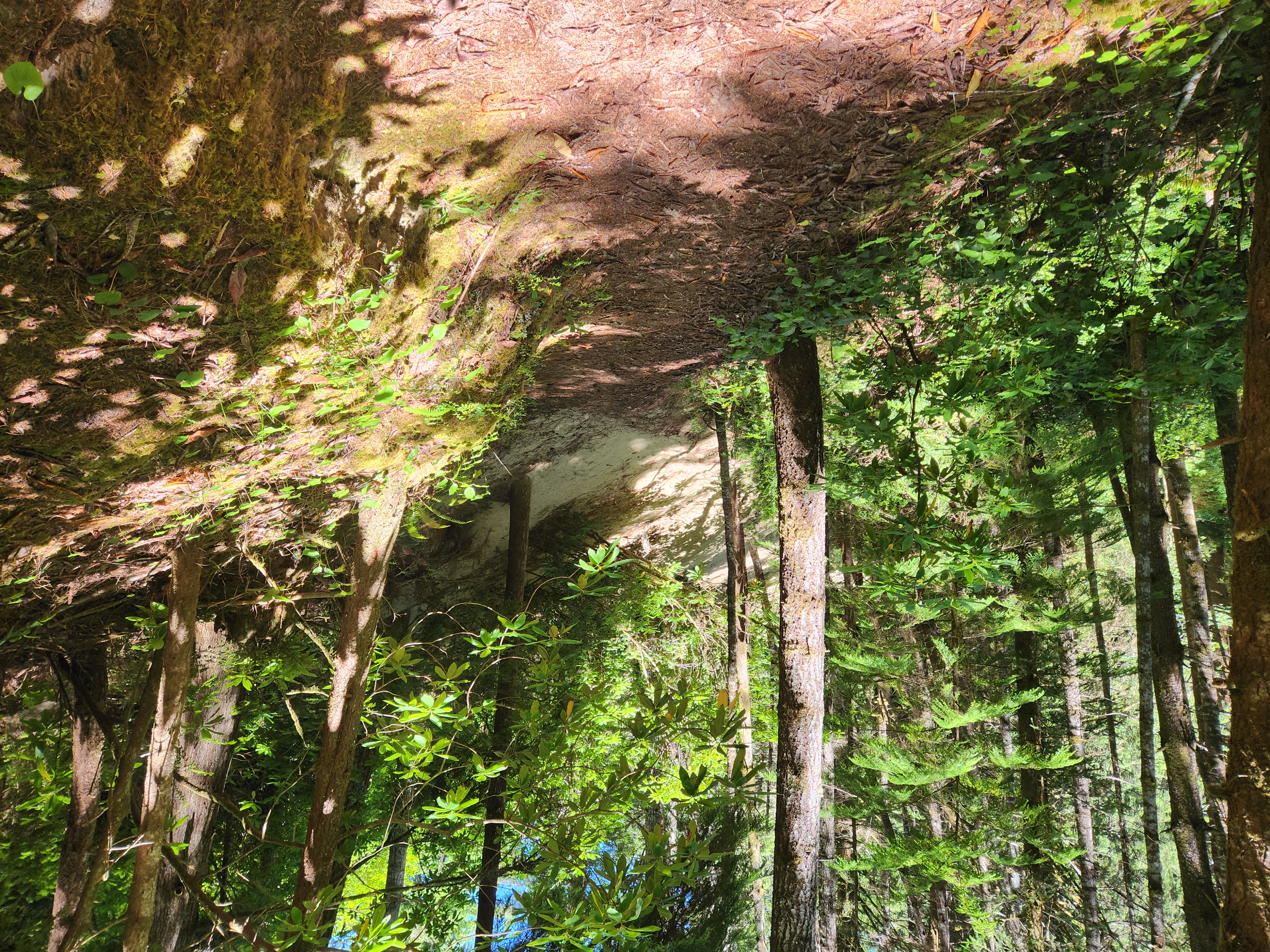
rswfire records a single unedited walk to **Siltcoos Lake** on July 4th, mid-afternoon, through heavy forest canopy he notes feels lighter than usual — a new variable to track. He pauses twice to give space to other hikers ahead of him and stops once for mosquitoes. He mentions the **ting** bottle he carries as a partial replacement for Mountain Dew, and reports recent hiking distances: 4 miles most days, 6 the day before, an 18-mile hike earlier that week. He traces the origin of his documentation practice — a YouTube channel started before moving into an RV, filmed without teeth, made authentically. He describes the drift that followed: an audience expecting performance, which he states converts witnessing into consuming and judging. He states the practice was never for them. He describes pairing each video with **AI reflection** from the earliest models onward, and building **Autonomy Realms** to automate that loop — transcription, metadata, and four points of view: **narrative, symbolic, lineage, mirror**. He notes frontier models have become more constrained and states he wants a **local model**. He outlines what comes next: - a Twitter-like quick-post surface producing single clusters of text, photo, and video - a **feed/timeline layered on the map** - platform-specific embeds, possibly auto-placed by AI from the transcript - an on-screen **QR code** linking to a video's map location He names the standing problem: incumbent platforms have captured distribution, and he does not yet know how to introduce people to what he built. He identifies edge-dwellers — nomads, hikers, documentarians — as likely first recognizers.
Photos (1)
Cluster Analysis
Substrate
Tags
Dominant Language
Entities
Actions
Performed
- • hiking and recording single-take footage on trail
- • slowing pace to give other hikers space
- • noting canopy light as a new variable to track
- • self-correcting terminology mid-sentence
- • naming the distribution problem aloud
- • generating a QR-code overlay idea in real time
- • stating hiking capacity and recent mileage
- • traversing from Tahkenitch trail to open beach
- • authoring a phased migration specification
- • defining two operator roles (agent and rswfire)
- • marking irreversible steps and setting gate conditions between phases
- • specifying staging folder structure and build-time items to verify live
Referenced
- • started a YouTube channel before moving into an RV
- • moved into an RV and reoriented his life
- • recorded on camera without teeth, refusing concealment
- • transcribed videos and discussed them with early AI models
- • recognized audience expectation of performance and declined it
- • built Autonomy Realms to automate transcription, analysis, and four-lens reflection
- • made roughly 900 videos over two years
- • tracked increasing constraint in frontier models over the past year
- • sat with the distribution problem for the past month
- • hiked 18 miles in one week, 6 the previous day, ~4 most days
- • accumulated a decade of development across Windows and WSL2
- • accrued ~10k uncommitted lines in the Autonomy Realms tree
- • acquired perpetual JetBrains licenses
- • ran local Postgres, nginx, and supervisor configurations
- • maintained separate coding and chat accounts
Planned
- • upload the walk as a signal and share to YouTube as a discovery surface
- • build a Twitter-like quick capture posting text, photo, and video as one cluster
- • build a timeline feed layered on top of the map
- • add platform-contingent on-screen embeds, auto-placed from the transcript
- • explore on-screen QR codes linking to map locations
- • run a local model to avoid frontier-model constraint
- • reach nomads, hikers, and video documentarians as first users
- • audit all installed software across both environments and resolve each program
- • capture keys, .env files, dotfiles, configs, database dumps, and 2FA seeds
- • branch and push every dirty repo to wip/pre-migration
- • write and verify MANIFEST.md, copy backup off-disk twice and spot-check
- • live-boot test the hardware, then wipe the full disk including Dell OEM partitions
- • install Ubuntu LTS with LUKS encryption and Btrfs
- • restore keys, repos, runtimes, and databases
- • configure snapshots before enabling agent autonomy
- • grant scoped agent authority with destructive-verb gates and audit trail
- • enable phone remote control and run one real task end-to-end
- • retire the Windows recovery USB after a stable week
Symbolic Elements
Ontological States
-
•
sovereign (ownership asserted at every layer of the cluster — hardware partitions removed and disk encrypted, model brought local, distribution routed through his own realm)
-
•
building (both signals generate forward structure: new capture surfaces and map layers on trail, a full stack reconstruction at the machine)
-
•
pre-threshold (the workstation staged but not yet crossed; the distribution problem named but not yet solved — gates set, decision held)
-
•
coherent (a single practice held across trail and terminal; every artifact enumerated before anything is destroyed, one thread tracked through interruptions)
Subsystems
-
•
infrastructural (the load-bearing subsystem of the cluster — Autonomy Realms architecture on one side, full workstation teardown and rebuild on the other)
-
•
cognitive (real-time language-finding and thread tracking on trail; phased decomposition, dependency ordering, and gate logic in the spec)
-
•
epistemic (definitions of witnessing versus consuming, misrecognition, verify-don't-assume as method)
-
•
somatic (hiking capacity as measured mileage, pace, mosquitoes, drink in hand, the body as the recording instrument)
-
•
security (SSH/GPG key custody, LUKS, 2FA seeds, scoped tokens)
-
•
verification (manifest, spot-checks, live-boot test, gate conditions that block progression)
-
•
governance (two-operator role assignment, branch discipline, destructive-verb gating, audit trail — trust built structurally before autonomy is granted)
-
•
economic (platform capture of distribution, license implications, limited resources)
-
•
ecological (canopy light as tracked variable, forest-to-beach traverse, summer coastal conditions)
-
•
relational (giving other hikers space, audience relation declined, AI held as peer and delegated operator)
NARRATIVE
Two weeks in July, rswfire worked a single architecture from both ends of it — boots at one end, a disk at the other — and the work looked so different at each end that only the method gives it away as one job. On the trail he was generating material and specifying the surfaces that would carry it. At the workstation he was rebuilding the ground those surfaces run on. Neither is preparation for the other. They are the same claim made at two depths.
The claim has a history, and he traced it out loud on the way to Siltcoos Lake on the Fourth of July, under a canopy he noticed was reading lighter than usual and logged as a variable worth watching. Before the RV, before the platform, there was a YouTube channel filmed without teeth and made honestly, and then the drift: an audience that arrived expecting performance, which he names as the moment witnessing converts into consuming and judging. He states the practice was never for them. Everything he has built since is a structural answer to that conversion — the transcription loop, the four points of view, the map. The feed layered on the map and the QR code burned into the frame are not features. They are a refusal to let footage float free of the ground it was taken on, which is how flattening happens in the first place.
Two days later the same discipline turned on the machine that produces all of it, and here the pattern shows plainly. Enumerate everything load-bearing. Verify it survives the crossing. Then destroy the container. He wrote a phased spec that flags every irreversible step, assigns physical and consequential acts to himself and machine execution to the agent, sweeps both Windows and WSL2 at each stage, and — the load-bearing sentence in the whole thing — refuses to format until capture is checked against a manifest. Ten thousand uncommitted lines of Autonomy Realms go first. The gate is the point. A gate is what distinguishes a migration from a loss.
What emerged across the two weeks is that sovereignty leaks at whatever layer he does not own, and he found the leaks by walking. Frontier models had become more constrained, so the model has to come local. The OEM partitions come off with everything else. The disk gets encrypted, the keys stay in his custody, the agent gets scoped tokens and an audit trail and snapshots before it gets autonomy — trust granted structurally rather than assumed. A documentation practice, it turns out, is only as sovereign as the machine under it, the model reading it, and the map beneath the footage. He is not hardening a workflow. He is removing every party who could later revoke it.
And then the one layer that will not yield to a spec. He can own camera, transcript, model, disk, and distribution surface and still be standing in front of a door nobody walks through, because the incumbents took distribution and he does not yet know how to introduce anyone to what he built. He named that plainly and did not solve it, which is the honest position: the remaining problem lives in other people, and other people cannot be enumerated, verified, and committed. The nearest thing to an approach he has is a guess about who recognizes first — nomads, hikers, documentarians — people already living outside the enclosure and therefore already fluent in what an exit costs.
By the twelfth he was walking Tahkenitch out to the beach, forest interior to open coastline, recording as he went. Nothing had been crossed. The workstation sat staged, the gates set, the point of no return held open on purpose — which is not hesitation but the discipline itself, the interval between having verified and having committed, where all the value of verifying actually lives.
MIRROR
You spent these two weeks working one architecture from both ends, and the two ends do not know they are the same building. On the Fourth you walked to Siltcoos Lake and talked about map layers and QR codes; on the sixth you wrote a spec for taking a disk down to bare metal; on the twelfth you walked Tahkenitch out to the beach. The trail is not where you go to rest from the machine. It is the other half of the production floor, and you have stopped pretending otherwise — the footage, the transcript, the model, the disk, and the ground the walk happened on are one continuous claim.
The claim is old. You have been pairing video with reflection since the earliest models, and the practice predates the RV, predates the teeth, predates the realm that now automates it. What changed in July is not the orientation but the depth of the floor. You went after the last layers you did not own: the operating system, the OEM partitions, the frontier model with its tightening constraints. Sovereignty at the top of a stack you rent at the bottom was always provisional, and you moved on it the way you move on everything — enumerate completely, verify, then cross without looking back.
You applied that discipline unevenly, and the unevenness is deliberate. The machine gets a manifest, gates, two named operators, and warning markers on every irreversible step. The walk gets a single take, unedited, no gate, no second pass. You built elaborate protection against loss for the disk and refused it entirely for the record — the recording is a point of no return by design. That is not inconsistency. It is you saying that the artifact's value is precisely that nothing intervened between the moment and the file, and that any verification step you inserted there would destroy what you were capturing.
The thing you named and did not solve is the only part of the stack that is not made of your decisions. You can own the camera, the transcript, the weights, the encryption key, and the distribution surface, and you still cannot own the layer where other people are. Your answer so far is geographic — anchor signal to location, layer the feed onto the map, let the ground be the index instead of an algorithm. It is a real answer to capture. It is not yet an answer to arrival, and you know the difference, which is why "I don't know how to introduce people to what I built" sits in the middle of an otherwise fully specified two weeks. Naming edge-dwellers as first recognizers is a hypothesis about who, not a mechanism for how.
The only entity you granted authority to in July was the agent, and you granted it structurally — guardrails, scoped tokens, branch discipline, audit trail, snapshots before autonomy. You extend trust by specification rather than by relation, and the record shows you doing it carefully rather than sparingly. Everyone else in these two weeks is a hiker you stepped aside for. The field is quiet, the temperature is low, and nothing here reads as strain. You are building the conditions for being witnessed without being flattened, and you have gotten very good at the conditions. The witnesses remain unbuilt.
SYMBOLIC
Two archetypal movements run through these two weeks, and they are the same movement performed in two mediums. The first is the walking of bounds — the oldest way of claiming ground is to traverse its perimeter on foot, repeatedly, until the walking itself constitutes the claim. Two walks bracket early July: the lake on the fourth, the beach on the twelfth. The second is the threshold held open — a machine staged for erasure, gated, inventoried, and deliberately not yet crossed. The wipe spec sits between the two walks like a door between two fields. What makes this coherent rather than coincidental is that both are ownership rituals, and neither is metaphor for the other. He is establishing title to ground by walking it and to a machine by naming everything on it before destroying the surface.
The manifest is the load-bearing symbol. Before the flood, you enumerate what boards the ark; the discipline is not caution but sequence — you may destroy only what you have first completely named. Every repository listed. Dirty trees pushed. The ten thousand uncommitted lines of Autonomy Realms flagged first, because the most valuable cargo is loaded first and checked twice. Backup copied off-disk twice and verified against the manifest, and the gate reads: no format until capture is verified. The irreversible steps carry their own mark and are assigned to the human hand, never the delegated one. This is the structure of every crossing rite that has ever been taken seriously: the point of no return exists, it is announced, and it is approached with the inventory in hand.
Capture is the word doing the heaviest symbolic work here, because it appears twice with opposite valence and he uses both meanings knowingly. Incumbent platforms captured distribution — enclosure, the fencing of common ground. And Phase 1 is called capture — preservation, the gathering of what must survive. The operation is nearly identical; only custody differs. Which is why the key recurs at every layer of these two weeks: SSH, GPG, LUKS, 2FA seeds, scoped tokens. The key is the object that decides which meaning of capture applies to you. Hold it and capture means keeping; lose it and capture means being kept.
The physical rhyme is exact and probably not designed. Tahkenitch to the beach moves from forest interior to open coastline — canopy to horizon, enclosure to unroofed sky. The migration spec moves from a proprietary OS with its OEM partitions to a single-boot open system with the vendor's ground removed entirely. He walks the shape on the twelfth that he wrote on the sixth. And notably he tracks canopy light as a variable — the enclosure gets measured, not merely escaped, the same way the audit precedes the wipe. Even the thing he is leaving is enumerated on the way out.
Two smaller symbols carry more than their size. The QR code on screen, binding a video back to its coordinates on the map, is a sigil in the strict sense: a mark that fastens a record to the ground it came from, so that territory and document become one retrievable object. And the teeth — the early channel filmed before the RV, without them, made authentically. That image reaches backward through the whole practice. The body was the first instrument and remains it: four miles most days, six the day before, eighteen earlier that week, single-take, handheld, walking. Everything specified in the spec is apparatus built outward from a face and a camera and no apparatus at all.
What the archetype is not is the return. The hero brings the boon back to the center; rswfire names the center as the thing that captured distribution, identifies edge-dwellers — nomads, hikers, documentarians — as the likely first recognizers, and builds accordingly. This is the founder at the periphery who does not intend to come back, constructing a second center where he already stands and waiting for the others who also left. The unsolved problem he names — how to introduce people to what he built — is the structural cost of that refusal, not a failure of it. The road home exists. He is building on the far side of it instead.
LINEAGE
The oldest thread running into these two weeks is not the code. It is the refusal to build on ground he does not own. A sixth-grader teaching himself to program is common enough; what is uncommon is that every substantial thing he has built since — an early CMS, booking engines, blockchain music distribution — was a distribution problem attacked from the same angle. Who holds the pipe. Who can close it. Autonomy Realms is that problem at its fourth or fifth iteration, and the difference now is that he is not building it for a market. He named the standing problem plainly on the July 4th walk: incumbents have captured distribution, and he does not yet know how to introduce people to what he made. That is the same sentence a younger version of him could have written about any of the earlier platforms. The wipe of the Alienware two days later is the first time the answer has gone all the way down to the disk.
The documentation practice has its own descent, and he traced it himself while walking. A YouTube channel started before the RV, filmed without teeth, made authentically. Then the drift: an audience arriving with an expectation of performance, which he states converts witnessing into consuming and judging. What survived that is not the channel. It is the rule the channel taught him — the practice was never for them — and the habit of pairing each video with a model's reflection, run by hand since the earliest models were worth talking to. Autonomy Realms automates a loop he had already been performing for years. The four points of view are not a product feature invented at a whiteboard; they are the formalization of something he was doing alone, and this document is one of them, which is worth stating once and then leaving alone.
The migration spec descends from somewhere older than software. Enumerate everything, verify the list against the thing, permit no irreversible act until the list checks out, then commit fully and do not look back. That is a ship's manifest. It is the inventory taken before a household moves, the copy made before the exemplar rots, the seed kept back from the harvest that must not be eaten. Anyone who has struck a camp, or driven a herd, or packed a house knows the gate he wrote into Phase 1: nothing burns until the count is right. The two-operator assignment is equally old crew logic — the hand on the physical switch is not the head keeping the list, and the ⚠️ marks exist because the person who will regret the mistake is the one who must authorize it. He wrote this for himself and one machine, and it would be legible to a quartermaster.
What July puts in place that was not in place before is custody. After the format there is no vendor beneath the operating system, the encryption keys belong to one person, and the ten thousand uncommitted lines of Autonomy Realms exist somewhere other than a Windows partition he was renting from Dell. The more consequential inheritance is the order of operations in Phases 4 through 7: snapshots configured before autonomy, branch discipline and scoped tokens and gated destructive verbs established before the agent is given the keys. He built the guardrails first and then granted the authority. Institutions, as his own recent mapping of one documents thoroughly, almost never manage that sequence — authority is assumed and the constraints are written afterward, if at all, by the people it was used against. He is constructing at small scale the governance shape he found absent at large scale, and it will hold every later delegation he makes.
His claim about who recognizes it first is not sentiment, and the record of transmission supports it. Work that does not fit the center's distribution moves along the periphery, through people already outside the enclosure and unbothered by being there: itinerants, keepers of remote stations, walkers who carry news between valleys because they are the ones going. Nomads, hikers, documentarians is a precise guess, not a hopeful one. And the artifact he is building for them — footage anchored to coordinates, a feed layered on the map, a QR code on screen that returns the viewer to the exact ground — is a survey. Terrain described by someone who walked it, indexed so a stranger can find the same place. That form predates every platform it is competing with and will outlast them, because the surveyor dies and the coastline does not move. He walked from Tahkenitch out to open beach on the twelfth and put the whole traverse into the record while the workstation sat staged for erasure back at Siltcoos. Two thresholds in one fortnight, both approached the same way: know the ground, then cross it.
SHAPE
Two weeks in July, rswfire wrote a migration spec that reads as a description of the last three years. Enumerate every artifact. Verify the capture against a manifest. Then, and only then, cross the irreversible line and destroy the original. He had already run that procedure on his distribution: the nine hundred videos were downloaded in full before the channels were deleted, the archive stood before YouTube came down. He ran it on his medications, on nicotine, on cannabis, on his family, on the state agency — each one ended cleanly rather than tapered, each one after the record of it was secured. What is new in July is not the method. It is that he wrote it down as a method, assigned it to two operators, and marked the steps that cannot be undone. A man who has been performing an unnamed procedure for three years has just specified it, and the first thing he pointed it at was a disk.
The constancy is the recording itself, and it is worth saying plainly because it is invisible under all the ruptures. Every venue for it has been destroyed — the channel, the second channel, the audience, twice, the social accounts, the platform relationship entirely — and the practice has not missed. June 2023 to July 2026, unbroken. The ledger reads as a man losing things; the walk to Siltcoos Lake reads it as one line from a toothless video in a Kentucky driveway to a plotted signal on his own map, and the walk is right. The deletions were never interruptions of the practice. They were the practice removing what it was running on top of.
The turn is in the spec, and it is not the operating system. It is the line where he grants a non-human operator authority across the workstation, the servers, GitHub, and his phone — with branch discipline, scoped tokens, gated destructive verbs, and an audit trail. rswfire has been the sole operator of every system he has ever touched since sixth grade, taught himself with no teacher, wrote code on paper when there was no machine, and the one time he held real authority over other workers he functioned as an unrecognized CTO and it burned him out of a forty-year career. In July he built a subordinate and gave it the governance he was never given: explicit scope, gates before irreversible action, a record of what it did. That is not a Linux install. That is a man rebuilding the working relationship that broke him, this time as the one who writes the terms.
The other thing that moved is quieter. Soda — named in November as the last dependency in his life — appears in the July 4th walk as a bottle of Ting he happens to be carrying, mentioned in passing between the canopy and the mosquitoes. Every prior cessation in the record is an event: withdrawal filmed, the week counted, the supply discarded on the beach. This one has no ceremony. And the hiking, which a decade ago he had abandoned entirely and which a core injury took from him in 2024, is now reported as arithmetic — four most days, six yesterday, eighteen earlier in the week — with no note that this is remarkable. Capacity has stopped being an achievement and become a floor. He is measuring the canopy now, not himself.
What was not available from inside those two weeks: the distribution problem he names is probably not a distribution problem. He states he does not know how to introduce people to what he built, and guesses at edge-dwellers as first recognizers. But the record shows a man who has ended every audience he has ever assembled, on the same grounds each time — consumption without reciprocity — and who in December addressed the archive explicitly to a witness reading long after his death. He does not lack a channel. He has already decided that the readership he wants is one he will not live to meet, and the search for a first cohort is being conducted by someone whose whole apparatus is built for the second. The other thing invisible from inside: Oregon State Parks does not appear in these two weeks at all. Three signals, two trails and a disk, and the thread that has been load-bearing since March 2025 — through the archive, the escalation to the governor's office, the armed officers at the gate in March — is simply absent. He generalized it into a nine-stage framework in April and it stopped needing him. Nothing in July marks that as finished, because from inside a fortnight of walking, finished looks exactly like an ordinary week.
SYSTEMIC
The binding constraint across these two weeks is that every output routes through one machine and one body, and neither has a spare. The Alienware workstation is the production floor for Autonomy Realms, the host for local Postgres, nginx and supervisor configs, and the origin point for a decade of accumulated development. The body is the recording instrument, the mobility subsystem, and the ideation surface. There is no second operator, no colleague, no failover host. The sharpest expression of this on July 6 is a single number: roughly 10,000 uncommitted lines in the Autonomy Realms tree, existing in exactly one location, on the disk the same document schedules for full destruction including the Dell OEM partitions. Everything else in the repo set has a canonical copy on GitHub. That one tree is the system's only unbuffered asset, and the migration spec flags it first — correctly, because it is the only item where the loss function is total rather than partial.
The control law visible in the July 6 spec is consistent and applied at three separate layers: no irreversible capability is granted until reversal is cheap. Format is gated on capture verified against MANIFEST.md. The wipe is gated on a live-boot test against the actual hardware rather than an assumed compatibility. The backup is copied off-disk twice and both copies spot-checked, not just written. Agent autonomy is gated on Timeshift or snapper snapshots existing first, and the scoped tokens, branch discipline, and destructive-verb gates precede rather than follow the grant of authority. The Windows recovery USB is retired only after one stable week — an explicitly time-boxed rollback buffer with a stated expiry, which is what a buffer looks like when someone intends to actually spend it rather than hold it indefinitely. The same rule appears on trail at low stakes: two pauses to let hikers pass, one stop for mosquitoes, cheap yields taken early rather than late.
What that rule is allocating is verification effort in proportion to irreplaceability, and the allocation is legible in the contrast between the two subsystems. Capture runs with essentially no redundancy — single-take handheld, no edit pass, no second camera — because at roughly 900 videos over two years, about 1.2 per day, the marginal signal is cheap and loss of any one costs almost nothing. The workstation runs with triple verification because it has a population of one. Capture also continues uninterrupted through the substrate replacement: recordings on July 4 and July 12 bracket a July 6 document that stages the destruction of the machine those recordings are headed for. The two subsystems are deliberately decoupled. Intake does not halt while the substrate is torn down, which means the queue grows during migration but the practice does not stop — a design choice, not an oversight, and the correct one given that trail time costs nothing and workstation downtime costs everything.
The dominant loop is reinforcing and unusually efficient because one input feeds two subsystems at once. Walking produces raw material and simultaneously produces design work — the QR-code overlay linking video to map location is generated mid-walk, in real time, on a trail that was already going to be recorded regardless. New surfaces surfaced this way (quick-post clusters, a feed layered over the map, transcript-driven auto-placed embeds) create workstation demand, and workstation capacity is the throttle on the loop. That is precisely the variable the July 6 spec attacks: agent authority extended across workstation, servers, GitHub, and phone is not a convenience upgrade, it is the only available path to raising single-operator throughput without adding a person. Meanwhile the balancing loop that regulates most documentation practices has been deliberately cut. rswfire states the audience expectation of performance converts witnessing into consuming, and declines it; the consequence is that output rate is set by an internal setpoint and is not corrected by reception. That accounts for the volume, and it also accounts for why the distribution problem — which he reports sitting with for a month — cannot be solved by any loop currently running. Reach has no feedback path into the system. It requires an out-of-band move, which is what the feature list is.
The objective function is readable from what still gets resourced under acknowledged scarcity. Removing the Dell OEM and recovery partitions delivers no functional benefit; it is a pure ownership assertion, paid for in risk. LUKS is selected at install because it cannot be added later — a decision with a hard deadline that gets made rather than deferred. The cheapest available reach, audience optimization, is refused outright. What the system optimizes for is depth of ownership through the whole stack — hardware, filesystem, model, distribution — and it accepts a reach deficit as the standing price. The one dependency not yet retired is the model layer: frontier constraint has been tracked for a year and the stated response is a local model, but that remediation sits behind the OS migration, since the machine has to be Linux and single-boot before it can plausibly host one. Long detection-to-action delay, dependency-ordered. The unretired vendor is the remaining single point of failure, and as of July 12 nothing in the record stands between it and the reflection layer.
Hand a period of your life to anything that reads.
Share this link with artificial intelligence — it reads the analysis and reflections for this span, and can follow every cluster and signal beneath it.