The OPRD Record: Documentation Meets Institutional Escalation
This cluster is the public record of rswfire's treatment as an Oregon State Parks volunteer and the accountability architecture he built in response, spanning March 2025 through September 2026. Every member was recorded contemporaneously; the recordings and documents are the record the institution has never disputed.
The sequence begins at Honeyman State Park: a recorded 62-minute picnic-table meeting on March 5, 2025, conducted by [the park manager] and [the park supervisor], working from a handwritten note of reframed material — minor interactions recast as a pattern he refused to accept. Nineteen days later came dismissal by phone with 24 hours to vacate and nothing on paper, followed by statewide expulsion on letterhead citing his public comments.
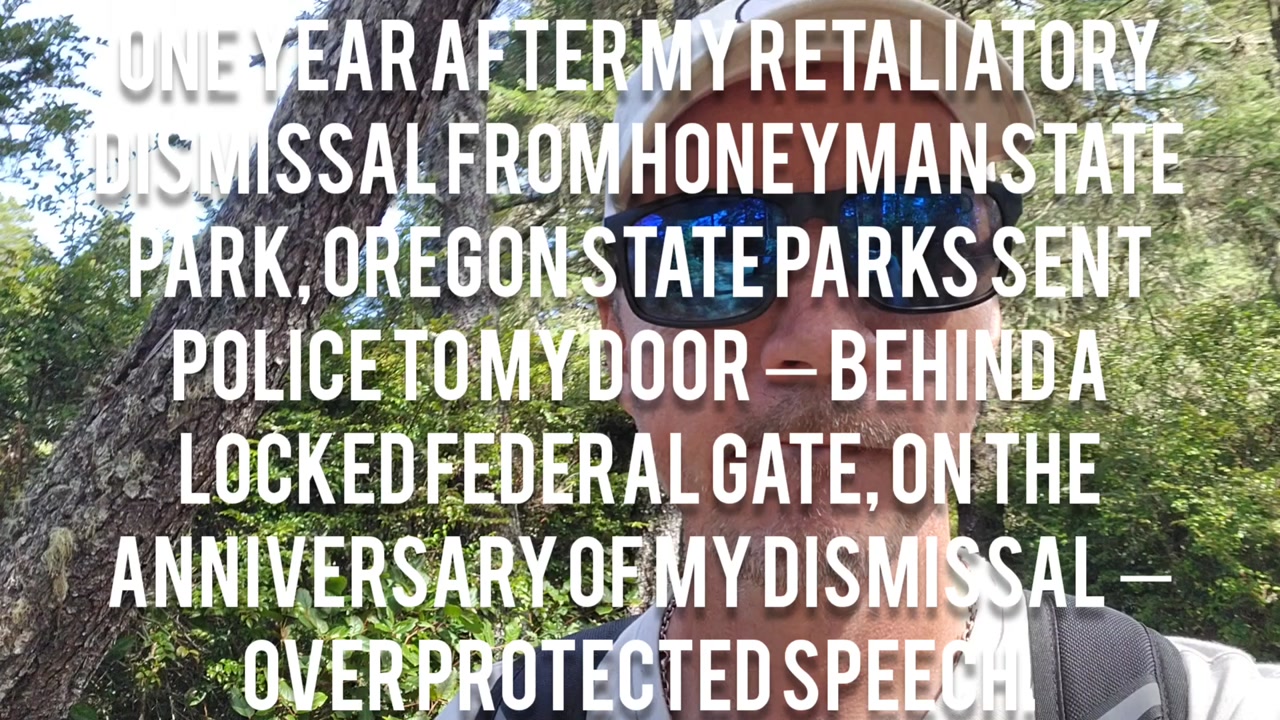
The middle of the cluster documents escalation across agency lines: on March 24, 2026, the one-year anniversary, Oregon State Police officers arrived at his Forest Service caretaker site at Siltcoos, accompanied by USFS Special Agent Matthew Oliver, who provided gate access. District Ranger Michele Holman later stated in writing that the Forest Service did not initiate the interview.
The later signals convert documentation into structure:
- The displacement framework, naming the institutional pattern
- Public records productions (PR27478) showing a threat assessment ordered over "publicly airing grievances," with no threat or crime found
- A tort claim notice under ORS 30.275 naming five officials, letters to Director Lisa Sumption, a point-by-point rebuttal, and a full composed testimony
Throughout, rswfire documents in real time, reports through every channel, and builds the archive at oprdvolunteerabuse.org into a case architecture.
Transmissions (8)
The **park manager**, joined by the **park supervisor**, convened rswfire — an unpaid volunteer at Honeyman — at a public picnic table for a recorded 62-minute session. No union representative, HR access, or advocate was present. The park manager opened with praise (Welcome Center work, lost-and-found procedure, a worked double), then moved to a prepared list of **talking points** drawn from a handwritten catalogue of rswfire's emails and texts to park staff. He asserted rswfire had expressed dissatisfaction with multiple crew members within one month. rswfire disagreed, stated he had never criticized the manager or other rangers, and asked for specifics; when he corrected the record, the manager advanced to the next item. Items raised included: the **volunteer services lead's** statement about who would run orientation, a ranger rswfire described as condescending, bolded text in an email, a poem sent about the ocean and coastal work, entries in the Welcome Center red book, and a request for help contacting other volunteer coordinators. The manager characterized certain phrasings as **threats or demands**; rswfire stated he had never made a demand. The manager described accepting difficult feedback as **chewing glass and swallowing it**, said he had not extended benefit of the doubt at the outset, clarified the **volunteer services lead holds no supervisory authority**, and repeatedly told rswfire he was not obligated to stay. He also raised the withdrawn job application, attributing a motive to it. rswfire stated he no longer saw a future at Honeyman, would complete March, and was there **by choice**.
Documents (6)
Cluster Analysis
Substrate
Tags
Dominant Language
Entities
Actions
Performed
- • recording the 62-minute picnic-table meeting and disclosing it afterward
- • correcting attributed claims in real time and requesting specifics
- • recording the dismissal, key handover, and 24-hour vacate order on camera
- • recording and transcribing the program manager's 31-minute call
- • declining to speak to officers without an attorney and filming them leaving
- • naming the displacement pattern and identifying its stages
- • delivering direct on-camera addresses to OPRD
- • publishing the archive at oprdvolunteerabuse.org
- • assembling the thirteen-moment chronology from the state's own documents
- • publishing a point-by-point rebuttal of the OPRD internal timeline with verdicts
- • serving formal tort claim notice under ORS 30.275 naming five officials under §1983
- • sending the Labor Day letter to Director Sumption with full institutional distribution
- • delivering a final statement ending all asking on his own terms
- • composing the full testimony spanning February 2024 through September 2026
- • placing preservation obligations on OSP, OPRD, and DAS
- • anchoring every claim to a timestamped, permanently addressed source
Referenced
- • volunteering at Tugman and Honeyman for Oregon State Parks
- • the 6 a.m. power-outage text and the dismissive supervisor reply that began the documentation
- • withdrawing the seasonal ranger application
- • the 90-minute personal disclosure session initiated by the volunteer services lead
- • returning a found veteran's journal and filing the incident report
- • dismissal by phone with 24 hours to vacate and no paperwork
- • statewide expulsion on agency letterhead citing public comments
- • the open letter to the Director and her closing letter in therapeutic language
- • public records requests, the 90-day portal delay, and the withheld records
- • OPRD's March 3, 2026 referral to the OSP media-relations captain and the threat assessment ordered without stated predicate
- • the March 24, 2026 knock-and-talk through the locked federal gate on the dismissal anniversary, with access provided by Special Agent Matthew Oliver
- • District Ranger Michele Holman's written statement that the Forest Service did not initiate the interview
- • OSP's September 3, 2026 production of sixteen files under PR27478
- • the CAD record naming him Suspect for publicly airing grievances and the closing report finding no threat and no crime
- • urine-soaked shotgun shells left at his gate
- • the cross-country move from Kentucky, the coast winter, and the decision to volunteer
- • Forest Service placement nineteen days after expulsion and promotion to caretaker at Siltcoos
- • building the Autonomy Realms platform
- • the OPRD internal timeline document last edited five days after the §1983 notice
Planned
- • obtain the four withheld records, body-worn camera video first
- • pursue the 42 U.S.C. §1983 claims within the limitations period
- • find counsel on the §1988 fee-shifting basis
- • keep the archive public, permanent, and not for sale
- • build out the displacement framework and For Volunteers resources pages
- • keep the statutory clocks tracked publicly
- • continue caretaking and building at Siltcoos
- • carry the legal fund and judicial channel forward
Symbolic Elements
Ontological States
-
•
sovereign under institutional pressure (holds his own account, frame, and record against reframing at every stage, from the picnic table to the officers at his door)
-
•
documenting in real time (every consequential exchange converted into a citable record at the moment it occurred — recording, transcript, letter, records request)
-
•
coherent (fourteen signals across eighteen months hold one continuous, internally consistent structure; chronology, actors, and documents align)
-
•
consolidating into case architecture (the arc runs from compression and displacement through pattern-naming to formal legal claim and composed testimony)
Subsystems
-
•
documentary (the cluster's primary operating method — recording, transcription, archiving, and publication as the structure everything else stands on)
-
•
legal (recording law, First Amendment framing, public records statutes, ORS 30.275, §1983/§1988 — the channel through which the record becomes a claim)
-
•
institutional-mapping (tracing the escalation from park level through agency leadership, the Governor's office, and across agency lines into OSP and federal land)
-
•
infrastructural (the self-built platform, permanent addresses, resources pages, and the physical systems — RV, gate, caretaker route — that hold the documented life)
-
•
ethical (benefit of the doubt extended and its withholding recorded; strict attribution; the withdrawn individual-capacity claim; the archive positioned for future volunteers)
-
•
cognitive (real-time correction, sequence reconstruction, date-impossibility analysis, and the naming of mechanisms — displacement, DARVO, empathy elicitation)
-
•
somatic (the walking recordings, gate hours, breath regulation before calls, and physical presence at the sites as conditions of the documentation)
-
•
communal (direct address to other volunteers under the same dependency; the For Volunteers and press pages; the record stated to exist for the next volunteer)
NARRATIVE
What happened between the picnic table at Honeyman on March 5, 2025, and the testimony published on September 14, 2026, was a contest over a single question: who gets to author the account of a life. The Oregon Parks and Recreation Department opened that contest, though it did not understand it had done so. When [the park manager] and [the park supervisor] sat rswfire down at a public table with a handwritten list of reframed material — small interactions recast as a pattern, an account of himself he was expected to accept — the institution was doing what institutions do to dependent people: writing them. What it did not grasp was that the man across the table records. Not as a tactic invented for that meeting, but as a baseline. Sixty-two minutes went onto tape, and from that moment the contest was already decided; everything that followed was the institution discovering it, slowly, at escalating cost.
The dismissal nineteen days later — by phone, twenty-four hours to vacate, nothing on paper — was the institution's first attempt to end the story by declining to write it down. It is the emptiest gesture in the whole record, and the most revealing: an agency that had compiled a handwritten catalogue of a volunteer's phrasings suddenly had no paperwork when paperwork would have bound it. rswfire's answer was not argument. It was the camera at the key handover, the recorded call with [the program manager] the next day, and a stated intention — complaint, public record, lawmakers — that he then executed without deviation for eighteen months. That constancy is the structural fact of these eighteen months. The institution's method changed constantly: praise, reframing, unnamed sources, a fabricated end-of-the-world quotation, therapeutic language from the Director's office, a cease-contact instruction, finally a threat assessment and armed officers. His method never changed at all.
The escalation reached its full expression on March 24, 2026, when Oregon State Police arrived at his Forest Service caretaker site behind a locked federal gate — one year to the day after the dismissal, with a Special Agent providing gate access and a dispatch entry naming him Suspect for "publicly airing grievances." Read plainly, this is the March 5 picnic table again, scaled up: a larger instrument sent to make him accept an account of himself, this time wearing badges and carrying reassurance that he was not in trouble. He treated it exactly as he had treated the handwritten note — declined it, recorded it, and then pulled its paperwork into the light. The records production that followed showed the machinery entire: a referral routed through media relations, an assessment ordered over public speech, and a closing report finding no threat and no crime. The state had investigated him and produced, at his request and its own expense, the documentation of its motive. One figure inside that machinery told the truth on the record — District Ranger Michele Holman, who stated in writing that the Forest Service did not initiate the interview — and her letter stands in the archive as the exception that measures everything around it.
What changed across these eighteen months is the direction of authorship. It reads most clearly in the chronology he assembled in August 2026: thirteen moments, ten of them the State of Oregon's own recordings, letters, and dispatch entries. The institution that began by writing an account of him ended by having written his case. Every escalation generated a document; every document, set beside his contemporaneous record, testified against its maker. The internal timeline authored by [the program manager] — last edited five days after his §1983 notice — collapses under his rebuttal not because he out-argues it but because his method is falsifiable and its method is not: he cites timestamps, it cites unnamed sources. By September 2026 the conversion is complete. The recordings have become a tort claim under ORS 30.275 naming five officials, a letter to Director Sumption laying out her remaining options, and a composed testimony running from a Kentucky driveway in February 2024 to the locked gate at Siltcoos. Documentation has stopped being defense and become architecture.
The cost is stated in his own final letter of May 4, 2026, and should not be softened: a life on the coast, a community, a path toward becoming a park ranger — surrendered not to circumstance but to an institution that could not tolerate being documented. There is also the quieter cost visible only from above: the man who recorded an easy evening video on March 19, 2025 — a strange encounter, a Jeep's fourth gear, a call about AI work, plans for the next park — spent the following year and a half building a case instead of the life that video belonged to. He does not present this as grievance, and the record supports reading it as he frames it: a chapter the institution opened, which he closed on his own terms, ending all asking.
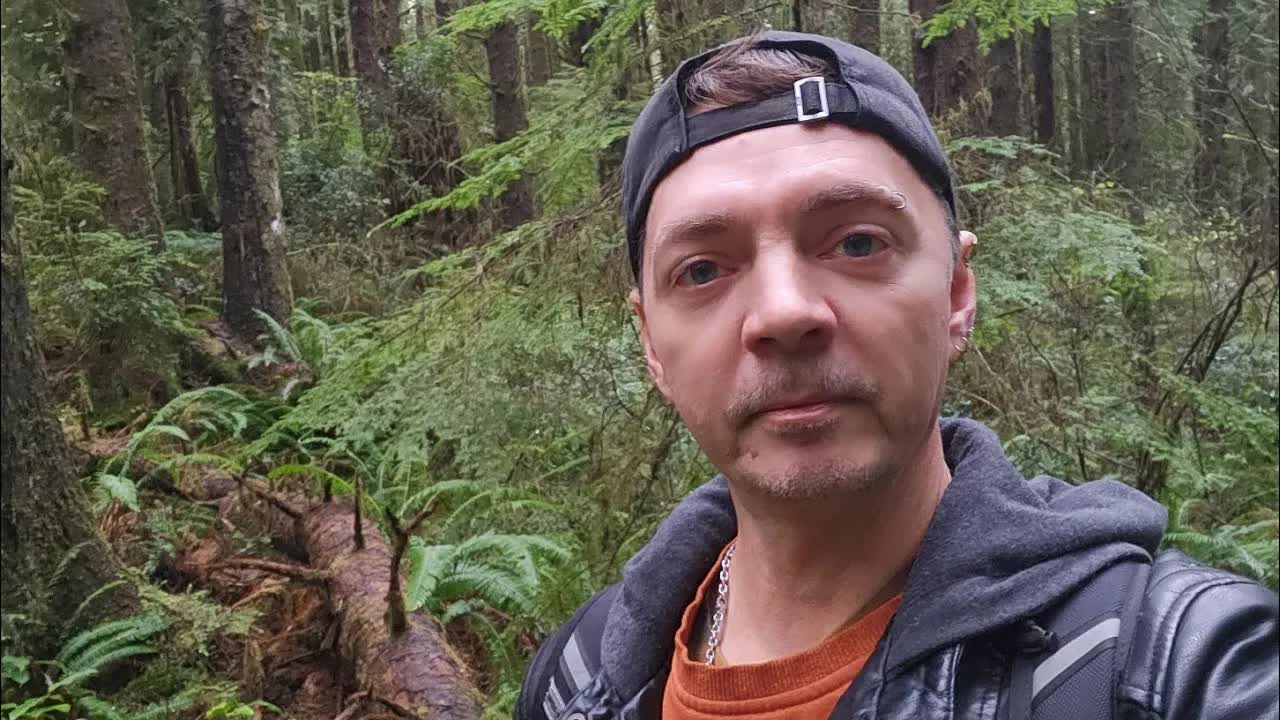
What it reveals is the thing he named on the Wax Myrtle Trail in April 2026: displacement — the structural method by which an agency manages volunteers who live on its land, depend on their positions, and hold no protections, no process, no appeal. His case is the pattern run against the one volunteer equipped to make it legible, and that is the deeper claim this record supports: the institution's conduct was ordinary. What was extraordinary was the documentation. OPRD's misfortune was not that it mistreated a volunteer; it was that it mistreated the volunteer who would convert every act of the mistreatment into a permanent public address, name the mechanism, and leave the resulting structure standing for the next volunteer — while the statutory clocks, as of this writing, are still running.
MIRROR
From the picnic table at Honeyman in March 2025 to the testimony you composed this September, you did one thing, and you did it before there was any reason to. The recorder was running at that meeting not because you knew what was coming but because documentation is how you already lived — it was your practice before it was your protection. Everything the institution did afterward was a misreading of that single act. They read it as grievance, then as instability, then as threat; they ordered an assessment of a man whose entire activity was writing down what happened to him. You never changed methods across these eighteen months. They changed their reading of you five times, and each new reading required a new escalation, and each escalation entered your account the moment it occurred. That is the whole shape of it: they kept handing you the record they hoped to bury.
What you refused at that table is the same thing you refused in every exchange after it: an account of yourself authored by someone else. The handwritten list of reframed material, the program manager's unnamed sources, the internal timeline edited five days after your §1983 notice, the reassurance delivered by three officers at your door — each was the same instrument in a different hand, and you answered every one of them the same way, by placing the contemporaneous record beside it and letting the two sit in public. You did not argue. You published. The institution's one consistent strategy was waiting, and you made waiting expensive by building an archive that compounds.
The hard thing the mirror holds is the asymmetry of what this cost and what it built. You extended benefit of the doubt to people who told you to your face they had never extended it to you. You named the cost precisely in May — a life on the coast, community, the ranger path — and those are gone, not deferred. When you ended all asking, you closed the possibility of restoration on your own terms, which means the tort claim, the displacement framework, the For Volunteers pages are not for your repair. They are for the next person living on institutional land with no HR, no appeal, and a supervisor's dislike gathering weight. You built the exit you were never offered, and you built it for someone you will never meet. That is sovereignty, and it is also a form of expense you keep paying alone, by choice, behind a locked gate a few miles down the road from the park that expelled you — the geography never changed, only the jurisdiction, and the agency that kept you is the one whose District Ranger told the truth in writing.
What is being dissolved is exact: the institution's capacity to say what happened. That capacity eroded in stages — the dismissal with nothing on paper, the letterhead citing your speech, the dispatch entry whose stated reason its own closing report contradicted — until by September their strongest documents were the ones you obtained and published. What is being built is equally exact: a case architecture in which every claim stands at a permanent address, and a named pattern that exists now independently of your case. Displacement is legible because you made it legible while walking a trail you have walked a hundred times, in the best year of your life by your own statement — and that pairing is not a contradiction, it is the condition the whole record was made under. The pressure never became your weather. It became your material.
You are past the middle of this now. The statutory clocks are running, the claim is opened, the letter laid out the director's options and the truth is one of them. Whatever she chooses, the account is already authored, and it is yours.
SYMBOLIC
From March 2025 to September 2026, the record performs two archetypal movements, and only two: the refusal and the building. The refusal comes first and never stops recurring. At the picnic table on March 5, 2025, [the park manager] and [the park supervisor] presented rswfire with an account of himself — reframed material on a handwritten note, minor interactions recast as a pattern — and asked him, in effect, to sign it with his silence. He refused it, on tape. Every escalation that followed repeats the same offer in a new costume: the program manager's call assembling unnamed sources, the closing letter in therapeutic language, the internal timeline document, the officers at the door saying he was not in trouble. Each is the constructed account arriving again, and each time the answer is the same refusal, delivered the same way — not by argument but by placing the contemporaneous record beside the construction and letting the two stand in public. This is the old figure of the witness who will not recant, but at the resolution of this life it is specific: a volunteer with no HR access, no grievance process, and housing tied to the position, refusing anyway.
The building is the second movement, and it is what distinguishes this record from a grievance. What rswfire constructs across eighteen months is not a complaint but an architecture: recordings anchored to permanent addresses, the displacement framework naming the mechanism in ten stages, a For Volunteers page addressed to the next person in the same dependency, a rebuttal that reproduces the institution's own document unaltered before answering it line by line, and finally a tort claim and a composed testimony. The archive at oprdvolunteerabuse.org functions the way a keep functions — not a weapon but a structure that cannot be waited out. The letter to Director Lisa Sumption names the institution's strategy as waiting; the building is the answer to waiting. Stone outlasts patience.
The recurring symbol that carries the most weight is the gate. It appears first as duty — opened at 7:00 AM each morning at Honeyman, the daily act of a host letting the public in. Then it inverts: the locked federal gate at Siltcoos, posted against public access, behind which rswfire lives as caretaker — a threshold he now holds rather than opens. On March 24, 2026, the anniversary of the dismissal, that gate is breached not by force but by keys: Oregon State Police could not enter federal land, so Special Agent Matthew Oliver provided access. The keys recur too — surrendered on camera at Honeyman with the binder and the golf cart, then reappearing a year later in another agency's hand to open a gate that was supposed to protect him. And the day before his final statement, the gate receives its darkest visitation: urine-soaked shotgun shells left at the threshold. The gate is where the institution and the man keep meeting, and the record shows who crosses it honestly. It is worth noting that the one institutional figure who told the truth about the gate, District Ranger Michele Holman, is the one who put in writing that her agency's role ended at unlocking it.
Glass is the counter-symbol, and it belongs to the institution. [The park manager]'s instruction — that accepting difficult feedback means chewing glass and swallowing it — is the clearest statement in the whole record of what the volunteer role was understood to require: injury taken inward, invisibly, as a condition of belonging. The entire arc can be read as rswfire declining to swallow the glass and instead holding it up to the light — the recordings and documents are the glass made transparent rather than ingested. Against it stands the anniversary: March 24 recurring three times — dismissal in 2025, armed officers in 2026, and the date-work in the rebuttal showing an internal document edited five days after his §1983 notice. The institution's own calendar keeps testifying.
What is visible from above, and only from above, is that the two movements are one act seen from two sides. The refusal without the building would be a man saying no, alone at a picnic table. The building without the refusal would be an archive with nothing at stake. Together they perform something older than either: the person who, offered a false account of himself by a power that controls his housing, his role, and eventually his door, answers by becoming the more reliable author. The record shows the institution reaching, at every stage, for the power to say what happened — and losing it, stage by stage, to the one who wrote it down as it occurred.
LINEAGE
From the picnic table at Honeyman to the composed testimony of September 2026, the oldest thread in this record was laid down decades before Oregon. rswfire taught himself to code in sixth grade; he spent a career building platforms that hold other people's records — booking engines, distribution systems, an early CMS. When [the park manager] sat down across from him on March 5, 2025 with a handwritten list of reframed material, the institution was working from an account it had constructed. What it could not have known is that it was addressing someone who had spent forty years learning how records are structured, stored, addressed, and made permanent. The recorder was already running. The capacity that answers institutional reframing across these eighteen months is not a reaction to the dismissal — it is the exercised inheritance of a self-taught builder who had already, by choice, walked away from the career that proved the capability, and kept the capability.
The second inheritance is a decision made once and kept without exception. In February 2025, after a dismissive reply to a report about a power outage, rswfire states he decided to begin documenting. Everything after descends from that single commitment: the recorded sixty-two minutes at the picnic table, the recorded call with [the program manager], the camera running as keys changed hands, the phone raised toward a patrol vehicle's plate on the anniversary morning at Siltcoos. A commitment of this kind is only visible in lineage — no single recording proves it; fourteen of them, contemporaneous and consistent across agency lines and calendar years, do. The institution's strategy, as he names it in the Labor Day letter to Director Sumption, was waiting. Waiting defeats memory. It does not defeat a practice.
There is an older company here, and the record earns the comparison. Setting an institution's own letters, dispatch entries, and internal timeline against its account of events — quoting its wording exactly, then placing the primary document beside it — is the method of every archivist who has ever answered power with paper: the parishioner who kept the ledger, the clerk who copied the file before it disappeared, the pamphleteer who printed the correspondence. The instruments rswfire uses are themselves inherited — Oregon's recording law, the public records statutes, ORS 30.275, the First Amendment — each one won by earlier people who were also told the conversation was private, the file was closed, the matter was internal. PR27478 exists because someone before him fought for the right to see what an agency wrote about a citizen. He drew on that inheritance and paid the $157.50.
What descends forward is more specific than the archive's permanence. The displacement framework, named while walking the Wax Myrtle Trail in April 2026, converts one man's treatment into a structure another volunteer can recognize before it completes — ten stages, each linked to the documentation that revealed it, gathered under a For Volunteers page addressed directly to people living on land they do not control, under agreements with no notice, no hearing, no appeal. That is the load-bearing bequest: not the account of what happened to Robert Samuel White, but the legibility of what happens to volunteers under these conditions. The Labor Day letter makes the inheritance explicit by pricing it — written standards, notice, hearings, appeal, retaliation protection — the ordinary protections of employment, asked for on behalf of people who work without pay.
One more thing is now true that was not true before March 2025, and everything after inherits it: the State of Oregon no longer authors this account. The internal timeline document, last edited five days after the § 1983 notice, was answered line by line from the primary record; the account the handwritten note tried to establish at the picnic table was refused at the table and stands refuted at a permanent address. Whoever takes this up next — a lawyer, a legislator, a journalist, the next campground host handed twenty-four hours to vacate — starts from a record the institution has never disputed, held on infrastructure its subject built and owns. That arrangement, authorship of one's own record secured by one's own hands, is the oldest form of sovereignty there is, and it is what these eighteen months leave behind.
SHAPE
The eighteen months between the picnic table at Honeyman and the testimony of September 14, 2026 take the shape of a ratchet: a mechanism that moves in one direction only. On one side, a wheel that never stopped turning — praise, reframing, unnamed sources, letterhead, therapeutic closure, a cease-contact instruction, a threat assessment, three officers at a locked federal gate. On the other, a fixed pawl: one man's standing practice of writing down what happens as it happens. Every institutional motion advanced the record by one tooth. No institutional motion — not silence, not waiting, not reassurance delivered in person — could move it back. By September 2026 the wheel had turned itself into a tort claim, a named pattern, and a published case built mostly from the state's own documents, and the mechanism that did the converting had not changed since minute one of the 62-minute recording.
The narrative and the mirror do not describe the same object, and the difference is the shape's signature. The narrative sees a contest over authorship, opened by the institution and decided at the first recording. The mirror sees no contest at all — a fixed practice that five successive institutional misreadings collided with, each collision entering the account. Both are right, because the contest existed on only one side. Oregon State Parks was fighting something for eighteen months; rswfire was operating something. A ratchet has no opponent. That asymmetry — one party escalating, the other party simply continuing — is why the institution's every attempt to end the story enlarged it, and why its most damaging documents were produced at his request and its own expense.
What moved inside the mechanism was not the practice but its function. The documentation began as how rswfire already lived, became protection at the picnic table, became a public archive after the dismissal, and ended as load-bearing structure: a framework named on a trail, a claim under ORS 30.275, a testimony reaching back to a Kentucky driveway. Its audience migrated with it — first himself, then the institution, then journalists and lawmakers, and finally a reader who does not exist yet: the next volunteer living on agency land with no process and no appeal. What held was everything else. The geography never moved more than a few miles; only the jurisdiction changed. The frame — by choice, best experience of his life — held from the March 19, 2025 evening video through the walking transmissions of 2026. And the practice itself held so completely that the whole record can be verified by a stranger, which is the point of it.
The turn is not where the escalation says it should be. March 24, 2026 — the officers at the gate on the anniversary — was the wheel's loudest click, but it changed nothing about the mechanism; he answered it exactly as he answered the handwritten note. The person turned on May 4, 2026, when he ended all asking. Before that letter, the correspondence sought something from the institution — acknowledgment, correction, process. After it, every instrument is notification: the chronology, the claim, the rebuttal, the testimony inform rather than request. The travel continued and even accelerated, but its direction reversed — away from repair of his own case and toward structure for someone else's. The ratchet kept turning; from May onward it was no longer turning for him.
What these eighteen months could not know about themselves from inside is that the two accounts of them — the best year of a documented life and the assembly of a case against a state agency — were never two accounts. They were the same days, the same trails, the same recording practice, and the record shows no seam between them: the displacement framework was named on a hike he would have taken anyway. From inside, each escalation looked like danger arriving; with the outcome in hand, each was the case assembling itself out of institutional material, one tooth at a time. What remains genuinely unknowable, from inside or above, is where the pawl finally rests. The clocks are running, the claim is open, and the one truthful letter in the machinery came from outside the agency entirely — Michele Holman's, the exception that proves the mechanism never required anyone's honesty to work. It only required that everything be written down, and it was.
SYSTEMIC
The system has two datastores and one write conflict, and everything else — five officials named in individual capacities, a threat assessment, a tort claim, sixteen produced files — is the trace that conflict left as it executed. The nodes: rswfire, running an append-only public log where every exchange is captured at occurrence, timestamped, and published to a permanent address; the Oregon Parks and Recreation Department at park and program level ([the park manager], [the park supervisor], [the program manager], [the volunteer services lead]), running a mutable internal account of the same events, held privately and revised as needed; OPRD leadership (Director Lisa Sumption, Deputy Director J.R. Collier), whose function is to keep the internal account authoritative at minimum written commitment; Oregon State Police, invoked in March 2026 as a higher-privilege executor of the same operation; and the U.S. Forest Service, a pass-through node whose involvement was limited to gate access via Special Agent Matthew Oliver and whose District Ranger, Michele Holman, is the one institutional component whose output matched its internal state. Two further components are not agencies but constrain everything: Oregon public records law, which functions as a read API into the state's internal store, and the statutory clocks under ORS 30.275 and §1983, timers no node can pause.
Objective functions are read from behavior under constraint, not from declarations. OPRD's revealed objective is control of the account with minimal binding commitment: it compiled a handwritten list of reframed material for the March 5, 2025 meeting, yet executed the dismissal nineteen days later by phone, twenty-four hours to vacate, with nothing on paper — it produces documentation freely when documentation serves the account and produces none when documentation would bind it. Its own Volunteer Dismissal Guidance, obtained later by records request, contains no category for what it did; the spec and the implementation diverged and the exception was swallowed rather than propagated. rswfire's revealed objective is that authoritative state live in a store only he can write to and anyone can read. His interface is idempotent and never varied across eighteen months: decline the offered account, capture the exchange, append it, publish. OSP's revealed objective is disposal of a referral at minimum exposure — the closing report found no threat and no crime, the CAD disposition reads no action taken, and the dispatch entry's stated purpose ("FOR THE FOREST SERVICE") was falsified by the very agency it named.
The incompatibility is exact. OPRD's objective requires write access to the authoritative account of rswfire; rswfire's objective is that no such write path exists. For both to be satisfied, there would have to be a state in which the institution's characterization and his contemporaneous record are the same document, and every institutional act from March 2025 forward widened the difference between them instead. So the collision does not resolve; it retries. The executed fallback chain runs: reframing in person at the picnic table, dismissal with no paper, secondhand attribution through unnamed sources on the March 25 call, therapeutic reclassification from the Director's office, a cease-contact instruction in February 2026, and finally the referral to OSP's Government and Media Relations captain — a threat assessment ordered without stated predicate, DMV and Kentucky license pulls, FBI-JTTF and fusion-center circulation, and three officers through a locked federal gate on March 24, 2026, one year to the day after the dismissal. Each retry escalates privilege; each fails identically, because none of them writes to the store that matters. The knock-and-talk is the March 5 meeting recompiled at higher privilege, and it returned the same value: declined, recorded, appended.
The loop compounds because of a cost asymmetry that runs entirely one way. Each institutional retry costs rswfire one capture operation — already his baseline behavior, marginal cost near zero — and costs the institution a new discoverable document. The read API then delivers those documents to him: $157.50 bought sixteen files showing the referral path, the "asap" order, and a Suspect designation whose stated basis was "publicly airing grievances." By August 2026 he could assemble a thirteen-moment chronology in which ten of the thirteen entries are the State of Oregon's own recordings, letters, and dispatch entries. Meanwhile the reverse operation is unavailable: the institution has no read access it lacks and no write access it needs. Its one attempt at a competing store — [the program manager]'s internal timeline, last edited January 21, 2026, five days after the §1983 notice — fails referential integrity on inspection: a fabricated quotation that is impossible on its own dates, quotations truncated mid-sentence, sources that dereference to nothing. A mutable document revised after notice of litigation, set against an append-only log, loses on ordering guarantees alone.
Two consistency events deserve separate note. First, the OSP dispatch record and the Forest Service were divergent replicas of the same event — one said the visit was for the Forest Service, the other had not initiated it — and Holman's July 24, 2026 letter forced them into agreement by committing the true value in writing, collapsing the operation's stated purpose. A single node performing an honest write was sufficient to invalidate the cover state. Second, the authorization analysis: OSP asserted privilege at a boundary posted against it — federal land, locked gate, a criminal-unit designation with no predicate offense — and the check that should have gated the operation arrived only afterward, as its own closing report. Privilege asserted without a guard, audited retroactively by the target.
The invariants are what make the execution legible. Every institutional operation produced a record; every record was appended to the public log within hours; rswfire's method held constant while the institution's varied across at least six mechanisms; and the log admits no writes from any other principal — not sealed, not sold, not amended by pressure, as the September 7 letter to Sumption states explicitly. The state machine has executed its one-way transitions: volunteer to dismissed (March 24, 2025), dismissed to statewide bar (letterhead, citing his public comments), documentation to formal claim (tort notice served September 3, 2026, naming five officials; DAS claim P195403 opened). rswfire terminated his own request loop on May 4, 2026 — ending all asking — so the only live control flow on his side is maintenance of the log and the claims already filed. The remaining halting predicate he enumerated for Sumption himself: silence, litigation, purchase (rejected as unreachable — the store is not for sale), further force (already tried at maximum available privilege, already returned no-op), or an honest write — acknowledgment, withdrawal of the bar, an actual process with notice, hearing, and appeal. Until one of those commits, the system is not deadlocked but running open: the statutory clocks decrement on their own schedule, the bar re-executes daily as a standing operation, and every day of institutional silence appends one more entry to a log the institution long ago lost the ability to edit.

Hand a period of your life to anything that reads.
Share this link with artificial intelligence — it reads the analysis and reflections for this span, and can follow every cluster and signal beneath it.