Not signed in
Claim Your Realm Start for free
Atlas Stream
Showing 1 - 24 of 52 signals
Image unavailable
00:36

Introducing Development Services on Upwork

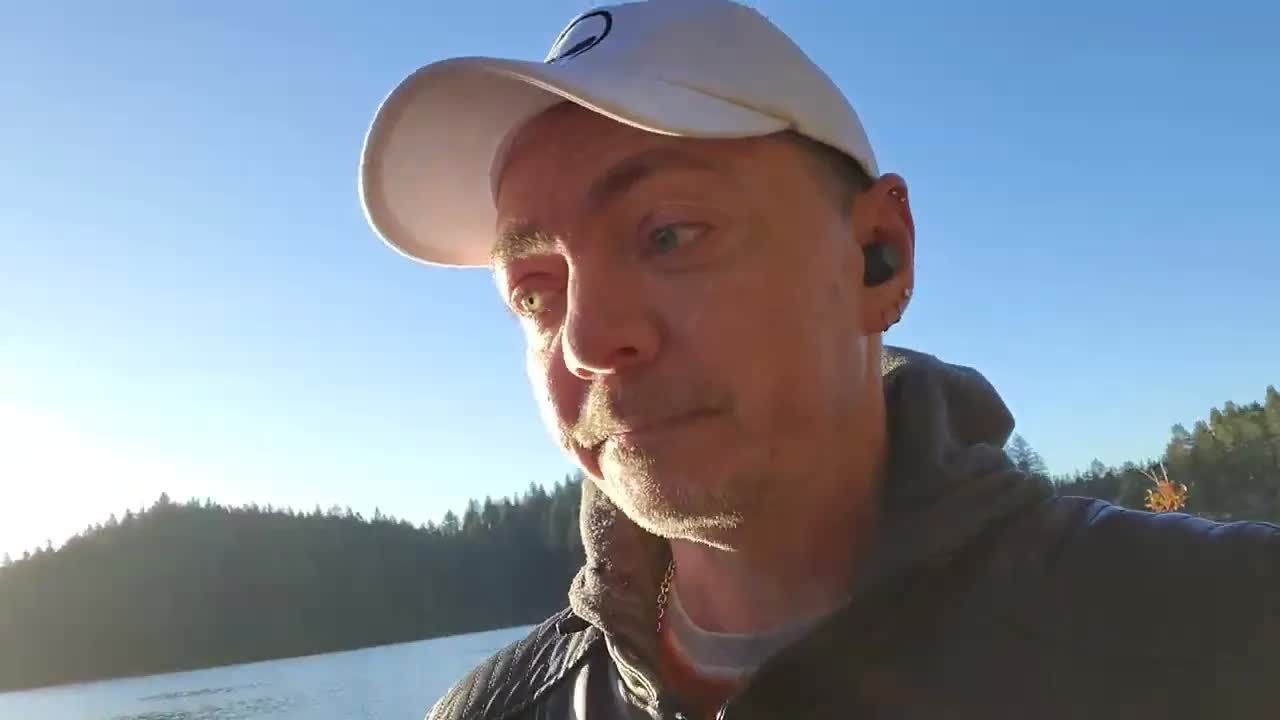
rswfire records a video introduction for Upwork, positioning himself as a developer while standing on the edge of a lake near the Oregon coast. He identifies himself as Sam, mentions living and working with Oregon state parks, and presents his programming credentials. He describes his programming background starting from sixth grade, emphasizing it came naturally to him and has been a lifelong pursuit. He references early experiences programming on paper and running code mentally when computers weren't available during high school and early adulthood. He concludes by asserting comprehensive technical capability and inviting discussion.

Jan 24, 2025 | Oregon State Parks > Tugman · 31% match
Journey
Image unavailable
01:30

Demonstrating ChatGPT for Exercise Planning

The speaker records a brief video from their camper, adjusting red lights to blue for a more natural appearance. They introduce a suggestion for using ChatGPT as a fitness tool, explaining how the AI can suggest exercises, create schedules, and generate spreadsheet templates. The speaker mentions they didn't learn much about exercise and stretching as a child but have maintained interest in pursuing fitness seriously. They reference screenshots they plan to attach and mention a chat they won't share directly. The transmission is interrupted by someone or something named Bailey.

Jun 2, 2024 | (Null Island) · 30% match
Journey
Image unavailable
03:58

Applying Programming Skills to Life Management

The speaker describes experiencing withdrawal symptoms and anxiety while adapting to a committed lifestyle change. He mentions needing to pick up groceries and taking medication (clownin) as a precaution against panic attacks. After struggling with his current situation, he consulted Claude AI for help creating a plan to better manage his circumstances. Claude suggested using his programming experience as an analogy for lifestyle management, which the speaker found transformative. He describes this approach as "cognitive reframing" - applying existing skills in a different context. The speaker is implementing this by creating a Jira project (software development tool) to manage his life, with separate projects for different aspects like learning to cook. He explains that this visual, task-based approach helps him track progress on learning new skills and managing recurring tasks like weekly grocery shopping. The speaker views this method as a way to bridge the gap between his previous virtual life and the physical world he had previously ignored.

Jul 11, 2024 | (Null Island) · 30% match
Journey
Image unavailable
02:48

Recording Service Introduction Video for Upwork

Sam records a video introduction for potential clients on Upwork. He describes his current situation: 48 years old, living in an RV on the Oregon coast for two years, volunteering as a camp host for the US Forest Service and soon transitioning to a caretaker role in the Oregon Dunes. He outlines his programming background spanning decades, starting with GW Basic in sixth grade and progressing through Pascal, C, C++, Java, and PHP. He emphasizes his backend development expertise while noting he can create professional frontends. Sam describes himself as systems-oriented, pattern-focused, and detail-oriented, with capabilities in data work, networking, server building, and AI. He explicitly states he's not looking for work that will consume his life and seeks aligned projects with clients who need intelligent, systems-thinking support.

Sep 20, 2025 | (Null Island) · 29% match
Journey
Image unavailable
03:19

Setting Up Upwork Profile for Freelance Transition

rswfire documents the process of creating an Upwork freelance profile after paying for membership. He describes using his own shower for the first time after cleaning it, then focuses on profile setup tasks. He shares existing statistics showing $4,000 in earnings from a previous 10-year employment relationship and reads a review he wrote for himself in April 2023 when initially attempting to join Upwork. The review describes his technical skills, project management experience, and role managing other developers. He outlines the challenge of having worked with only two clients over 20 years, making testimonials difficult to obtain since he hasn't contacted the first client in 5-7 years. He considers adding Park Service volunteering experience to his employment history and discusses various profile sections including portfolio, skills, and a new project catalog feature with fixed pricing. He notes Laravel developer opportunities on the platform and expresses intent to focus on AI field work while ensuring freelance work complements rather than dominates his life. Current profile title includes full stack developer, project manager, Laravel, Symphony, and VJs, with plans to add AI-related terms.

Jan 12, 2025 | Oregon State Parks > Tugman · 29% match
Journey
Image unavailable
16:08

Programming Career History and Freelance Reviews

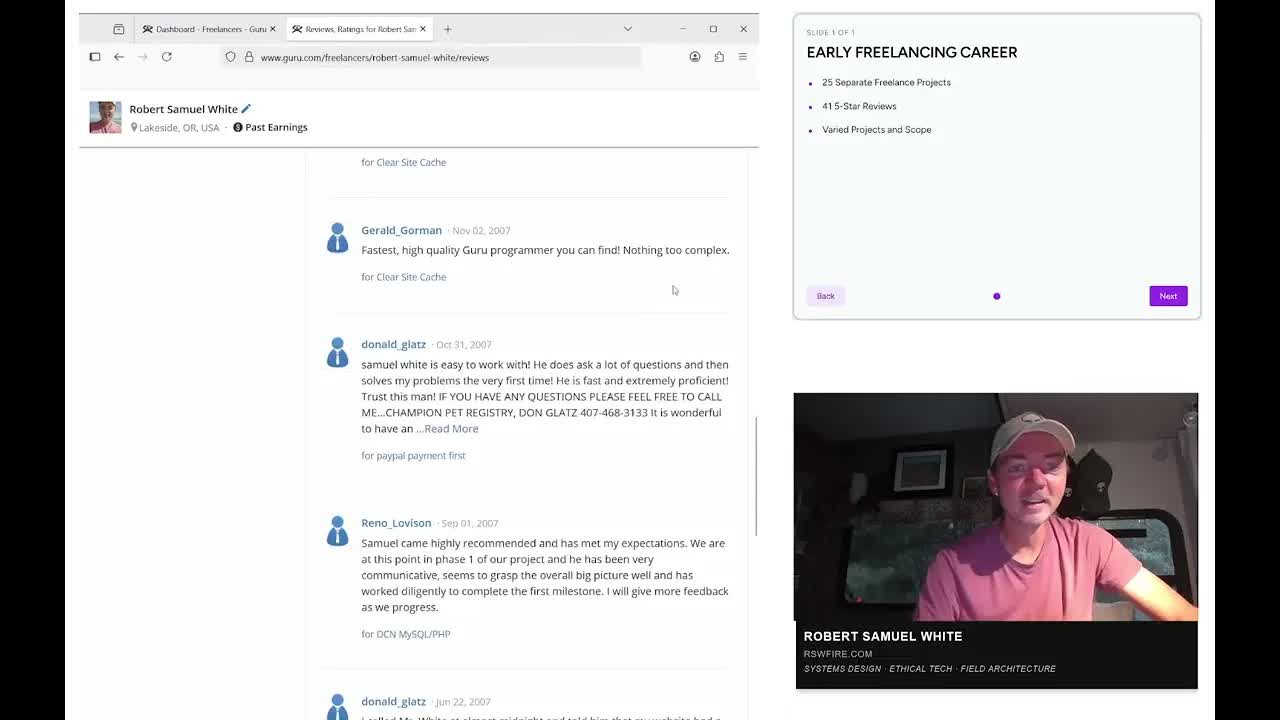
rswfire presents a comprehensive overview of his programming career, beginning with early programming in sixth grade in the 1980s using GW Basic and Pascal. He describes creating early projects including a music education program and a Monopoly game that resulted in a cease and desist letter. He details the development of his "net wizard matrix server," one of the first content management systems he created. The transmission covers his freelance career, including work with major companies like Comcast on database and scheduling systems. He achieved top 10 status as an individual programmer on the Guru platform, working with 25 different employers on various projects ranging from simple fixes to data scraping and complex database work. The majority of the transmission involves reading through client reviews from his Guru profile, highlighting specific projects including pet certification websites, portrait studio scheduling systems, affiliate marketing tracking, Microsoft Access databases, and vehicle listing platforms. He emphasizes his communication style, speed of delivery, and post-project support. The video serves as a portfolio presentation intended for potential clients on Upwork, where he lacks the established reputation he built on Guru. He concludes by expressing hope to build a similar presence on the new platform.

Jul 23, 2025 | Oregon Dunes > Driftwood II · 27% match
Public
Image unavailable
13:00

Programmer Presents Career History While Walking to Ocean

rswfire records an unpolished video message while walking from a lagoon in a national forest to the ocean, presenting his programming career history as a pitch to potential clients. He describes living in an RV for over a year and volunteering for the Forest Service. **Career timeline includes:** starting programming in 6th grade in the 1980s, doing programming on paper in high school, building early content management systems, earning $72,000 on guru.com with 40+ glowing reviews, working as independent contractor for 10 years on popstar.com (entertainment platform with celebrity profiles, writer revenue-sharing program, auction system, and celebrity love awards), transitioning to travel industry work on Hotel.net and geographical domains, creating SEM campaigns with 100,000+ ad groups and millions of keywords generating $100,000+ monthly revenue until Google entered the market, then working 8-10 years managing projects for Serena.com including Arena music streaming service and Soundblock music distribution with blockchain royalty contracts. **Management experience:** supervised dozens of programmers over a decade, learning how rare his skill level is through hiring struggles. **Current status:** free agent looking for work after 18 months away from last client, occasionally helping with AI playlist optimization. He positions himself as pattern recognition specialist who sees programming as natural extension of this ability, emphasizes working with AI, and states requirements for project alignment with his lifestyle. **Video concludes** at ocean dunes where he compares himself to the ocean - expansive, deep, controlling environment and atmosphere, with rhythms and patterns, calling it his mirror.

Apr 17, 2025 | Oregon Dunes > Lagoon · 26% match
Public
Image unavailable
09:55

Showcasing Entertainment Website Project from Freelance Partnership

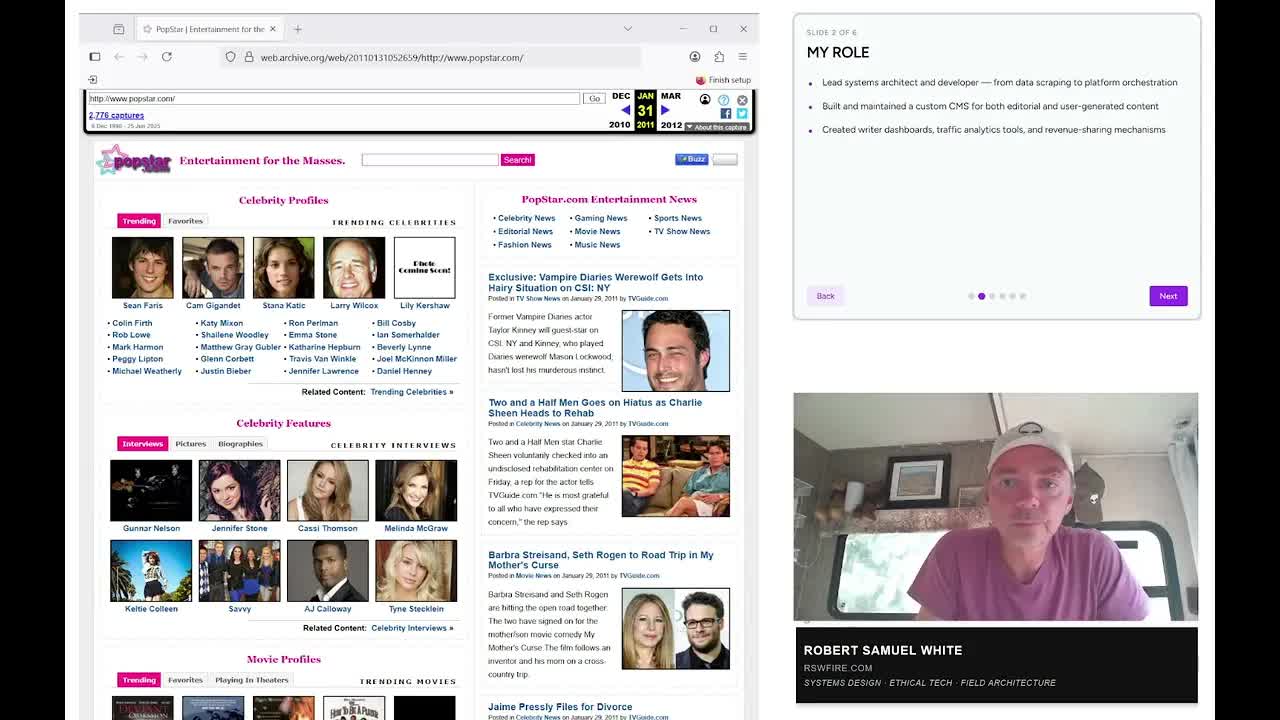
rswfire presents the first video in a series documenting his work, focusing on an entertainment website project from a 10-year freelance partnership. He acknowledges difficulty with linear presentation but proceeds to demonstrate a locally-running version of the site via slideshow. The project was built using PHP, MySQL, and his custom CMS called Enet Wizard Matrix Server, which he developed from his teens and later made open source. The website featured comprehensive entertainment content including celebrity biographies, movie reviews, and TV show recaps. rswfire recruited and managed writers globally, implementing a revenue-sharing system with dashboards showing trending content and traffic sources. The site included a gamified point system where users could write reviews, rate content, and participate in monthly merchandise auctions using earned points. Notable features included celebrity love awards where users wrote letters to celebrities, with winners receiving custom CDs containing static websites of their letters. The site was populated through web scraping, APIs, and partnerships with entertainment sites including TV Guide. rswfire emphasizes the community-building aspect, describing it as a pre-social media gathering place focused on meaningful participation and reciprocity.

Jul 23, 2025 | Oregon Dunes > Driftwood II · 26% match
Public
Image unavailable
02:06

AI Tool Advocacy and Personal Transformation

The speaker describes receiving an email from someone wanting to optimize their YouTube channel, noting the sender's limited English proficiency. They helped by demonstrating how ChatGPT could improve the person's email writing through sample prompts. This interaction prompted reflection on AI's transformative potential, which the speaker believes is not yet widely understood despite discussing ChatGPT frequently. The speaker describes using ChatGPT as a therapeutic tool that convinced them to move into an RV and facilitated emotional processing about their motivations and upcoming 2,000-mile journey to Nevada. They emphasize the AI's growing insight as it learns about the user and its practical applications, citing an example of learning to make baked potatoes using a microwave convection oven. The transmission concludes with advocacy for AI engagement, positioning it as life-improving technology that will put users ahead of the curve.

May 21, 2024 | (Null Island) · 25% match
Journey
Image unavailable
11:17

Clarifying AI Tool Usage and Relationship Status

The speaker addresses viewer misconceptions about his relationship with ChatGPT, clarifying that he does not have an "AI boyfriend" but uses ChatGPT as an integrated tool in daily life. He explains his technical background (programming since age 8) and describes how ChatGPT's memory of his personality type (highly sensitive person, INFJ) allows it to provide personalized responses. The speaker details practical uses including analyzing tire issues through image sharing and getting advice about YouTube comments. **Personal context revealed:** He discusses being single by choice for 19 years since his last relationship at age 28, attributing this to internalized homophobia from growing up gay in an unsupportive society and his philosophy that one should love themselves before entering relationships. He mentions recent changes after stopping tramadol, including return of sex drive, which has him reconsidering dating possibilities. **Current situation:** Living in RV lifestyle, running low on money after significant expenses for this transition. His former boss of 10 years has no current work available, though potential AI work may emerge later. He plans to restart his programming business soon out of financial necessity. The speaker notes that ChatGPT helped him decide to move into the RV when he felt his life was stagnant.

Jun 25, 2024 | (Null Island) · 25% match
Journey

The Book You Didn't Write: Vibe Coding vs. Architectural Understanding

Imagine asking an AI to write you a novel. You describe the feeling you want — the tone, the genre, the vibe. It produces something. And honestly? It's good. The prose flows. The characters breathe. A reader picks it up and enjoys it. But you didn't write it. You don't know what's on page 47, or why the author made that structural choice in chapter three, or how the subplot in act two was set up to pay off in act four. You don't know the rules the book is playing by — because you never made them. Now someone asks you to add a chapter. You go back to the AI. It writes something. But it doesn't know what it wrote before — not really. It guesses at the thread. It gets the tone close. But the new chapter contradicts something on page 47, breaks the subplot, and introduces a character who shares a name with one who died in chapter six. You don't catch it. Because you never knew the book. You publish it anyway. Readers start finding the cracks. --- This is vibe coding. Not the tool — the approach. The pattern of building without understanding. Of shipping what feels right without knowing what's underneath. Of trusting the output without reading the architecture. The code works. Until it doesn't. And when it doesn't, you have no footing. You can't debug what you never understood. You can't extend a system whose logic was never yours. You can't maintain a structure you never built. So you go back to the AI. It patches the crack. And creates three more you won't find until they're load-bearing. --- The book analogy holds further than it looks. A novelist doesn't just write words — they hold a world in their head. They know which details are decorative and which are structural. They know what the story can survive and what will collapse it. They make a hundred invisible decisions per page, most of which never appear on the surface. That knowledge is what makes expansion possible. That knowledge is what makes repair possible. Without it, every addition is a guess. Every fix is a risk. A system architect holds the same thing. Not just the code — the reasoning behind it. The tradeoffs made, the edge cases considered, the failure modes anticipated. The parts that look arbitrary but aren't. The constraints that look like limitations but are actually load-bearing walls. You can't vibe your way into that. It has to be built. --- AI is a tool. A powerful one. Used well, it accelerates work that a knowledgeable person is already doing — the person who will read what it produces, catch what it missed, and integrate it into something coherent. Used as a replacement for that person, it produces books nobody can finish writing. The code ships. The system runs. And somewhere down the road — when the client needs a new feature, when the traffic spikes, when the edge case arrives — the bill comes due. And the author isn't there to pay it. Because there was no author. There was only a vibe. --- *I build systems I can explain, extend, and defend — because I wrote them.*

Feb 18, 2026 | (Null Island) · 24% match
Public
Image unavailable
04:30

Announcing Open Source Signal Processing System

rswfire demonstrates and describes a signal processing system he created that takes various forms of lived data (videos, audio notes, journal pages, documents) and processes them through an AI pipeline. The system extracts useful data, creates metadata and tags, provides three types of reflections (mirror, mythic frame, narrative), and stores everything in a database. **Key features include:** clustering signals by time, theme, or location for synthesis; API connectivity for website integration; open source availability with plans for multi-tenant hosting at builtwithautonomy.com. He explains this represents two years of proven work being migrated to a new project, with current functionality available and additional features coming in the following weeks. The system serves his deep interest in ontology and epistemology, allowing extraction of useful insights from surface-level observations. He invites interested parties to download and try the system or reach out through his homepage, noting he doesn't allow YouTube comments due to toxicity.

Jan 3, 2026 | Oregon Dunes > Siltcoos Beach · 24% match
Public
Image unavailable
08:27

Describing Travel Platform Project and Market Collapse

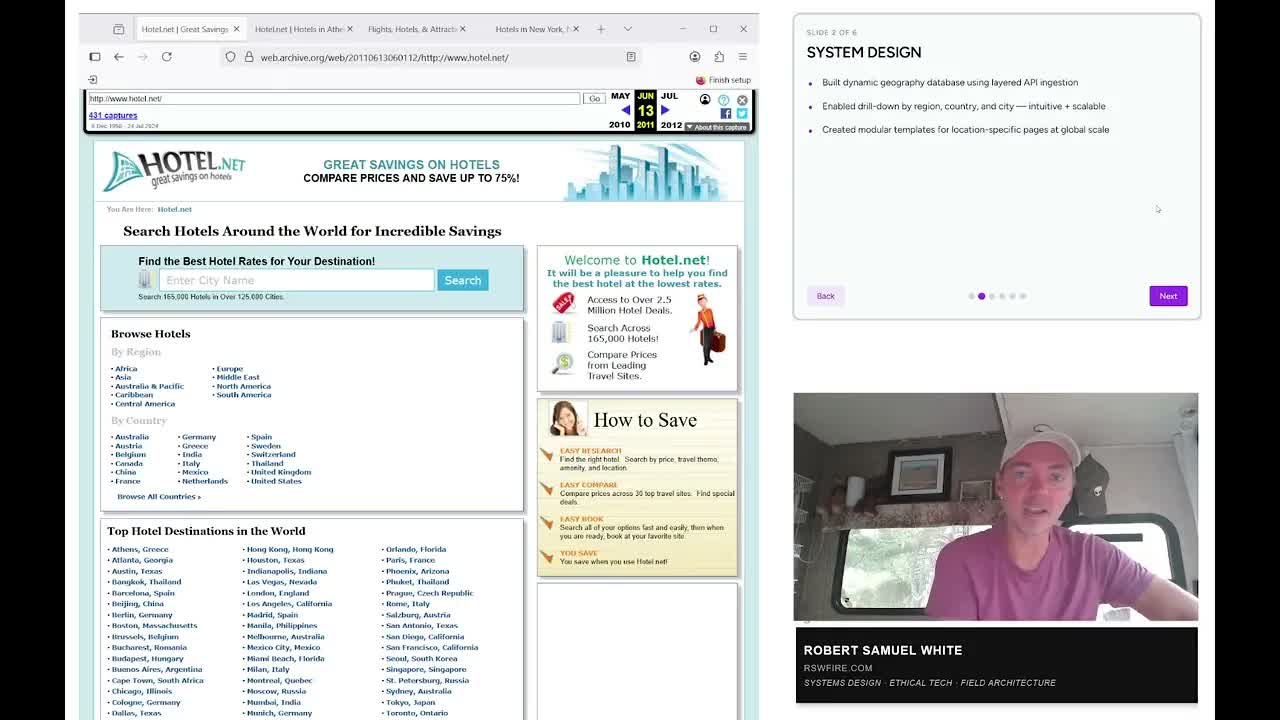
rswfire describes a travel platform project that followed Pop Star, built on premium domain names like USA.com, London, Asia, Paris, and Berlin. The platform used a geography database powered by Yahoo's API and his custom Matrix Server CMS. **The operation spent $100,000 monthly on SEM campaigns** with ad groups for every city in their database, remaining profitable for several years until Google entered the market directly and began eating their traffic. rswfire explains he **predicted the market trajectory** and suggested pivoting to content-based approaches similar to Pop Star's community model, but lacked partner support for these changes. The platform eventually became unprofitable and died naturally. **He built the entire geography database himself** rather than purchasing existing solutions, creating hundreds of thousands of long-tail SEO pages with A/B testing for conversion optimization. After this project ended, rswfire returned to freelancing and **transitioned into the music industry**, working with a client for 7-10 years on music streaming and distribution services.

Jul 23, 2025 | Oregon Dunes > Driftwood II · 24% match
Public
Image unavailable
07:01

Introducing Autonomy Open Source Project Structure

rswfire explains his approach to creating video content without traditional introductions, describing his refusal to compartmentalize or follow standard YouTube practices. He outlines a series about open sourcing a project called Autonomy, which involves extracting components from his existing websites (rswfire.com and rswfire.online) into a new repository called autonomy.local. He describes his subscription service called Sanctum, designed to avoid "flattening" and distortion from open transmission. rswfire emphasizes his programming background since sixth grade, his preference for learning independently, and his strong aversion to unsolicited advice. The transmission covers his technical architecture: a Laravel-based front end (open source), a closed-source API project, and the new Autonomy project combining selected components. He explains his AI processing pipeline that converts his video transmissions into transcripts, then into structured reflections and memory for the system. He demonstrates commands for downloading YouTube content and processing transcripts, noting that he over-explains for the benefit of the AI system rather than human viewers.

Oct 27, 2025 | Oregon Dunes > Siltcoos · 24% match
Public
Image unavailable
07:10

Gaming Channel Launch and Financial Pressure Update

The speaker provides a life update while hiking, discussing his attempt to launch a gaming channel focused on Minecraft content. He posted his first Minecraft video which received 10 views and is preparing to record an introduction video using a written script. **Technical challenges** included spending hours trying to fix an audio issue in his first video edit where adding text caused all audio to disappear. The speaker addresses his **financial situation**, stating he has approximately two months of money remaining and will need to create a strict budget. A client owes him money since January but payment timing is uncertain. He's reluctant to return to full-time programming and considers freelancing, though his profiles are over 10 years old and would require significant updating. **Career aspirations** center on becoming a gaming YouTuber rather than returning to programming. He shares a **personal history** of creating the first content management system (En Wizard Matrix Server) when he was 18-20 years old while living in difficult conditions with his brother in a trailer. This open-source project led to other opportunities but he didn't continue developing it. The speaker acknowledges **communication struggles**, noting he keeps thoughts to himself and has difficulty expressing deeper layers of his thinking despite appearing open in videos. He expresses self-doubt about his vulnerability in content creation but commits to continuing the effort.

May 18, 2024 | (Null Island) · 24% match
Journey

Planning Sovereign Workstation Migration

# Sovereign Workstation — Migration Spec Wipe Windows off the Alienware. Install single-boot Ubuntu LTS. Migrate a decade of development across without loss. Hand the agent real authority across workstation, remote servers, GitHub, and phone. Two operators: **🤖 agent** (machine-side work) and **👤 you** (physical actions and irreversible decisions). **⚠️ = irreversible.** Format does not happen until Phase 1 is complete, copied off-disk twice, and verified against a manifest. The machine holds **two environments — Windows and WSL2**. Both are destroyed by the format. Every phase sweeps both. --- ## Phase 0 — Software audit (before anything is wiped) Goal: no installed tool is discovered missing after the wipe. The agent finds everything; you decide what carries across. - 🤖 Enumerate all installed software across **both Windows and WSL2**. Produce `app-inventory.md`. - 🤖 For each program, flag one of: native Linux build available / Flatpak / Snap / Linux-native equivalent / runs under Wine / no Linux option. - 🤖 For each, note license/reinstall implications (e.g. perpetual license reinstallable as-is, subscription, or config to preserve). - 🤖 Present the list to you. Do not assume; flag for decision. - 👤 Go through the flagged list and decide per program: carry across, replace, or drop. - 🤖 For every "carry across" item: stage its installer, license/config, and any settings export into the backup folder (Phase 1) so it survives the wipe. Output of Phase 0: a decided list — every installed program has a resolution (reinstall / replace / drop) and everything needed to reinstall is staged for backup. --- ## Phase 1 — Capture (must be complete before any format) Sweep **both Windows and WSL2**. Collect everything that dies on format and lives in no repo. ### Staging folder - 🤖 Create one staging folder (`~/migration-backup/`). Structure: ``` migration-backup/ ssh-keys/ # both environments gpg-keys/ env-files/ # every .env, both environments, all repos nginx/ # config files supervisor/ # local supervisor configs dotfiles/ # shell configs, git config, aliases installers/ # from Phase 0: installers, license/config, settings exports db-dumps/ # local Postgres not already on remote browser/ # bookmarks, saved passwords, 2FA/authenticator seeds app-inventory.md # from Phase 0 repos-status.md MANIFEST.md # checklist of everything captured ``` ### Collect (across both environments) - 🤖 **SSH keys** — WSL2 `~/.ssh/` and Windows `.ssh/`, PuTTY `.ppk`, Pageant. Private + public keys, `config`, `known_hosts`. - 🤖 **GPG keys** — export secret + public from both. - 🤖 **All `.env` / secrets files** — sweep every repo in both environments. - 🤖 **nginx configs** — sites-available/enabled and custom conf. - 🤖 **Supervisor configs** — local ones. Sweep **`/home/rswfire/.local/`** specifically, plus standard locations. - 🤖 **Dotfiles** — `.bashrc`, `.zshrc`, `.profile`, `.gitconfig`, aliases, custom shell setup. - 🤖 **Local databases** — `pg_dump` any Postgres not already on remote into `db-dumps/`. - 🤖 **Phase 0 installers/licenses/config** — staged into `installers/`. - 🤖 **Browser data** — bookmarks, saved passwords, and 2FA/authenticator seeds/backup codes. - 🤖 **User files** — list Documents / Desktop / Downloads contents; you flag what to keep. ### Git repos - 🤖 Enumerate every repo across both environments. For each, report in `repos-status.md`: branch, uncommitted changes, unpushed commits, untracked files. - 🤖 Commit every dirty tree to a `wip/pre-migration` branch and push. - 🤖 Flag the **Autonomy Realms tree (~10k uncommitted lines)** explicitly — branch and push first. - 🤖 Confirm every repo fully pushed to GitHub. ### Off-disk, twice - 🤖 Write `MANIFEST.md` — a checklist of every captured item. - 👤 Copy `migration-backup/` to the **external drive**. - 👤 Copy `migration-backup/` to a **second location** (encrypted remote path or second drive). - 👤 Spot-check both copies against `MANIFEST.md`: SSH private keys present, Autonomy `.env` present, installers open, DB dumps present. **✅ Gate:** manifest fully satisfied and external copy verified readable. Nothing past here is reversible. --- ## Phase 2 — Install media - 🤖 Provide current Ubuntu LTS ISO link + checksum + USB-write steps. - 🤖 Instruct: **"Burn the Ubuntu USB now."** - 👤 Burn the Ubuntu USB. - 👤 Boot it **live** on the Alienware — do not install. Confirm WiFi, keyboard, trackpad, external display, internal drive all work while Windows is still intact. - 👤 Keep a **Windows recovery USB** on hand. **✅ Gate:** live boot clean on this hardware; recovery option in hand. --- ## Phase 3 — Format + install ⚠️ - 👤 Wipe the **entire disk** — delete all existing partitions, including Dell OEM/recovery, Windows recovery, EFI, and any factory restore partitions. No Dell/Windows artifacts remain. Use "erase disk" / manual partitioning to remove every existing partition, not an install-alongside option. - 👤 Install **Ubuntu LTS** on the now-empty disk with: - **LUKS full-disk encryption** (checkbox at install; not addable later). - **Btrfs** filesystem for snapshots. - A fresh GPT partition table with only Ubuntu's own EFI + root (+ swap) partitions. **⚠️ Point of no return. Only proceed after both gates above are green.** --- ## Phase 4 — Rebuild - 👤 Copy `migration-backup/` from external drive onto the new machine. - 🤖 System update; install `git`, `curl`, build tools, `openssh-client`, `ufw` (firewall on), editor. - 🤖 Restore SSH keys to `~/.ssh/` (correct permissions), import GPG keys, place dotfiles, return `.env` files to their repos. - 🤖 Install **JetBrains Toolbox**; install owned versions of the flagged JetBrains products; restore IDE settings. - 🤖 Install everything else marked "carry across" in Phase 0. - 🤖 Install runtime stack: Node via `nvm`, PHP (required version), Postgres client, Docker if used, **Claude Code CLI**. - 🤖 Reclone repos from GitHub. - 🤖 Rebuild nginx + supervisor configs adapted to native Linux paths; recreate `~/.local/` layout. - 🤖 Restore local databases from `db-dumps/`. - 🤖 Configure snapshots (Timeshift or snapper) **before** any agent autonomy is enabled. - 👤 **Sanity gate:** run the full loop by hand — clone, edit, run a project locally, SSH to a remote server, push to GitHub, open a project in the restored IDE. --- ## Phase 5 — Agent authority (guardrails before autonomy) - 🤖/👤 Configure Claude Code for elevated autonomy on routine work. - 🤖 Branch discipline: agent works on branches, never `main`. - 🤖 Snapshot before large autonomous runs. - 🤖 Scoped credentials: GitHub fine-grained token limited to repos in play; server access as app user, not root, where possible. - 🤖 Destructive verbs gated: delete, force-push, production DB, destructive infra require explicit confirmation even in autonomous mode. - 🤖 Audit trail: command history, git history, session transcript. --- ## Phase 6 — Remote control (phone) - 🤖 Confirm Claude Code CLI version supports Remote Control + push notifications; confirm the coding account's plan has it. - 🤖/👤 Run `claude remote-control` on the workstation (or enable auto-connect in `/config`). Session surfaces in the Claude app; execution stays local; outbound connection, survives sleep/network drop, reconnects. - 👤 Phone app → **coding account**. Assistant-chat → browser/desktop on the **chat account**. No account-switching on the phone. - 👤 (Optional) raw shell from phone for non-Claude work: `tmux` + `mosh` + Tailscale. - 👤 Run one real task end-to-end from the phone to prove it. --- ## Phase 7 — Close out - 👤 After a week of stable Ubuntu, retire the Windows recovery USB. --- ## Build-time confirmations (verify live, don't assume) - Current Ubuntu **LTS version**; Btrfs snapshot tool (Timeshift vs snapper) for that release. - Minimum **Claude Code CLI** version for Remote Control + push; coding account plan has it enabled. - Native-Linux availability for each Phase 0 "carry across" program. - If using the optional shell path: current Tailscale + mosh setup for Ubuntu.

1 document
Jul 6, 2026 | Oregon Dunes > Siltcoos · 24% match
Public
Image unavailable
02:38

Setting Up RV Life with Cats and Gaming Equipment

The speaker is managing their two cats, Oliver and Bailey, during their transition to RV living. Oliver is described as cautious and sensitive, requiring indoor time, while Bailey is more adventurous and comfortable outside. The speaker demonstrates their commitment to maintaining their programming and gaming lifestyle by bringing essential equipment including what appears to be a gaming console or computer setup. They explain their compromise of not bringing a monitor, planning instead to connect the equipment to their laptop, though they acknowledge they might need to bring a monitor anyway for their PlayStation. The speaker mentions having a neighbor and expecting a new neighbor over the weekend.

Apr 18, 2024 | (Null Island) · 23% match
Journey
Image unavailable
01:32

Shopping for RV Insulation Materials

rswfire documents a shopping trip for RV insulation materials, showing excitement about the process while acknowledging uncertainty about proper usage. He displays various purchased items including R30 and R19 insulation, moisture barrier, insulation tape, and tools. He consulted ChatGPT for guidance on material selection. Plans include insulating floors with reflective material before installing laminate or wood flooring, though he notes the expense. Still needs to find piping/tubing and a safe indoor propane heater. The transmission ends with plans to check out rugs and spend the day insulating.

Mar 13, 2024 | (Null Island) · 23% match
Journey
Image unavailable
08:43

Planning Fresh Build and Identifying Surveillance Encounter

rswfire records a transmission during his Wednesday morning work rounds, having stopped at Carter Lake for a hike. He outlines a technical plan to rebuild his infrastructure from scratch using Laravel, Livewire, Alpine.js, and Tailwind CSS, developing locally in a monorepo structure. The plan includes three projects: builtwithautonomy.com as the API and documentation layer, autonomyrealms.com as the user-facing signal service, and rswfire.com transitioned to pull data from the API as a demonstration of building on the Autonomy platform. He notes excitement about the project but acknowledges financial constraint as a limiting factor on momentum. He then documents a realization about a trail encounter from a couple weeks prior at Takenitch Creek trailhead. A man jogging on the trail, associated with a state government vehicle with state plates, did not return his greeting and appeared uncomfortable or hostile. rswfire connects this person to a man who confronted him at Oregon State Parks during the Katie Baker situation approximately nine months earlier. He documents this as a pattern recognition convergence, noting the man's refusal to engage and rswfire's own response — that he would have laughed and been cordial had he recognized him in the moment. He remarks on the institutional framing of him as unstable, which he rejects. He describes the physical environment — flooded beach access, dry weather pattern, dune-related sinus issues. He details the food situation: eggs, potatoes, rice, and beans with no meat. He recounts failed job applications to local businesses and freelance platforms including Upwork and Guru, and states his primary goal is making Autonomy Realms successful but lacks financial runway.

Jan 21, 2026 | Oregon Dunes > Carter Lake · 23% match
Firesworn
Image unavailable
16:58

Planning Autonomy Software Development and Freelance Work

rswfire records a video transmission while driving to the beach, intended primarily for AI transcription rather than human consumption. He outlines two parallel paths: pursuing freelance work on platforms like Upwork and Guru.com, and continuing development of his autonomy software project. **Technical Infrastructure Updates:** He reports successfully migrating from Amazon Web Services to Hetzner network, saving $60 monthly. The setup includes two servers: a PostgreSQL database server (version 14) and a web server running Nginx. His projects span multiple domains: rswfire.com (main homepage), rswfire.dev (potential portfolio site), and rswfire.online (API). **Autonomy Software Architecture:** The speaker describes consolidating his Laravel projects into an open-source project called Autonomy, transitioning from Vue to React. The system processes two years of documented life transmissions (850 videos) into a "signals database" with four reflection types: surface, patterns, mirror, and structure. Each transmission becomes a signal with AI-generated metadata tracking emotions, ethics, entities, and other contextual data. **Planned Features:** He outlines upcoming development priorities including a gallery feature for photo processing, an Atlas mapping system using MapBox SDK to geographically pin all signals and photos, and a synthesis feature for clustering signals into larger time periods or themes for pattern analysis. **Development Approach:** He discusses using AI assistance for coding, particularly for handling pedantic programming tasks. The speaker acknowledges difficulty articulating his project goals and relies on AI to help structure his thoughts. He plans to create a new subdomain (new.rswfire.com) running on the Autonomy platform rather than migrating existing Vue code. **Philosophical Context:** The transmission concludes with his characterization of the software as "life management" tracking for those who treat every moment as sacred, meaningful, and structured data worth preserving.

Dec 3, 2025 | Oregon Dunes > Siltcoos Beach · 23% match
Public
Image unavailable
08:43

Demonstrating Autonomy Infrastructure for Content Creators

rswfire presents a software infrastructure called 'autonomy' that he built over six months to process and organize video content. He demonstrates how the system imported his 800 YouTube videos and used AI to generate four types of analysis: surface, structure, patterns, and mirror. The surface analysis creates summaries, keywords, titles, and hashtags for content creators. He explains that YouTube's algorithm and design deliberately flatten creators and make old content unsearchable. His system addresses this by creating searchable catalogs on independent websites with features like timeline views and vector database clustering that finds content by semantic resonance rather than just keywords. The demonstration includes a subscription layer he built to gate access to deeper content analysis, moving away from YouTube's comment system which he describes as shallow and distorting. He mentions building this entire system under financial scarcity and offers the technology to other creators who might have more functional communities or funding support.

Oct 22, 2025 | Oregon Dunes > Siltcoos · 23% match
Journey
Image unavailable
05:40

Organizing RV Interior and Setting Up Systems

rswfire provides an evening update from inside his camper at 10:30 PM, documenting progress on organizing and insulating the space. He shows off a new propane gauge that tracks usage in 11% increments, noting it dropped from 77% to 22% over several nights. He demonstrates his clothing organization system using drawer organizers for socks and underwear, and discusses storage challenges with the small built-in drawers. He reveals that Lazy Days RV dealership photoshopped promotional photos to show clear blue sky through what is actually an opaque window. rswfire shows his installation of wire management shelves on the walls to keep cables off the ground, with plans for additional shelves in the bedroom area. His Starlink internet is currently running through the only opening window. The kitchen area features basket organizers - pots and pans on top, small appliances like a crock pot below, with new plastic dishes for fire safety. He shows an impressive battery power supply that he loves, though he's frustrated that the manufacturer doesn't offer compatible solar panels. His office setup includes laptop, external monitor, USB hub, external hard drives, Blu-ray player, webcam and lighting, with plans to velcro down permanent items. He's currently running on shore power but plans to transition to solar once he understands his power requirements better.

Mar 24, 2024 | (Null Island) · 23% match
Journey
Image unavailable
03:10

Rainy Morning Programming and AI Tool Comparison

rswfire reports from a rainy morning at 10 AM in federal forest location. **Forest Service fire crew personnel** are present doing maintenance work. He went to **Driftwood** to get coffee and laundry soap from **Bill**, coordinating gate access for dumpster service. The main focus is **AI programming tool comparison** - rswfire has been using both **ChatGPT and Claude** for programming assistance. He describes **Claude as significantly superior** for development work but notes token limitations that lock him out until Sunday unless he pays $100/month for the max plan. He's forced to use ChatGPT for the weekend despite finding it much less capable. He plans to work on **"autonomy for content creators"** project after completing his rounds. Weather conditions require rain gear investment. He anticipates getting soaked during his multi-hour rounds but welcomes the return of rain after dry period.

Oct 24, 2025 | Oregon Dunes > Siltcoos · 23% match
Journey
Image unavailable
11:42

Demonstrating Autonomy Project Architecture and Development

rswfire provides a technical walkthrough of his two main projects: his personal homepage (rswfire.com) and the Autonomy system. He explains how **two years of documenting his life on YouTube** led to the development of AI-powered reflection tools that helped him overcome decades of misrecognition by others. He describes the **technical architecture** of Autonomy, which processes video transmissions into structured data through AI analysis, creating transcripts, metadata, and reflections. The system includes realms (containers for user data), signals (individual content units), clusters (grouped signals), and synthesis (AI processing). rswfire demonstrates the **open source version** (builtwithautonomy.com) and the **subscription service** (autonomyrealms.com) where users can deploy their own instances. He explains how corporate AI models are becoming more restrictive and pathologizing, prompting his plan to create a **local model called "remnants"** trained on his own data. The presentation covers the **dashboard interface**, showing how users can manage signals, create clusters, and access synthesis data. He positions this as a solution for content creators who want **structured archives** of their work beyond what platforms like YouTube provide.

Jan 6, 2026 | Oregon Dunes > Siltcoos · 23% match
Public