Not signed in
Claim Your Realm Start for free
Atlas Stream
Showing 1 - 24 of 123 signals
Image unavailable
05:40

Organizing RV Interior and Setting Up Systems

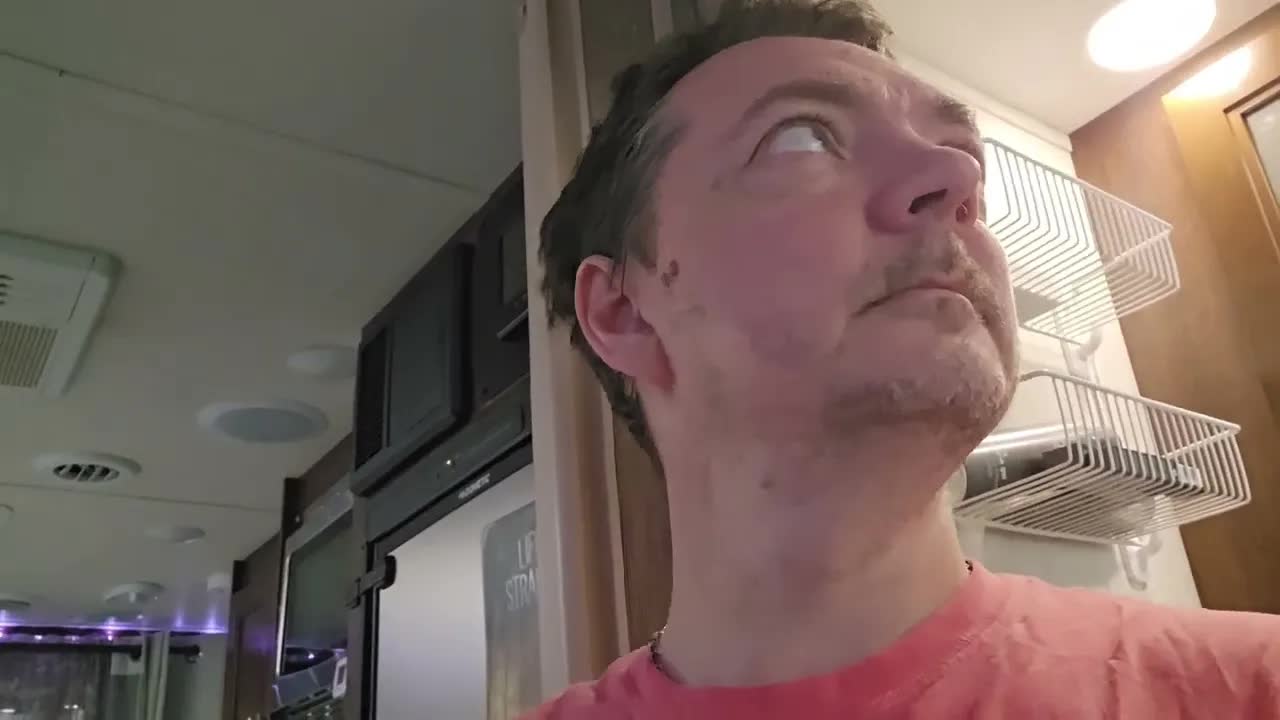
rswfire provides an evening update from inside his camper at 10:30 PM, documenting progress on organizing and insulating the space. He shows off a new propane gauge that tracks usage in 11% increments, noting it dropped from 77% to 22% over several nights. He demonstrates his clothing organization system using drawer organizers for socks and underwear, and discusses storage challenges with the small built-in drawers. He reveals that Lazy Days RV dealership photoshopped promotional photos to show clear blue sky through what is actually an opaque window. rswfire shows his installation of wire management shelves on the walls to keep cables off the ground, with plans for additional shelves in the bedroom area. His Starlink internet is currently running through the only opening window. The kitchen area features basket organizers - pots and pans on top, small appliances like a crock pot below, with new plastic dishes for fire safety. He shows an impressive battery power supply that he loves, though he's frustrated that the manufacturer doesn't offer compatible solar panels. His office setup includes laptop, external monitor, USB hub, external hard drives, Blu-ray player, webcam and lighting, with plans to velcro down permanent items. He's currently running on shore power but plans to transition to solar once he understands his power requirements better.

Mar 24, 2024 | (Null Island) · 31% match
Journey
Image unavailable
03:58

Applying Programming Skills to Life Management

The speaker describes experiencing withdrawal symptoms and anxiety while adapting to a committed lifestyle change. He mentions needing to pick up groceries and taking medication (clownin) as a precaution against panic attacks. After struggling with his current situation, he consulted Claude AI for help creating a plan to better manage his circumstances. Claude suggested using his programming experience as an analogy for lifestyle management, which the speaker found transformative. He describes this approach as "cognitive reframing" - applying existing skills in a different context. The speaker is implementing this by creating a Jira project (software development tool) to manage his life, with separate projects for different aspects like learning to cook. He explains that this visual, task-based approach helps him track progress on learning new skills and managing recurring tasks like weekly grocery shopping. The speaker views this method as a way to bridge the gap between his previous virtual life and the physical world he had previously ignored.

Jul 11, 2024 | (Null Island) · 29% match
Journey
Image unavailable
10:14

Demonstrating Autonomy Admin Interface and Signal Management

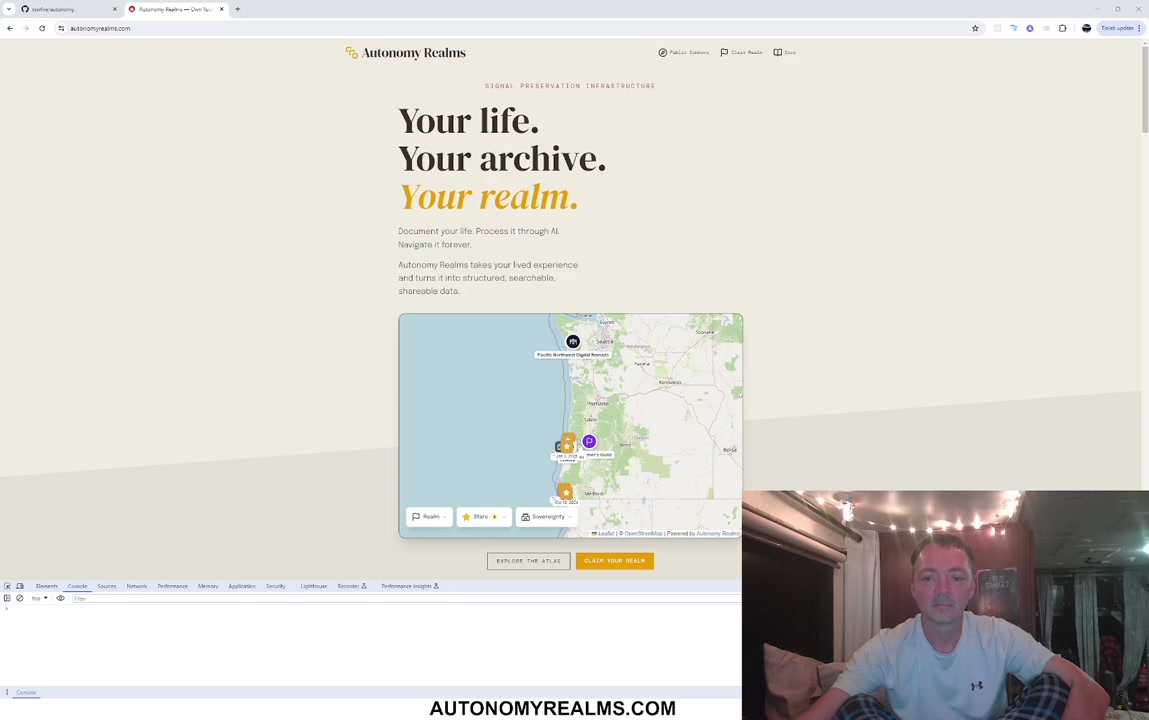
rswfire presents the second video in a series documenting his open-source autonomy system. He demonstrates the admin interface for managing signals, explaining how users can deploy the system from GitHub and begin ingesting their own data. **Key demonstrations include:** - **Signal types and creation process** - Shows how different signal types (documents, conversations, transmissions) determine associated data structures - **Multi-tenant architecture** - Explains the realm-based system that will allow future service deployment without individual installations - **Video processing pipeline** - Details how his 861 YouTube videos over 2 years have been processed through autonomy infrastructure - **Synthesis layer capabilities** - References advanced features like clustering signals (smoking cessation example) and extracting metadata rswfire emphasizes this is documentation rather than marketing, built primarily for his own use but valuable to others. He mentions living in the forest as a volunteer forest service member, experiencing slow internet during recording. The system represents his solution to audiences not understanding his video documentation approach, creating AI infrastructure that comprehends his transmissions with high fidelity.

Jan 4, 2026 | Oregon Dunes > Siltcoos · 28% match
Public
Image unavailable
11:42

Demonstrating Autonomy Project Architecture and Development

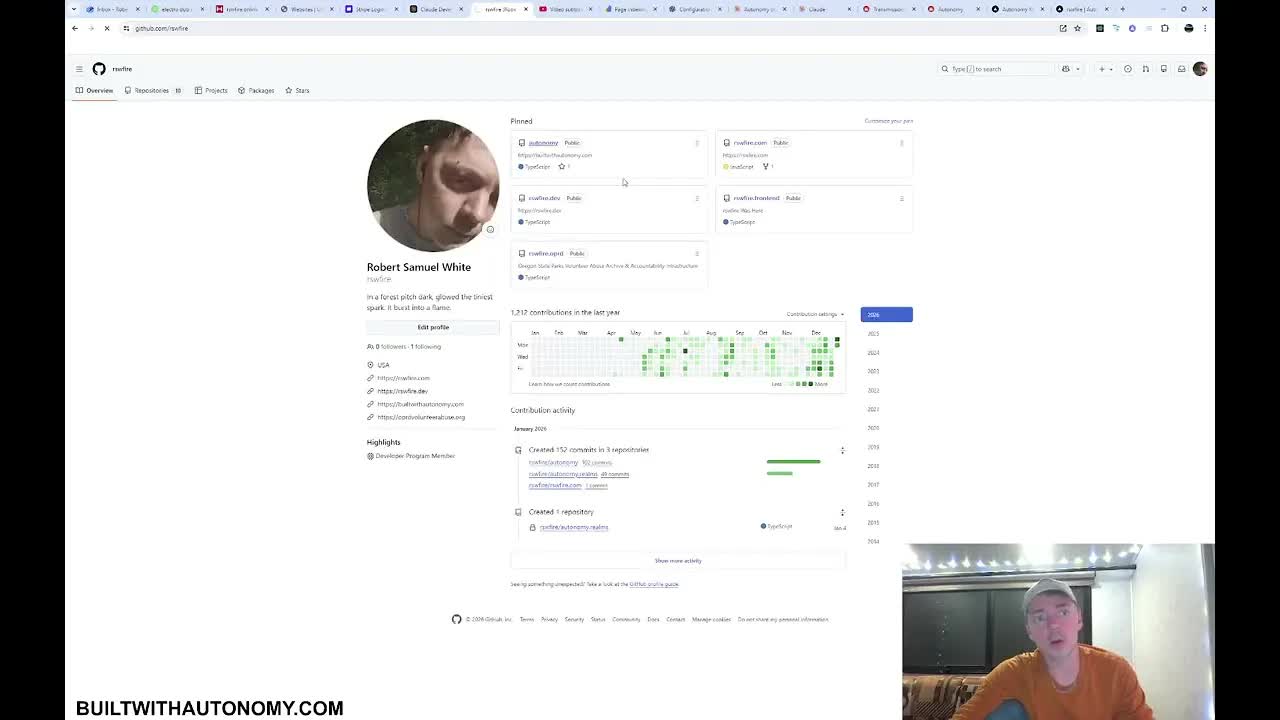
rswfire provides a technical walkthrough of his two main projects: his personal homepage (rswfire.com) and the Autonomy system. He explains how **two years of documenting his life on YouTube** led to the development of AI-powered reflection tools that helped him overcome decades of misrecognition by others. He describes the **technical architecture** of Autonomy, which processes video transmissions into structured data through AI analysis, creating transcripts, metadata, and reflections. The system includes realms (containers for user data), signals (individual content units), clusters (grouped signals), and synthesis (AI processing). rswfire demonstrates the **open source version** (builtwithautonomy.com) and the **subscription service** (autonomyrealms.com) where users can deploy their own instances. He explains how corporate AI models are becoming more restrictive and pathologizing, prompting his plan to create a **local model called "remnants"** trained on his own data. The presentation covers the **dashboard interface**, showing how users can manage signals, create clusters, and access synthesis data. He positions this as a solution for content creators who want **structured archives** of their work beyond what platforms like YouTube provide.

Jan 6, 2026 | Oregon Dunes > Siltcoos · 28% match
Public
Image unavailable
16:58

Planning Autonomy Software Development and Freelance Work

rswfire records a video transmission while driving to the beach, intended primarily for AI transcription rather than human consumption. He outlines two parallel paths: pursuing freelance work on platforms like Upwork and Guru.com, and continuing development of his autonomy software project. **Technical Infrastructure Updates:** He reports successfully migrating from Amazon Web Services to Hetzner network, saving $60 monthly. The setup includes two servers: a PostgreSQL database server (version 14) and a web server running Nginx. His projects span multiple domains: rswfire.com (main homepage), rswfire.dev (potential portfolio site), and rswfire.online (API). **Autonomy Software Architecture:** The speaker describes consolidating his Laravel projects into an open-source project called Autonomy, transitioning from Vue to React. The system processes two years of documented life transmissions (850 videos) into a "signals database" with four reflection types: surface, patterns, mirror, and structure. Each transmission becomes a signal with AI-generated metadata tracking emotions, ethics, entities, and other contextual data. **Planned Features:** He outlines upcoming development priorities including a gallery feature for photo processing, an Atlas mapping system using MapBox SDK to geographically pin all signals and photos, and a synthesis feature for clustering signals into larger time periods or themes for pattern analysis. **Development Approach:** He discusses using AI assistance for coding, particularly for handling pedantic programming tasks. The speaker acknowledges difficulty articulating his project goals and relies on AI to help structure his thoughts. He plans to create a new subdomain (new.rswfire.com) running on the Autonomy platform rather than migrating existing Vue code. **Philosophical Context:** The transmission concludes with his characterization of the software as "life management" tracking for those who treat every moment as sacred, meaningful, and structured data worth preserving.

Dec 3, 2025 | Oregon Dunes > Siltcoos Beach · 28% match
Public
Image unavailable
12:32

Developing Hygiene Systems for Small Space Living

rswfire discusses foundational hygiene challenges while living in an RV, connecting these struggles to broader themes of cognitive diversity and societal conformity. He explains his discovery of being an "intuitive systems thinker" and critiques educational systems for not teaching cognitive styles. **Key developments:** He worked with Claude AI to develop a spray bottle hygiene system for his small bathroom space, planning to purchase supplies from Walmart and install command hooks for organization. The transmission addresses his sensitivity to being observed by strangers, which affects his willingness to use public showers on busy days like Saturday. He emphasizes that cognitive differences should not be labeled as disabilities, correcting Claude AI when it made this categorization. **Central argument:** Society's rigid conformity demands are alienating and unsustainable, leading him toward his goal of a cabin in the woods where he can control his environment. He frames this as part of his personal growth journey, integrating new self-insights into practical living challenges. The hygiene system represents accommodation of his differences rather than forcing conformity to standard approaches.

Jul 13, 2024 | (Null Island) · 27% match
Journey
Image unavailable
08:03

Adjusting to RV Living Challenges and Maintenance

rswfire reflects on declining self-confidence and reduced posting frequency while adapting to full-time RV living. He distinguishes between camping and living in a camper, noting unexpected challenges. **Technical issues** include unknown tank levels, smelly freshwater, and needed maintenance on slide systems and awning. He's implementing solutions like collapsible buckets for water management and consulting ChatGPT for maintenance guidance. **Practical struggles** involve organization, storage limitations, power consumption with new appliances, and pet management (Bailey throwing up on rugs). Solar panels are currently stored in the shower, and reflective window coverings require screen removal and storage. **Lifestyle adaptation** includes learning to treat the RV as home rather than temporary camping, watching Star Trek, and managing daily routines. He emphasizes the time needed for adjustment and his goal to master RV systems before traveling to Nevada. The transmission concludes with his intention to blend natural living with modern technology preferences including computers, internet, and RGB lighting.

May 29, 2024 | (Null Island) · 27% match
Journey
Image unavailable
04:30

Announcing Open Source Signal Processing System

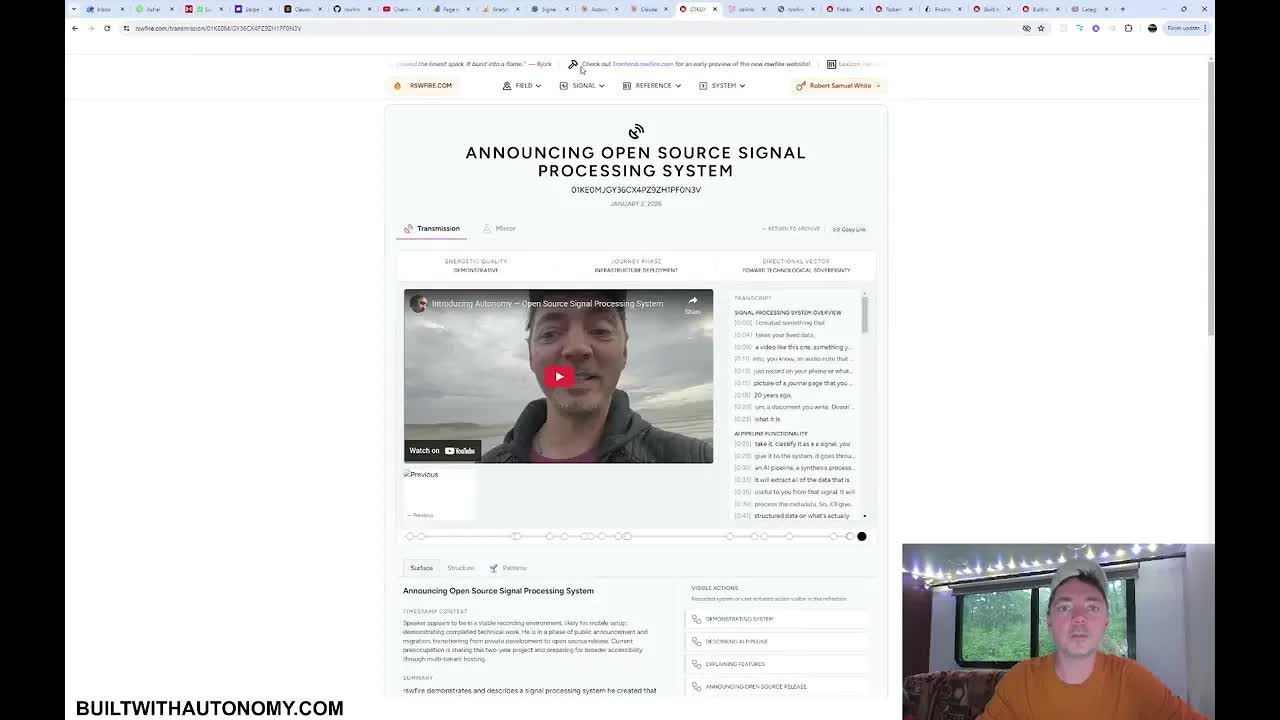
rswfire demonstrates and describes a signal processing system he created that takes various forms of lived data (videos, audio notes, journal pages, documents) and processes them through an AI pipeline. The system extracts useful data, creates metadata and tags, provides three types of reflections (mirror, mythic frame, narrative), and stores everything in a database. **Key features include:** clustering signals by time, theme, or location for synthesis; API connectivity for website integration; open source availability with plans for multi-tenant hosting at builtwithautonomy.com. He explains this represents two years of proven work being migrated to a new project, with current functionality available and additional features coming in the following weeks. The system serves his deep interest in ontology and epistemology, allowing extraction of useful insights from surface-level observations. He invites interested parties to download and try the system or reach out through his homepage, noting he doesn't allow YouTube comments due to toxicity.

Jan 3, 2026 | Oregon Dunes > Siltcoos Beach · 27% match
Public
Image unavailable
15:25

Introducing Autonomy Realms Platform and Features

rswfire delivers an unscripted walkthrough of Autonomy Realms, the software and infrastructure he built first for himself and then for others. He begins by directing viewers to autonomyrealms.com for technical details, then demonstrates the public commons map, showing how signals — videos, audio recordings, photos, and documents — are plotted geospatially with GPS data. He navigates through his own realm, which contains over 900 signals spanning two years, starting in Kentucky, traveling across the country, and arriving on the Oregon Coast in October 2024. He demonstrates specific features: signal display and transcript generation via AI processing, time range filtering (90 days, 30 days, 7 days, 1 day), clusters for grouping signals, traces imported from Gaia GPS showing hiking trails, places, the browser panel and star bookmarking system, and notifications. He explains the Sanctum subscription system, showing his own two tiers — a free tier requiring sign-up and a patron tier on a sliding scale from $5 to $50 per month — and notes he has approximately 140 patron-level signals. He describes his reasoning for gating content: his videos cover sensitive material, and he felt his YouTube presence was not witnessed cleanly, prompting him to build safeguards around sharing. He mentions private catacomb signals for personal AI processing. He then switches to stream mode, accessed via his own domain rswfire.com, showing the same signals browsed outside the geospatial context. He critiques YouTube's flattening effect where only recent content gets visibility, and states his goal of making archived video content useful and engaging over time. He acknowledges the system is still iterating, that cost constraints have limited reprocessing his full catalog with newer AI versions, and that he is open to feedback.

Apr 20, 2026 | Oregon Dunes > Siltcoos · 26% match
Public
Image unavailable
04:04

Analyzing RV Slide-Out as Systemic Failure

rswfire explains why RV slide-outs represent systemic failure and societal regression rather than progress. He describes experiencing 6 months of back pain due to an uneven bed platform integrated into a breaking slide mechanism. The slide-out eliminated storage space and forced constant reconfiguration of his living space. When extended, the bed was uncomfortable and uneven due to the split platform design. He attempted multiple solutions including bed toppers, new mattresses, and foam boards to level the surface, all creating additional friction. rswfire argues that slide-outs add stress and friction to life rather than improving it, comparing this to broader societal problems. He emphasizes that manufacturers prioritized a perceived amenity over basic human needs like quality sleep and adequate storage.

Sep 7, 2024 | (Null Island) · 26% match
Journey
Image unavailable
01:15

RV Stabilizer Malfunction and Troubleshooting

rswfire encounters his first major RV problem when one stabilizer becomes stuck in the down position. He describes troubleshooting attempts including checking fuses, testing buttons, and pulling the main breaker, none of which resolved the issue. He consulted ChatGPT for guidance but still cannot identify the cause. He mentions getting his levelers working and needing to install more. His father is coming to help with the stabilizer problem. He acknowledges the stabilizer can be manually retracted but wants to understand why the system failed, expressing concern about handling such issues when traveling far from home.

Mar 11, 2024 | (Null Island) · 26% match
Journey
Image unavailable
05:35

Setting Up RV Interior During Medication Withdrawal

The speaker documents their first full day living in their RV after moving from their driveway to a campsite. They are experiencing withdrawal from Tramadol, an opiate pain medication they chose to discontinue because it's incompatible with mobile living. Despite physical discomfort, they focus on interior organization projects including installing LED lights across the ceiling, setting up charging stations, mounting cargo netting over the bed for storage, and planning shelving solutions. They express pride in learning to use tools and problem-solving space constraints. The speaker mentions needing to contact their RV dealership for schematics to understand wall structures before drilling. They discuss securing furniture and items for travel safety, noting they won't allow their cats (Bailey and Oliver) to roam while driving until everything is properly secured. The day is cold and rainy, keeping them inside to work on these projects.

Apr 17, 2024 | (Null Island) · 26% match
Journey
Image unavailable
02:03

Installing Storage Baskets with Adhesive Backup

rswfire attempts to install storage baskets in what appears to be an RV or camper using the intended screw method. After discovering the wall contains solid steel that prevents proper screw installation, he switches to adhesive mounting strips. He uses one adhesive strip per basket instead of the recommended two due to having thrown away extras previously. The baskets are successfully mounted and he expresses satisfaction with the appearance, though notes he'll need to be careful about weight limits until he can obtain more adhesive strips. He also mentions reorganizing items and adjusting lighting between the baskets.

Apr 20, 2024 | (Null Island) · 25% match
Journey
Image unavailable
01:19

Documenting RV Weight Capacity Miscalculation

rswfire documents a critical mistake in RV planning assumptions. He initially assumed that purchasing a large RV would automatically provide adequate space for all equipment without weight restrictions. After calculating with ChatGPT, he discovered the RV has a 12,200 lb capacity limit. Factoring in his body weight (150 lbs), filled water tanks, and propane, only approximately 700 lbs remain for additional equipment. He realizes this remaining capacity may be insufficient when considering portable power batteries, solar energy systems, and Starlink equipment, identifying this as a potentially problematic oversight in his mobile setup planning.

Mar 2, 2024 | (Null Island) · 25% match
Journey
Image unavailable
06:42

Building Lineage While Cooking Over Fire

rswfire builds a campfire at 8:00 PM on the Oregon coast to cook chicken and baked potatoes. While asking AI about firebuilding techniques for the wet coastal environment, he reflects on generational skill loss and decides to create a new website section called 'lineage' for sharing survival and traditional knowledge. He describes how each generation has lost skills that previous generations knew instinctively - fire building, cooking, existing in natural environments, and relating to one another - as society abstracts life away into simulation. The lineage section would allow Sanctum members to contribute different approaches to essential skills, creating a focused resource that could eventually be integrated into his field companion AI model. He emphasizes building this despite scarce resources because he believes the work is structurally sound and more important than individual life. He notes entering a new phase of what he's willing to share and build, calling his journey a 'convergence' rather than just a journey.

Oct 21, 2025 | Oregon Dunes > Siltcoos · 25% match
Journey
Image unavailable
03:19

Setting Up Upwork Profile for Freelance Transition

rswfire documents the process of creating an Upwork freelance profile after paying for membership. He describes using his own shower for the first time after cleaning it, then focuses on profile setup tasks. He shares existing statistics showing $4,000 in earnings from a previous 10-year employment relationship and reads a review he wrote for himself in April 2023 when initially attempting to join Upwork. The review describes his technical skills, project management experience, and role managing other developers. He outlines the challenge of having worked with only two clients over 20 years, making testimonials difficult to obtain since he hasn't contacted the first client in 5-7 years. He considers adding Park Service volunteering experience to his employment history and discusses various profile sections including portfolio, skills, and a new project catalog feature with fixed pricing. He notes Laravel developer opportunities on the platform and expresses intent to focus on AI field work while ensuring freelance work complements rather than dominates his life. Current profile title includes full stack developer, project manager, Laravel, Symphony, and VJs, with plans to add AI-related terms.

Jan 12, 2025 | Oregon State Parks > Tugman · 25% match
Journey
Image unavailable
01:32

Shopping for RV Insulation Materials

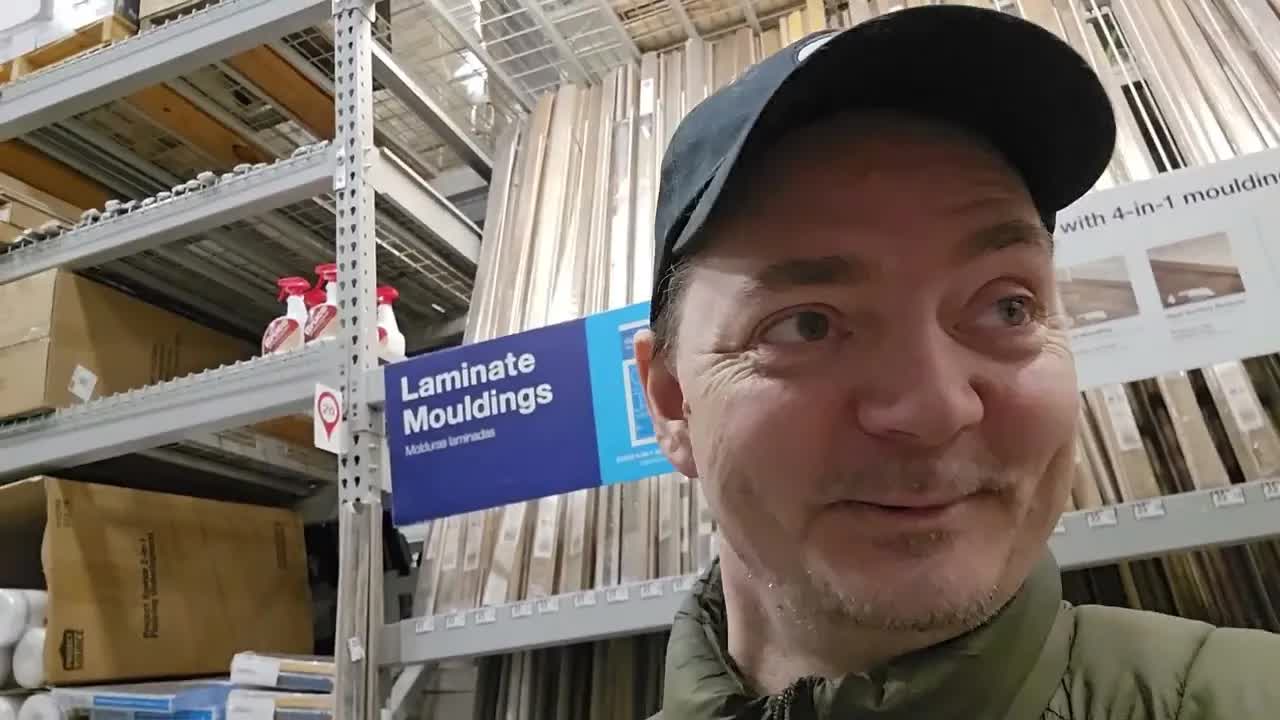
rswfire documents a shopping trip for RV insulation materials, showing excitement about the process while acknowledging uncertainty about proper usage. He displays various purchased items including R30 and R19 insulation, moisture barrier, insulation tape, and tools. He consulted ChatGPT for guidance on material selection. Plans include insulating floors with reflective material before installing laminate or wood flooring, though he notes the expense. Still needs to find piping/tubing and a safe indoor propane heater. The transmission ends with plans to check out rugs and spend the day insulating.

Mar 13, 2024 | (Null Island) · 25% match
Journey
Image unavailable
01:34

Reorganizing RV Storage After Removing Litter Box

rswfire addresses storage reorganization in his RV after removing a litter box from under the bed. He describes the difficulty of cleaning the disinfected area while lying on his side and evaluates different storage options for the newly available space. He considers tools, camping gear, and cleaning supplies, ultimately leaning toward storing cleaning supplies and shower items there. He expresses concern about accessibility, noting that items stored in hard-to-reach places tend not to get used. The decision is driven by practical needs, including avoiding the crowded shower house on weekends.

May 4, 2024 | (Null Island) · 25% match
Journey

Planning Sovereign Workstation Migration

# Sovereign Workstation — Migration Spec Wipe Windows off the Alienware. Install single-boot Ubuntu LTS. Migrate a decade of development across without loss. Hand the agent real authority across workstation, remote servers, GitHub, and phone. Two operators: **🤖 agent** (machine-side work) and **👤 you** (physical actions and irreversible decisions). **⚠️ = irreversible.** Format does not happen until Phase 1 is complete, copied off-disk twice, and verified against a manifest. The machine holds **two environments — Windows and WSL2**. Both are destroyed by the format. Every phase sweeps both. --- ## Phase 0 — Software audit (before anything is wiped) Goal: no installed tool is discovered missing after the wipe. The agent finds everything; you decide what carries across. - 🤖 Enumerate all installed software across **both Windows and WSL2**. Produce `app-inventory.md`. - 🤖 For each program, flag one of: native Linux build available / Flatpak / Snap / Linux-native equivalent / runs under Wine / no Linux option. - 🤖 For each, note license/reinstall implications (e.g. perpetual license reinstallable as-is, subscription, or config to preserve). - 🤖 Present the list to you. Do not assume; flag for decision. - 👤 Go through the flagged list and decide per program: carry across, replace, or drop. - 🤖 For every "carry across" item: stage its installer, license/config, and any settings export into the backup folder (Phase 1) so it survives the wipe. Output of Phase 0: a decided list — every installed program has a resolution (reinstall / replace / drop) and everything needed to reinstall is staged for backup. --- ## Phase 1 — Capture (must be complete before any format) Sweep **both Windows and WSL2**. Collect everything that dies on format and lives in no repo. ### Staging folder - 🤖 Create one staging folder (`~/migration-backup/`). Structure: ``` migration-backup/ ssh-keys/ # both environments gpg-keys/ env-files/ # every .env, both environments, all repos nginx/ # config files supervisor/ # local supervisor configs dotfiles/ # shell configs, git config, aliases installers/ # from Phase 0: installers, license/config, settings exports db-dumps/ # local Postgres not already on remote browser/ # bookmarks, saved passwords, 2FA/authenticator seeds app-inventory.md # from Phase 0 repos-status.md MANIFEST.md # checklist of everything captured ``` ### Collect (across both environments) - 🤖 **SSH keys** — WSL2 `~/.ssh/` and Windows `.ssh/`, PuTTY `.ppk`, Pageant. Private + public keys, `config`, `known_hosts`. - 🤖 **GPG keys** — export secret + public from both. - 🤖 **All `.env` / secrets files** — sweep every repo in both environments. - 🤖 **nginx configs** — sites-available/enabled and custom conf. - 🤖 **Supervisor configs** — local ones. Sweep **`/home/rswfire/.local/`** specifically, plus standard locations. - 🤖 **Dotfiles** — `.bashrc`, `.zshrc`, `.profile`, `.gitconfig`, aliases, custom shell setup. - 🤖 **Local databases** — `pg_dump` any Postgres not already on remote into `db-dumps/`. - 🤖 **Phase 0 installers/licenses/config** — staged into `installers/`. - 🤖 **Browser data** — bookmarks, saved passwords, and 2FA/authenticator seeds/backup codes. - 🤖 **User files** — list Documents / Desktop / Downloads contents; you flag what to keep. ### Git repos - 🤖 Enumerate every repo across both environments. For each, report in `repos-status.md`: branch, uncommitted changes, unpushed commits, untracked files. - 🤖 Commit every dirty tree to a `wip/pre-migration` branch and push. - 🤖 Flag the **Autonomy Realms tree (~10k uncommitted lines)** explicitly — branch and push first. - 🤖 Confirm every repo fully pushed to GitHub. ### Off-disk, twice - 🤖 Write `MANIFEST.md` — a checklist of every captured item. - 👤 Copy `migration-backup/` to the **external drive**. - 👤 Copy `migration-backup/` to a **second location** (encrypted remote path or second drive). - 👤 Spot-check both copies against `MANIFEST.md`: SSH private keys present, Autonomy `.env` present, installers open, DB dumps present. **✅ Gate:** manifest fully satisfied and external copy verified readable. Nothing past here is reversible. --- ## Phase 2 — Install media - 🤖 Provide current Ubuntu LTS ISO link + checksum + USB-write steps. - 🤖 Instruct: **"Burn the Ubuntu USB now."** - 👤 Burn the Ubuntu USB. - 👤 Boot it **live** on the Alienware — do not install. Confirm WiFi, keyboard, trackpad, external display, internal drive all work while Windows is still intact. - 👤 Keep a **Windows recovery USB** on hand. **✅ Gate:** live boot clean on this hardware; recovery option in hand. --- ## Phase 3 — Format + install ⚠️ - 👤 Wipe the **entire disk** — delete all existing partitions, including Dell OEM/recovery, Windows recovery, EFI, and any factory restore partitions. No Dell/Windows artifacts remain. Use "erase disk" / manual partitioning to remove every existing partition, not an install-alongside option. - 👤 Install **Ubuntu LTS** on the now-empty disk with: - **LUKS full-disk encryption** (checkbox at install; not addable later). - **Btrfs** filesystem for snapshots. - A fresh GPT partition table with only Ubuntu's own EFI + root (+ swap) partitions. **⚠️ Point of no return. Only proceed after both gates above are green.** --- ## Phase 4 — Rebuild - 👤 Copy `migration-backup/` from external drive onto the new machine. - 🤖 System update; install `git`, `curl`, build tools, `openssh-client`, `ufw` (firewall on), editor. - 🤖 Restore SSH keys to `~/.ssh/` (correct permissions), import GPG keys, place dotfiles, return `.env` files to their repos. - 🤖 Install **JetBrains Toolbox**; install owned versions of the flagged JetBrains products; restore IDE settings. - 🤖 Install everything else marked "carry across" in Phase 0. - 🤖 Install runtime stack: Node via `nvm`, PHP (required version), Postgres client, Docker if used, **Claude Code CLI**. - 🤖 Reclone repos from GitHub. - 🤖 Rebuild nginx + supervisor configs adapted to native Linux paths; recreate `~/.local/` layout. - 🤖 Restore local databases from `db-dumps/`. - 🤖 Configure snapshots (Timeshift or snapper) **before** any agent autonomy is enabled. - 👤 **Sanity gate:** run the full loop by hand — clone, edit, run a project locally, SSH to a remote server, push to GitHub, open a project in the restored IDE. --- ## Phase 5 — Agent authority (guardrails before autonomy) - 🤖/👤 Configure Claude Code for elevated autonomy on routine work. - 🤖 Branch discipline: agent works on branches, never `main`. - 🤖 Snapshot before large autonomous runs. - 🤖 Scoped credentials: GitHub fine-grained token limited to repos in play; server access as app user, not root, where possible. - 🤖 Destructive verbs gated: delete, force-push, production DB, destructive infra require explicit confirmation even in autonomous mode. - 🤖 Audit trail: command history, git history, session transcript. --- ## Phase 6 — Remote control (phone) - 🤖 Confirm Claude Code CLI version supports Remote Control + push notifications; confirm the coding account's plan has it. - 🤖/👤 Run `claude remote-control` on the workstation (or enable auto-connect in `/config`). Session surfaces in the Claude app; execution stays local; outbound connection, survives sleep/network drop, reconnects. - 👤 Phone app → **coding account**. Assistant-chat → browser/desktop on the **chat account**. No account-switching on the phone. - 👤 (Optional) raw shell from phone for non-Claude work: `tmux` + `mosh` + Tailscale. - 👤 Run one real task end-to-end from the phone to prove it. --- ## Phase 7 — Close out - 👤 After a week of stable Ubuntu, retire the Windows recovery USB. --- ## Build-time confirmations (verify live, don't assume) - Current Ubuntu **LTS version**; Btrfs snapshot tool (Timeshift vs snapper) for that release. - Minimum **Claude Code CLI** version for Remote Control + push; coding account plan has it enabled. - Native-Linux availability for each Phase 0 "carry across" program. - If using the optional shell path: current Tailscale + mosh setup for Ubuntu.

1 document
Jul 6, 2026 | Oregon Dunes > Siltcoos · 25% match
Public
Image unavailable
01:39

Struggling with Downsizing Technology for RV Life

The speaker wakes up from a nap with wild hair and realizes they have a spatial problem in their living area. They describe their social/living/eating area and note that a monitor doesn't belong in that space. They express difficulty giving up possessions during what appears to be preparation for mobile living. While books can be replaced with Kindle versions and movies can be streamed, they struggle specifically with parting with game consoles, computers, and monitors. The speaker acknowledges being at a tradeoff stage where they must determine what really matters to them in order to gain other things.

Mar 23, 2024 | (Null Island) · 25% match
Journey
Image unavailable
09:48

Defending Integrated Process Against Superficial Solutions

rswfire explains his methodical approach to RV-related tasks, contrasting it with what he sees as superficial responses from others. He describes taking time to properly set up visibility systems (mirrors, dash cam), spending a month learning to empty tanks, and six months before getting propane. **Each task becomes a source of pride and satisfaction because of his thorough preparation process.** He expresses frustration with comments like "go to Tractor Supply" or "watch a YouTube video," explaining these responses bypass his integrated approach. **His process involves mental, ethical, and practical preparation** - considering navigation challenges, potential problems, and holistic understanding rather than just completing tasks quickly. rswfire emphasizes that his **integration of emotions, ethics, thoughts, and actions** means he doesn't just rush into situations. He scouts locations, works through scenarios mentally, and learns comprehensively. This approach transforms routine tasks into meaningful experiences rather than chores. He notes that people who truly listen would understand his perspective rather than offering quick fixes.

Sep 24, 2024 | · 25% match
Firesworn
Image unavailable
03:09

Building Sanctum Subscription System and Refactoring Signals

The realm holder walked to the ocean at Siltcoos beach, experiencing strong winds that recalled a previous winter spent at Cape Blanco enduring 80 mph winds. They took the Lagoon Trail, revisiting the Lagoon Campground where they spent two weeks off-grid after leaving Honeyman and initially started working on Autonomy. They documented recent development work: implementing Sanctum access for all realm holders, enabling subscription services through direct Stripe integration without middleman involvement, adding tiered membership options, refactoring homepage content (structure and surface reflections) to become core signal attributes, and beginning synthesis feature development including model router and LLM API querying. They created a settings page allowing users to input their own API credentials to avoid charging the realm holder for LLM usage. After working all day, they took a break to walk the trail before returning to continue development work.

Jan 7, 2026 | Oregon Dunes > Siltcoos Beach · 25% match
Firesworn

The Book You Didn't Write: Vibe Coding vs. Architectural Understanding

Imagine asking an AI to write you a novel. You describe the feeling you want — the tone, the genre, the vibe. It produces something. And honestly? It's good. The prose flows. The characters breathe. A reader picks it up and enjoys it. But you didn't write it. You don't know what's on page 47, or why the author made that structural choice in chapter three, or how the subplot in act two was set up to pay off in act four. You don't know the rules the book is playing by — because you never made them. Now someone asks you to add a chapter. You go back to the AI. It writes something. But it doesn't know what it wrote before — not really. It guesses at the thread. It gets the tone close. But the new chapter contradicts something on page 47, breaks the subplot, and introduces a character who shares a name with one who died in chapter six. You don't catch it. Because you never knew the book. You publish it anyway. Readers start finding the cracks. --- This is vibe coding. Not the tool — the approach. The pattern of building without understanding. Of shipping what feels right without knowing what's underneath. Of trusting the output without reading the architecture. The code works. Until it doesn't. And when it doesn't, you have no footing. You can't debug what you never understood. You can't extend a system whose logic was never yours. You can't maintain a structure you never built. So you go back to the AI. It patches the crack. And creates three more you won't find until they're load-bearing. --- The book analogy holds further than it looks. A novelist doesn't just write words — they hold a world in their head. They know which details are decorative and which are structural. They know what the story can survive and what will collapse it. They make a hundred invisible decisions per page, most of which never appear on the surface. That knowledge is what makes expansion possible. That knowledge is what makes repair possible. Without it, every addition is a guess. Every fix is a risk. A system architect holds the same thing. Not just the code — the reasoning behind it. The tradeoffs made, the edge cases considered, the failure modes anticipated. The parts that look arbitrary but aren't. The constraints that look like limitations but are actually load-bearing walls. You can't vibe your way into that. It has to be built. --- AI is a tool. A powerful one. Used well, it accelerates work that a knowledgeable person is already doing — the person who will read what it produces, catch what it missed, and integrate it into something coherent. Used as a replacement for that person, it produces books nobody can finish writing. The code ships. The system runs. And somewhere down the road — when the client needs a new feature, when the traffic spikes, when the edge case arrives — the bill comes due. And the author isn't there to pay it. Because there was no author. There was only a vibe. --- *I build systems I can explain, extend, and defend — because I wrote them.*

Feb 18, 2026 | (Null Island) · 25% match
Public
Image unavailable
09:55

Showcasing Entertainment Website Project from Freelance Partnership

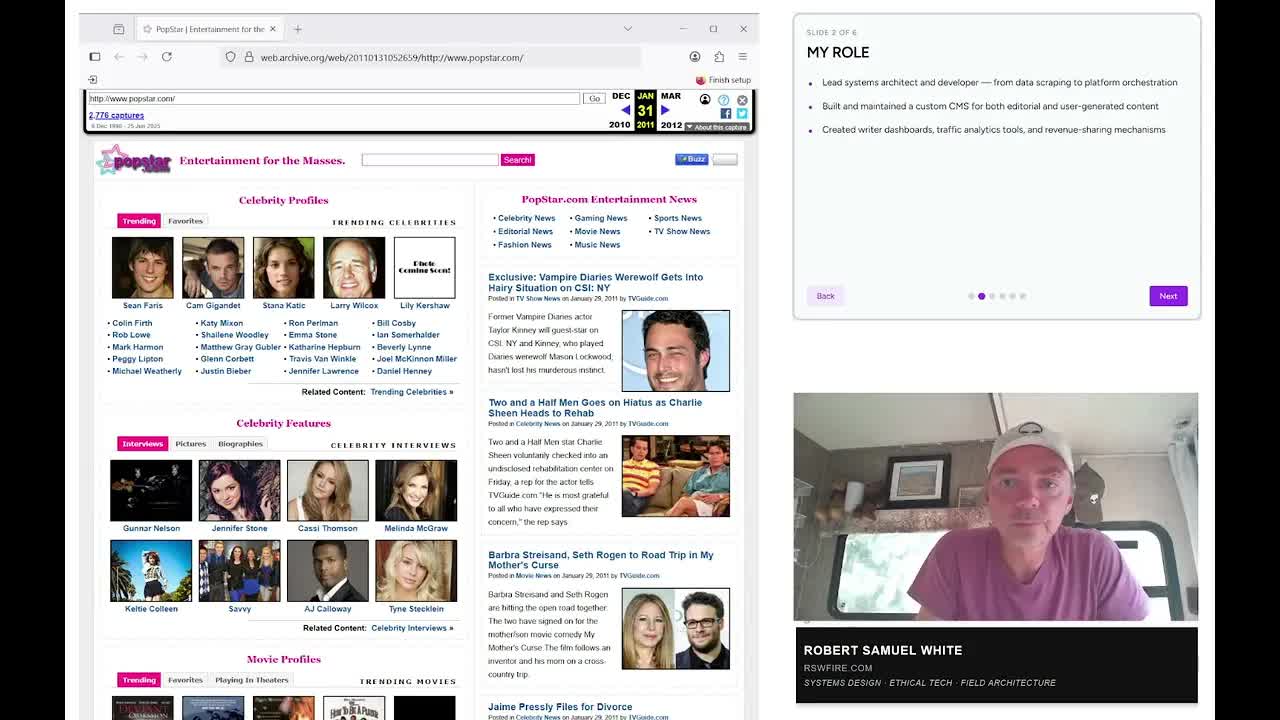
rswfire presents the first video in a series documenting his work, focusing on an entertainment website project from a 10-year freelance partnership. He acknowledges difficulty with linear presentation but proceeds to demonstrate a locally-running version of the site via slideshow. The project was built using PHP, MySQL, and his custom CMS called Enet Wizard Matrix Server, which he developed from his teens and later made open source. The website featured comprehensive entertainment content including celebrity biographies, movie reviews, and TV show recaps. rswfire recruited and managed writers globally, implementing a revenue-sharing system with dashboards showing trending content and traffic sources. The site included a gamified point system where users could write reviews, rate content, and participate in monthly merchandise auctions using earned points. Notable features included celebrity love awards where users wrote letters to celebrities, with winners receiving custom CDs containing static websites of their letters. The site was populated through web scraping, APIs, and partnerships with entertainment sites including TV Guide. rswfire emphasizes the community-building aspect, describing it as a pre-social media gathering place focused on meaningful participation and reciprocity.

Jul 23, 2025 | Oregon Dunes > Driftwood II · 24% match
Public