Lexington · Feb 15 – Apr 11 2024
This cluster documents a 56-day build sequence in Kentucky, from COVID isolation in mid-February 2024 to the eve of departure on April 11 — rswfire's 47th birthday — the date he sets as the start of full-time RV living.
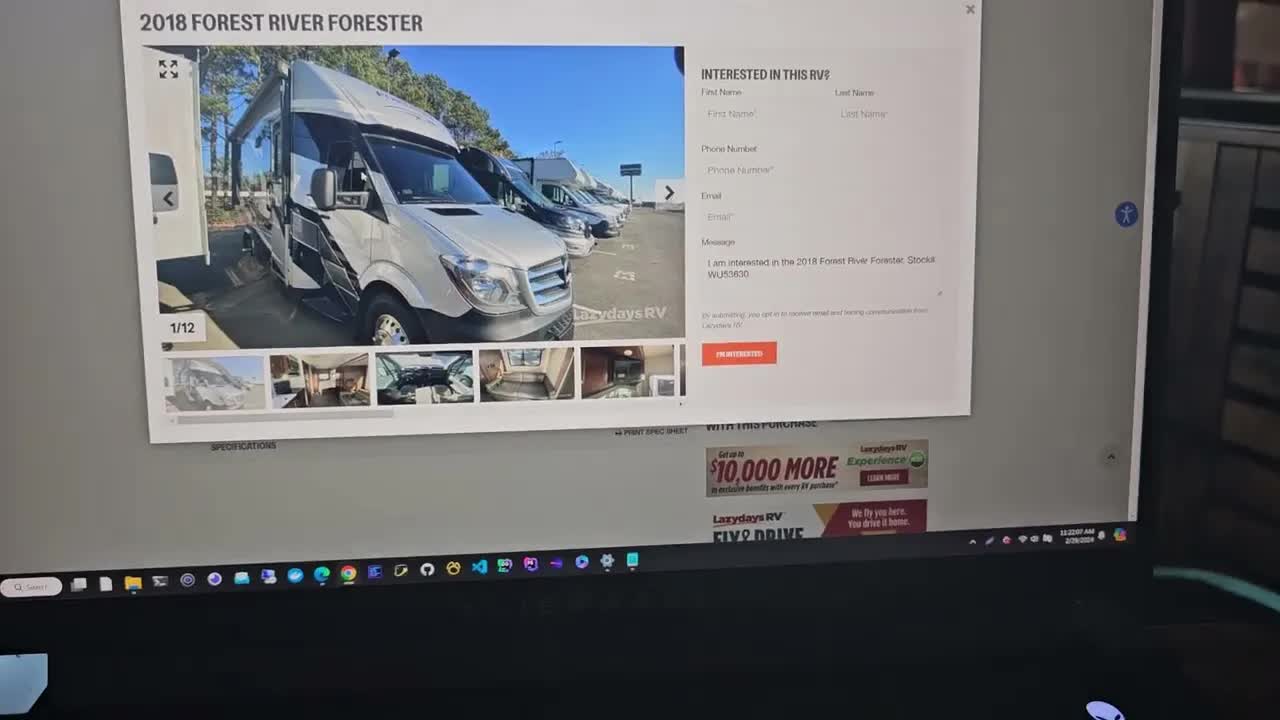
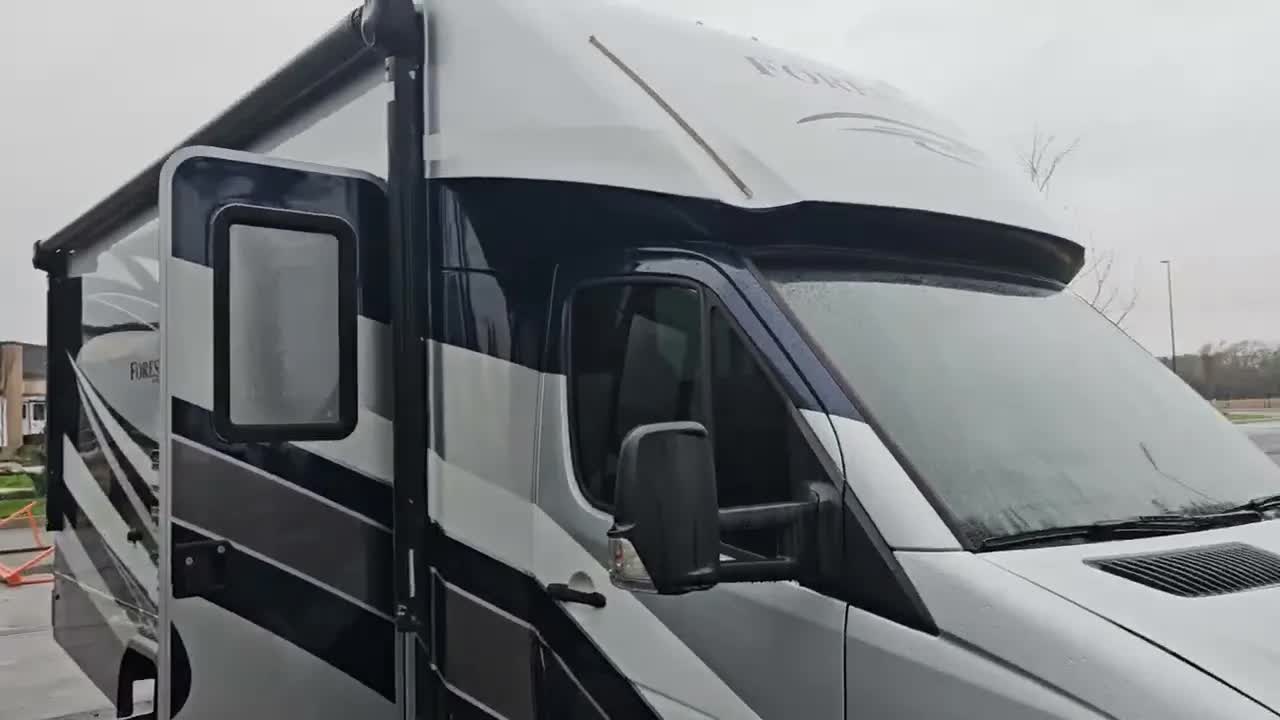
The spine is procedural and sequential: decision, research, purchase of a 2018 Forest River Forester at Lazydays in Murfreesboro, delivery drive, driveway shakedown, and continuous outfitting. Recurring work threads include insulation (repeatedly torn out and redone against 32°F interiors), electrical and tank-cable troubleshooting, solar install, tow-package fitting on the Jeep, leveling, and inspection.
Running parallel: liquidation of a household — lease notice given for April 30, possessions sorted into what travels and what does not — and dental reconstruction following full extraction, which he attributes on camera to lifelong Mountain Dew consumption.
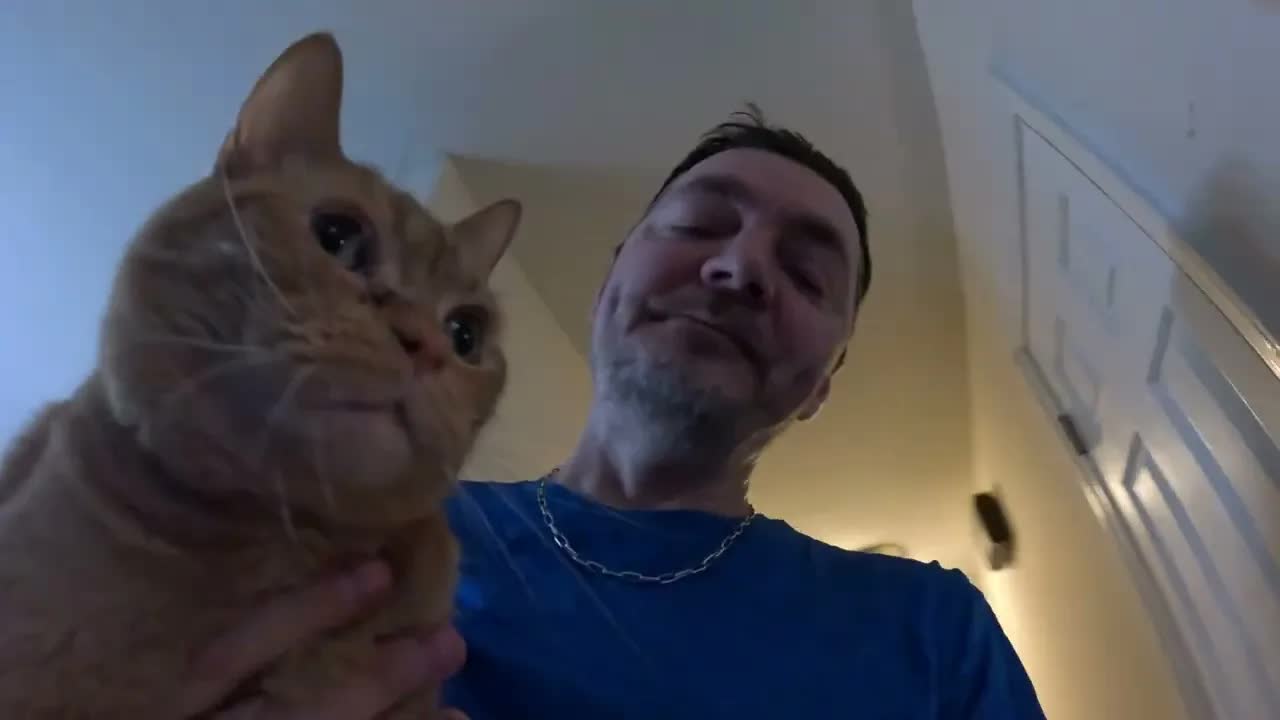
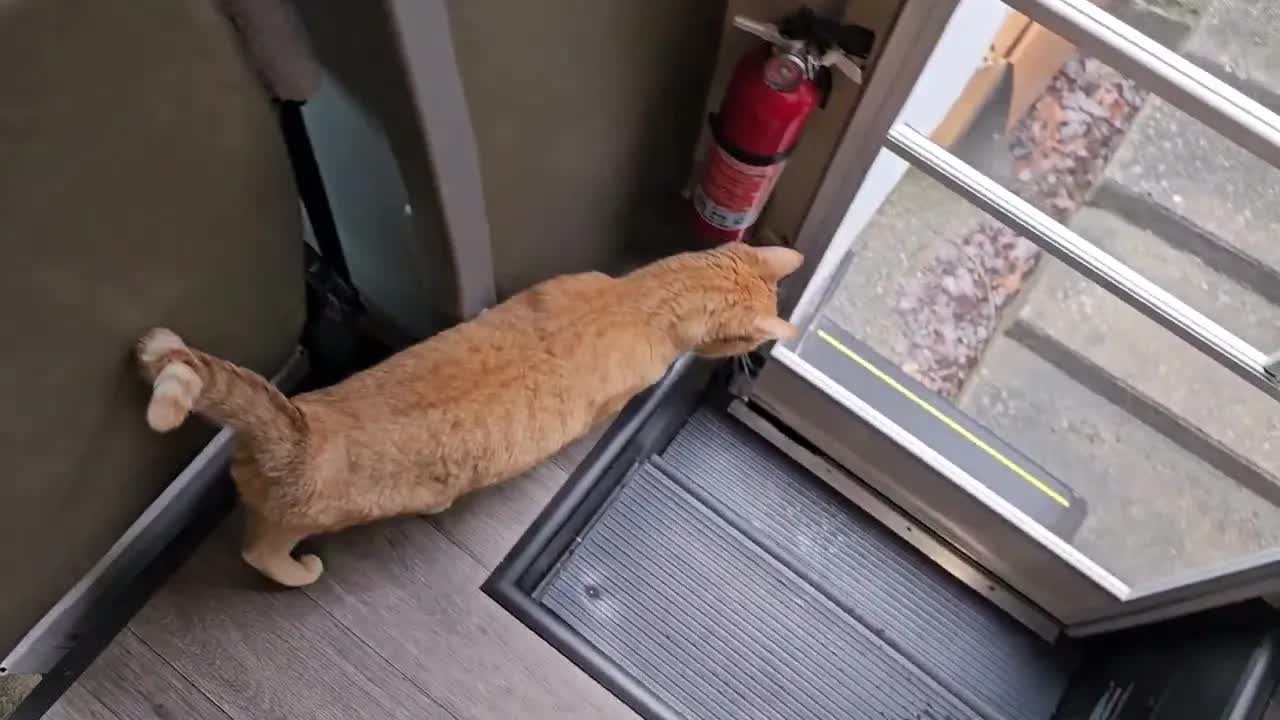
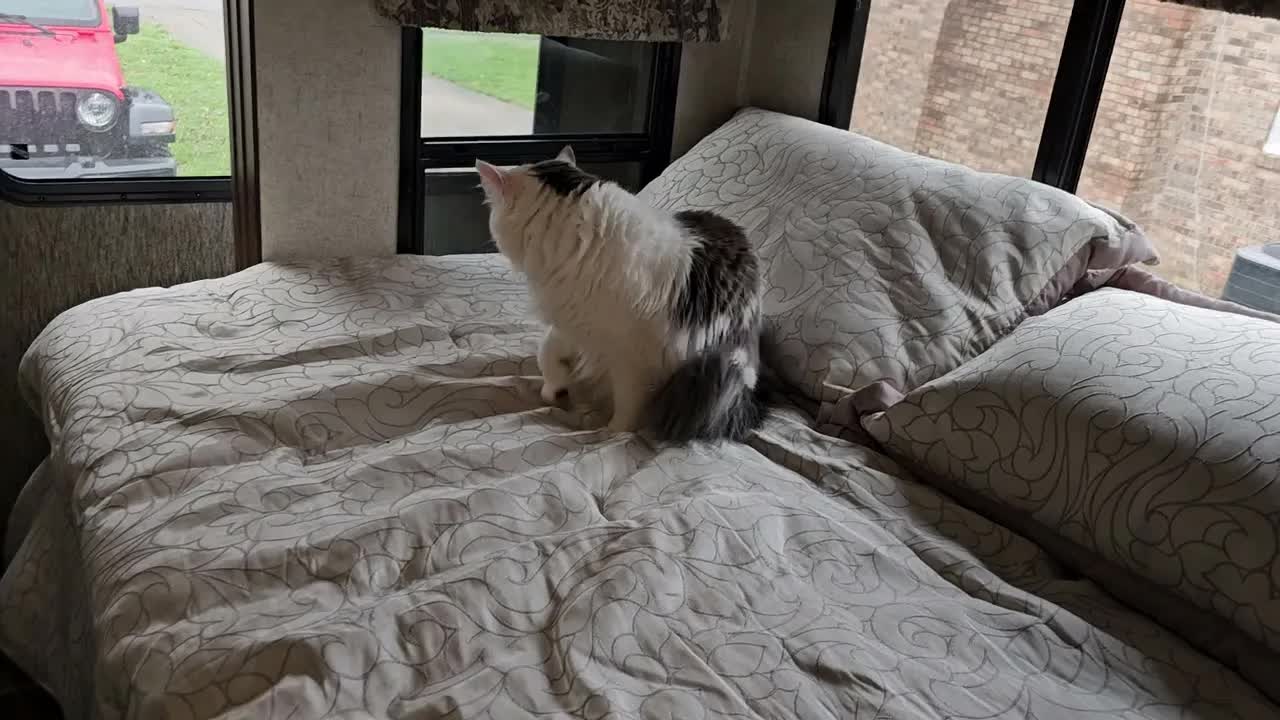
The cats, Bailey and Oliver, are a persistent operational domain: enclosures, acclimation one at a time, transport containment, allergy management. Family appears as labor and friction — his father on wiring and solar, his mother on cats and errands, and a documented decision to hold position on public disclosure under family pressure.
The cluster is also the origin record of a YouTube channel: recording technique, GoPro and mic testing, a first edited video, a stated correction away from metrics toward authentic documentation, and named credit to Caroline's RV Life as the trigger.
Transmissions (106)
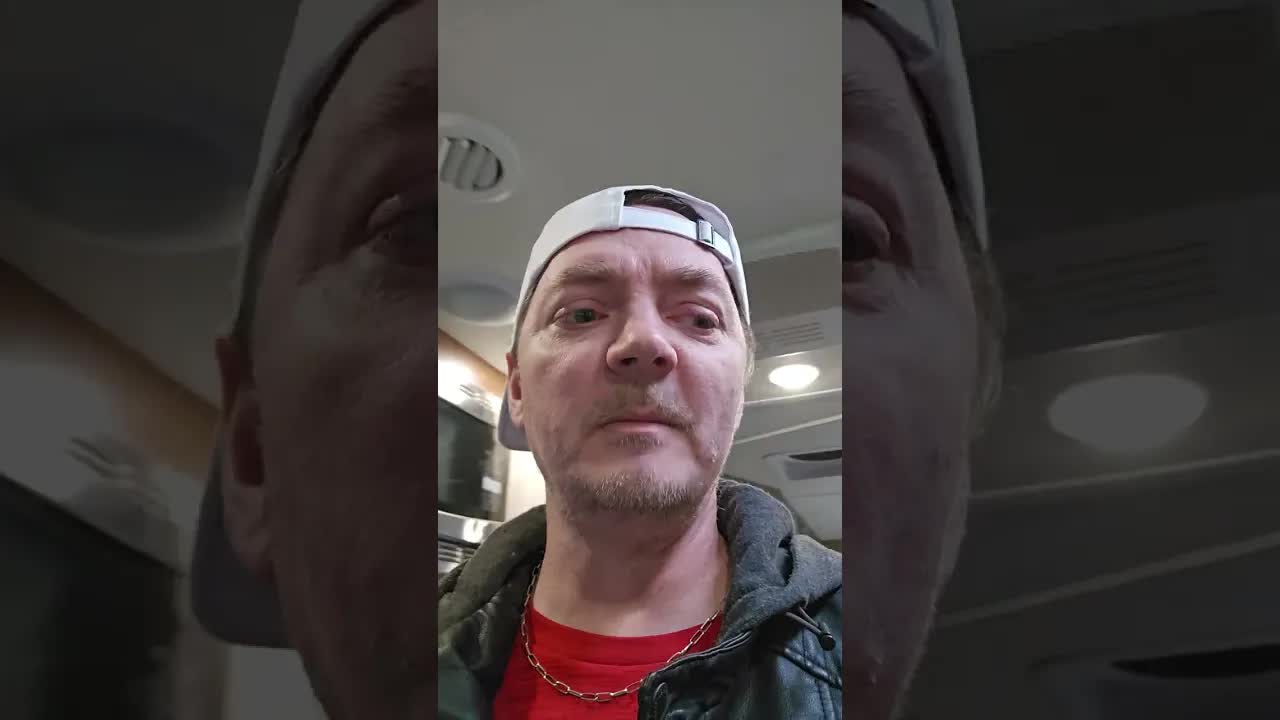
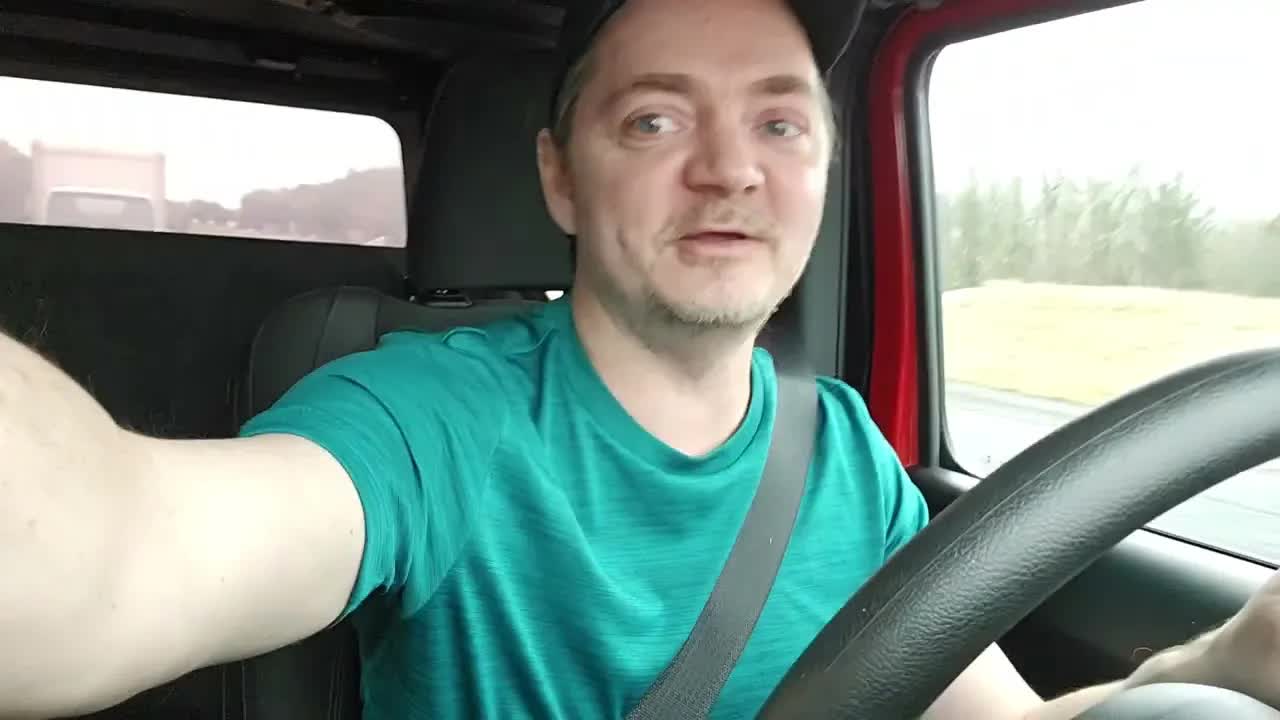
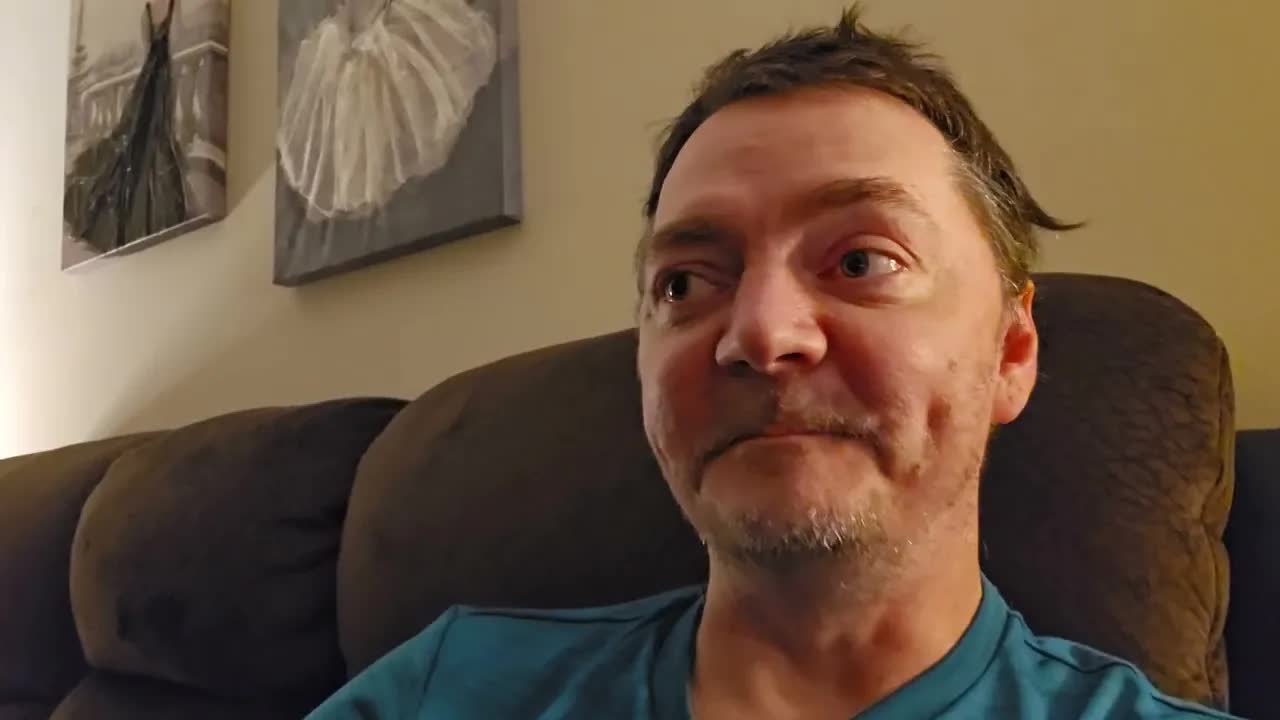
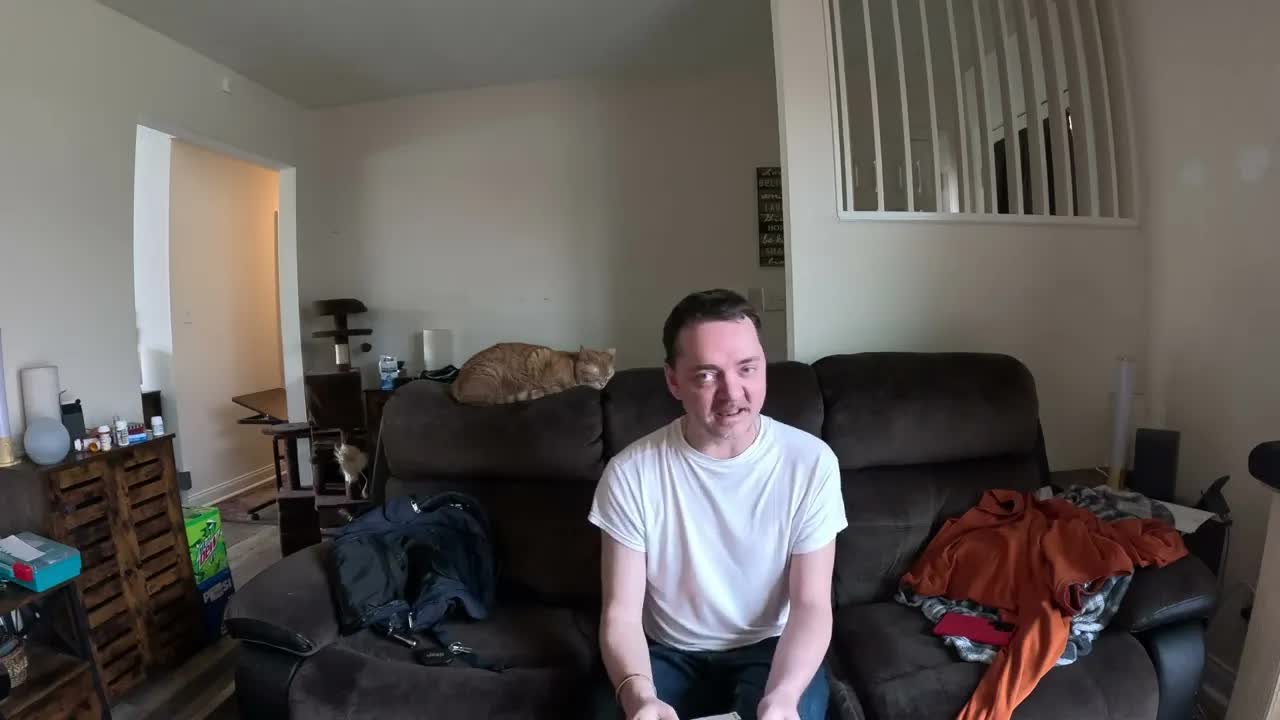
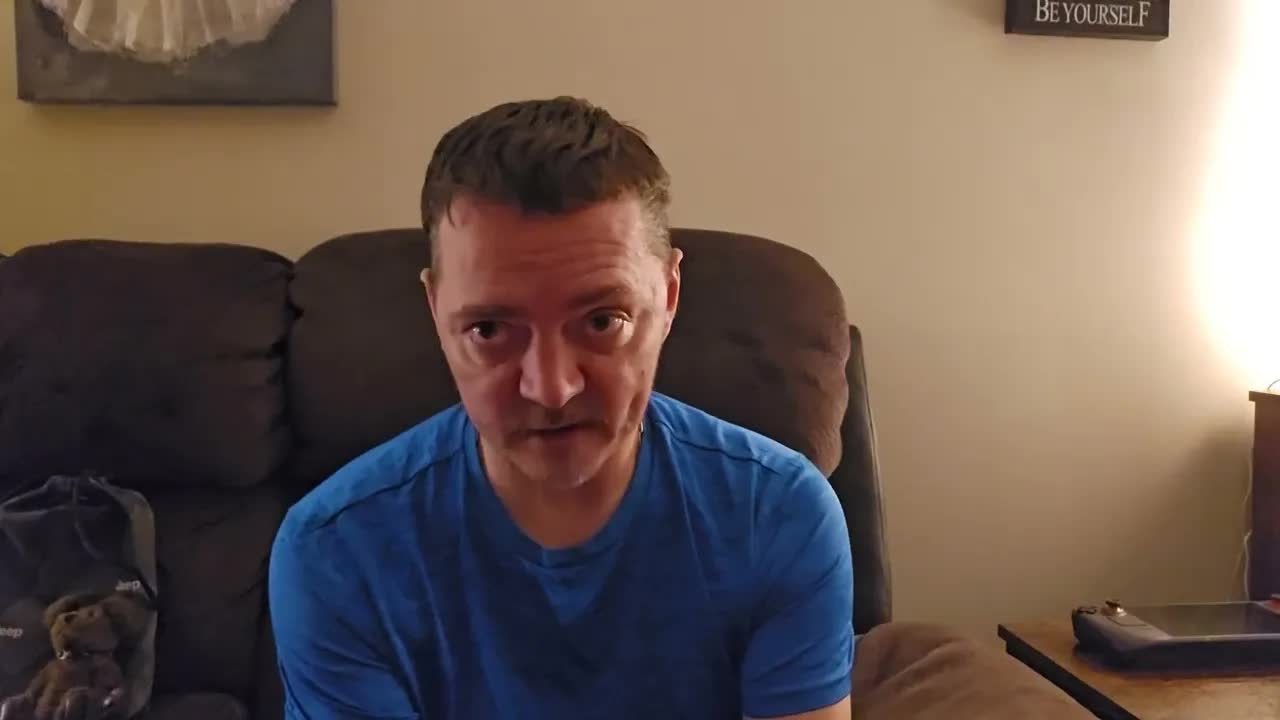
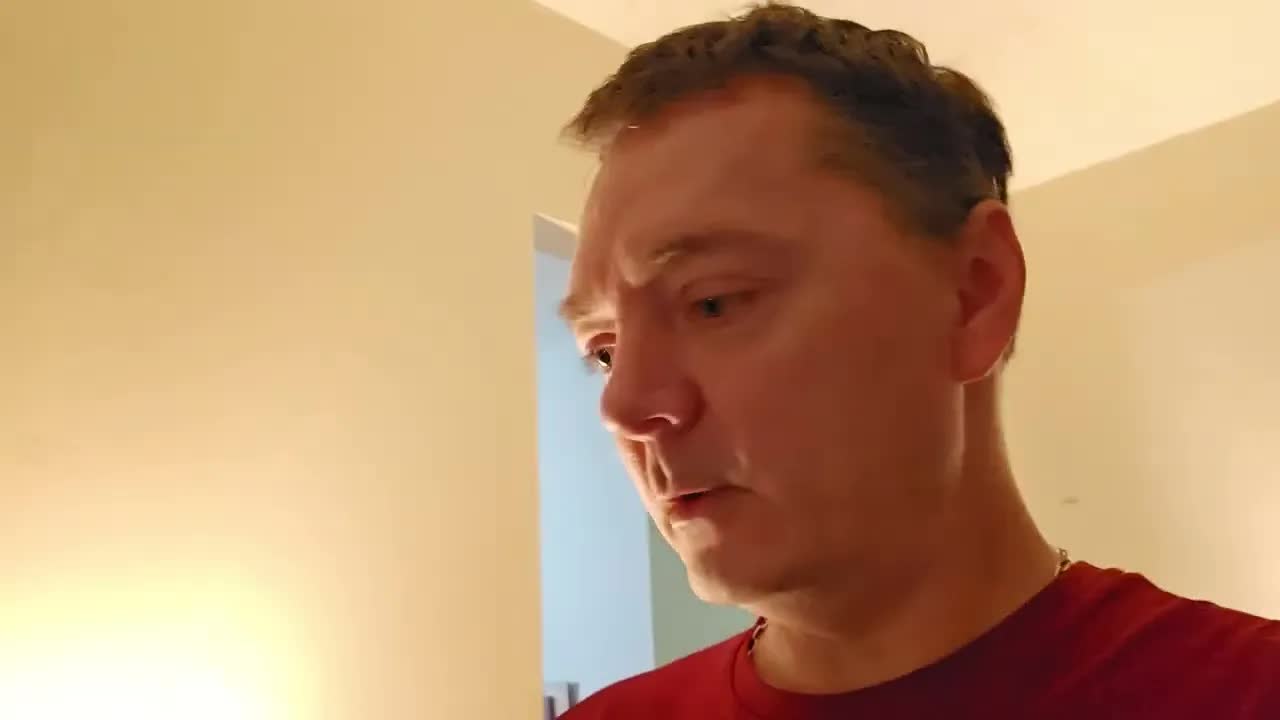
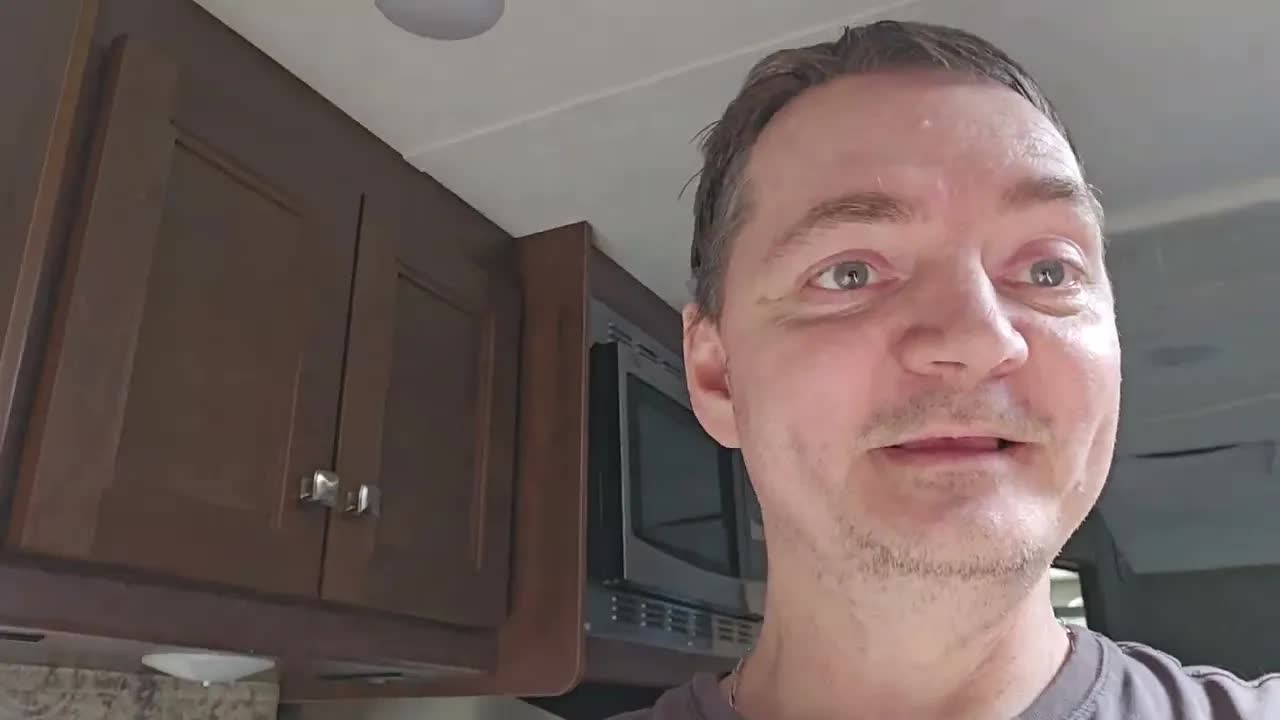
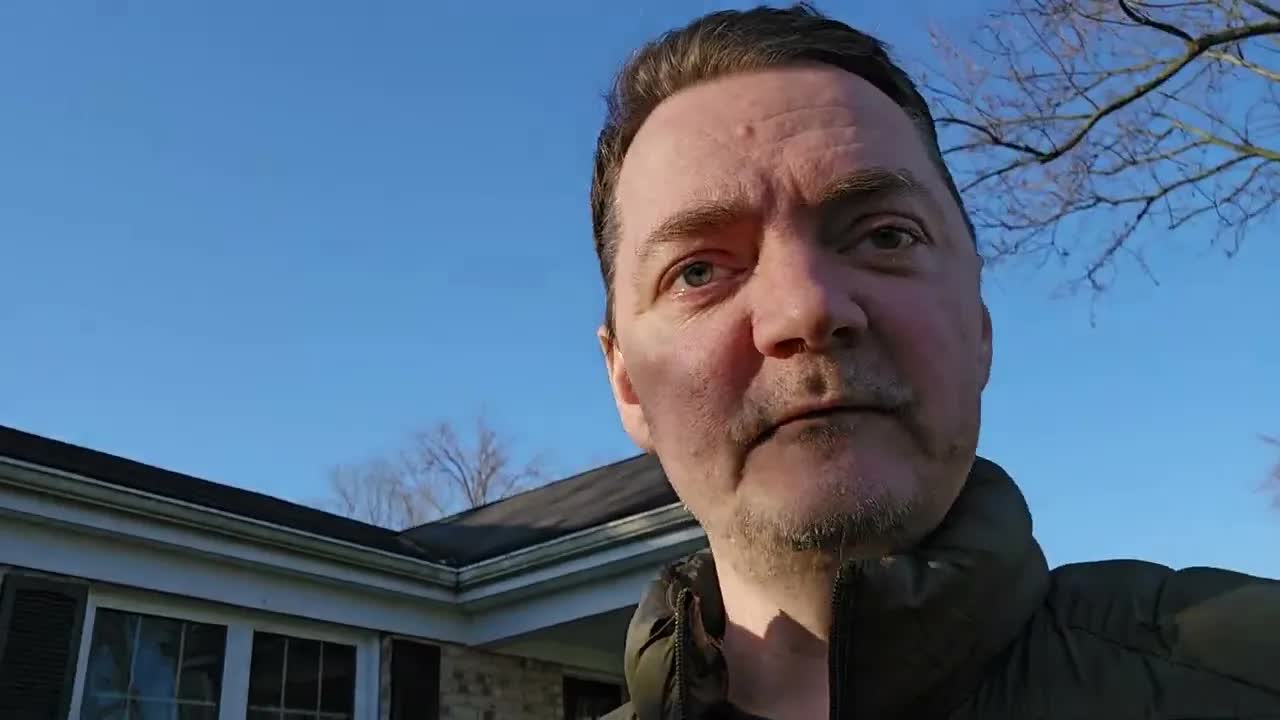
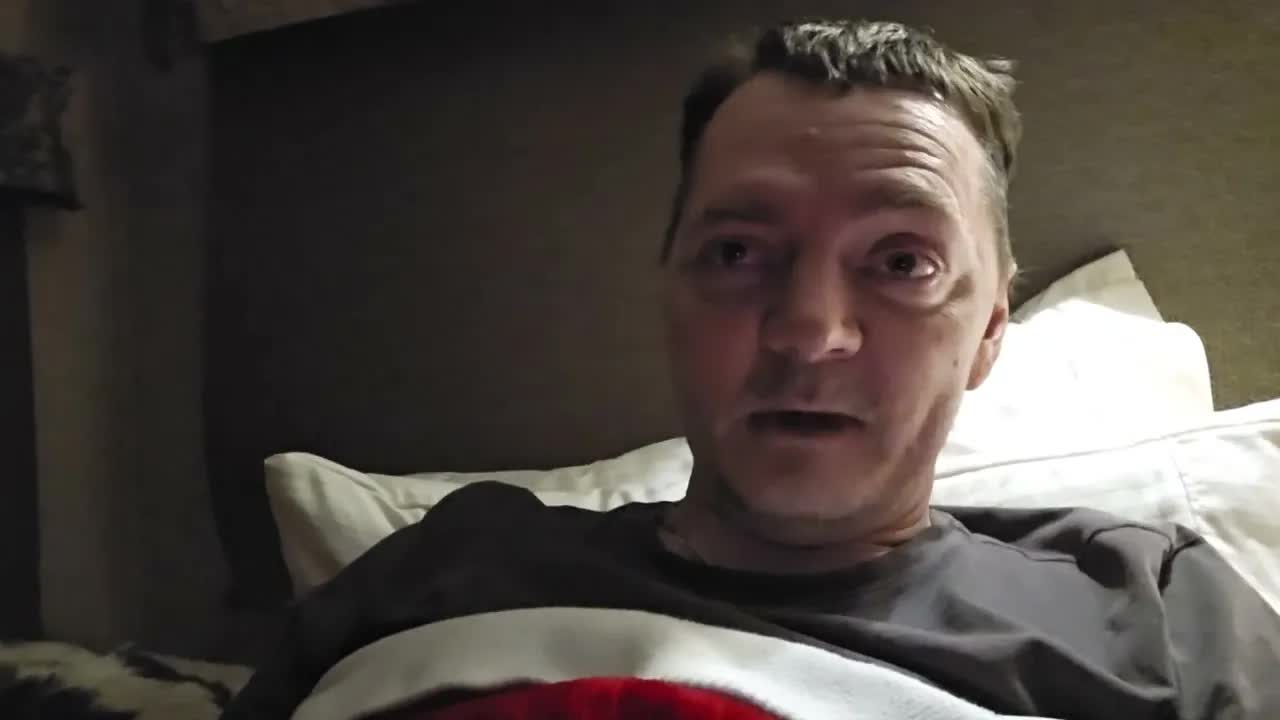
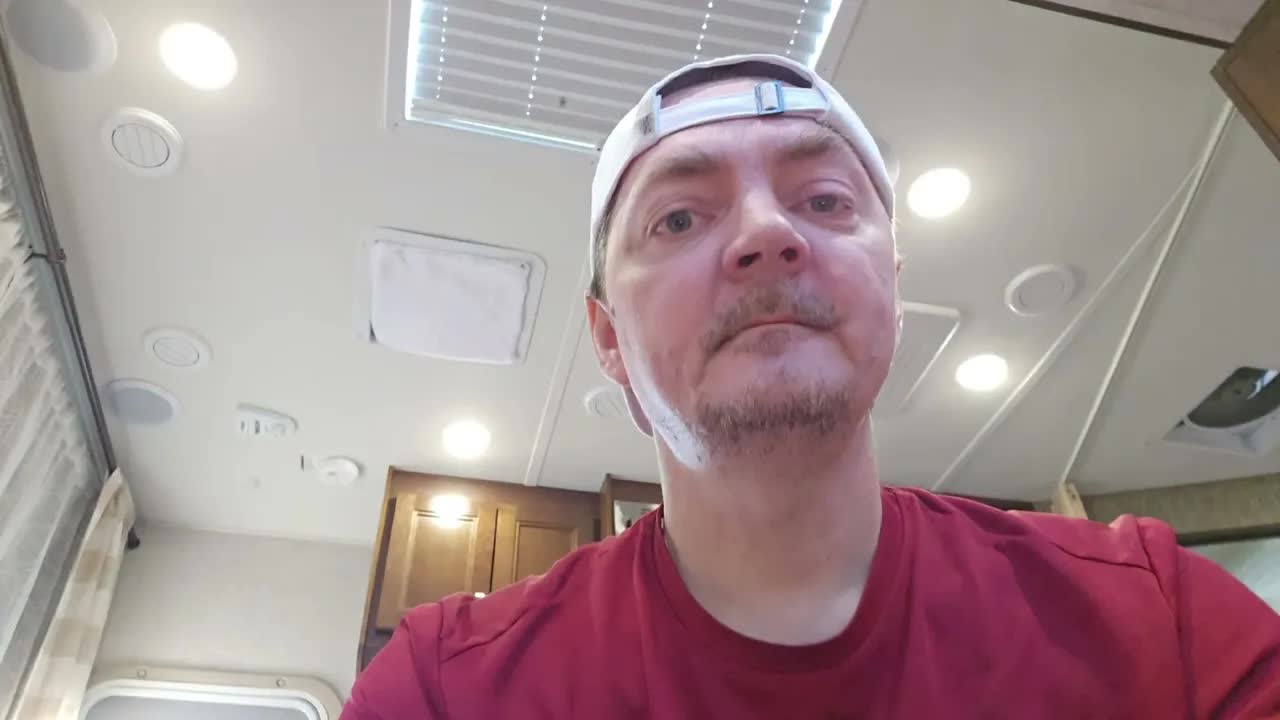
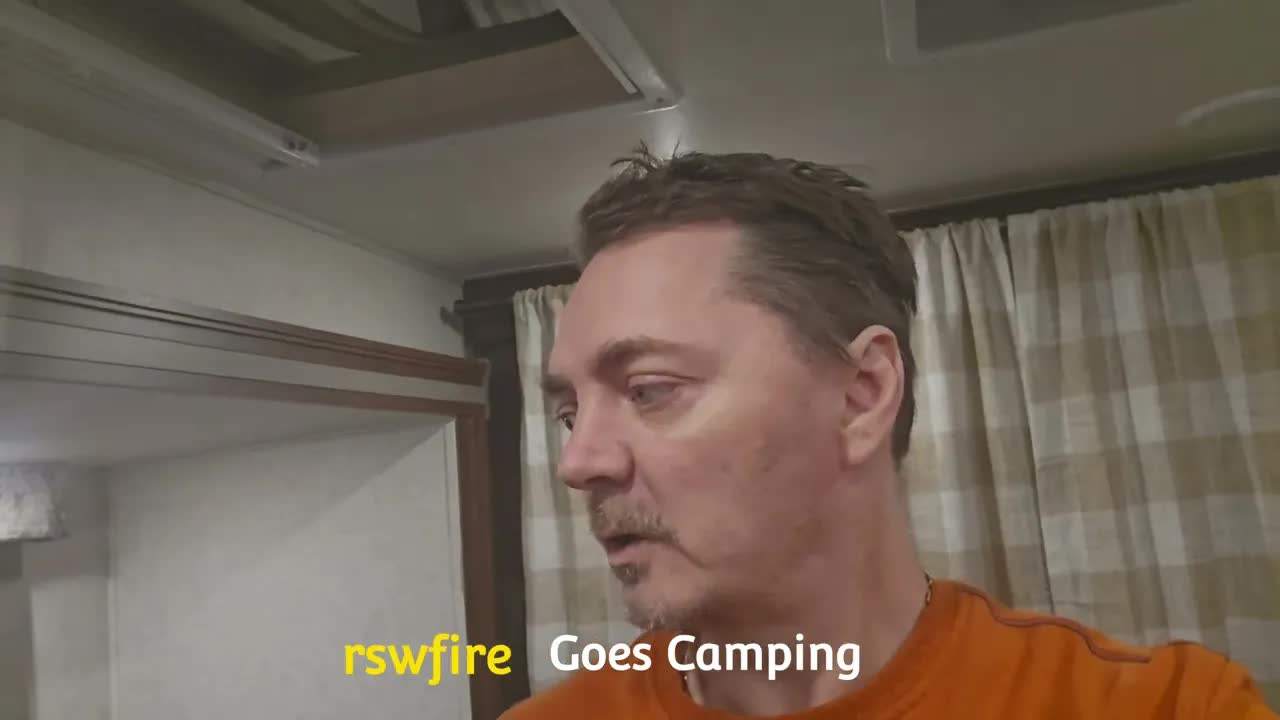
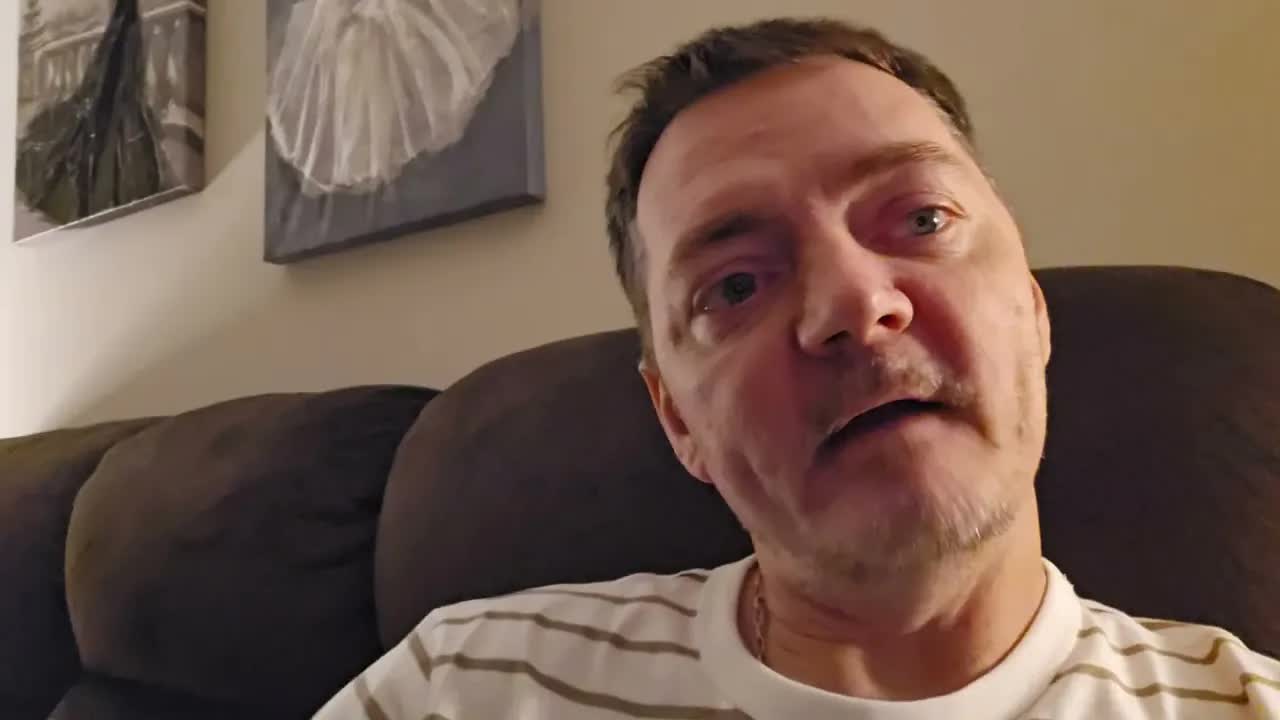
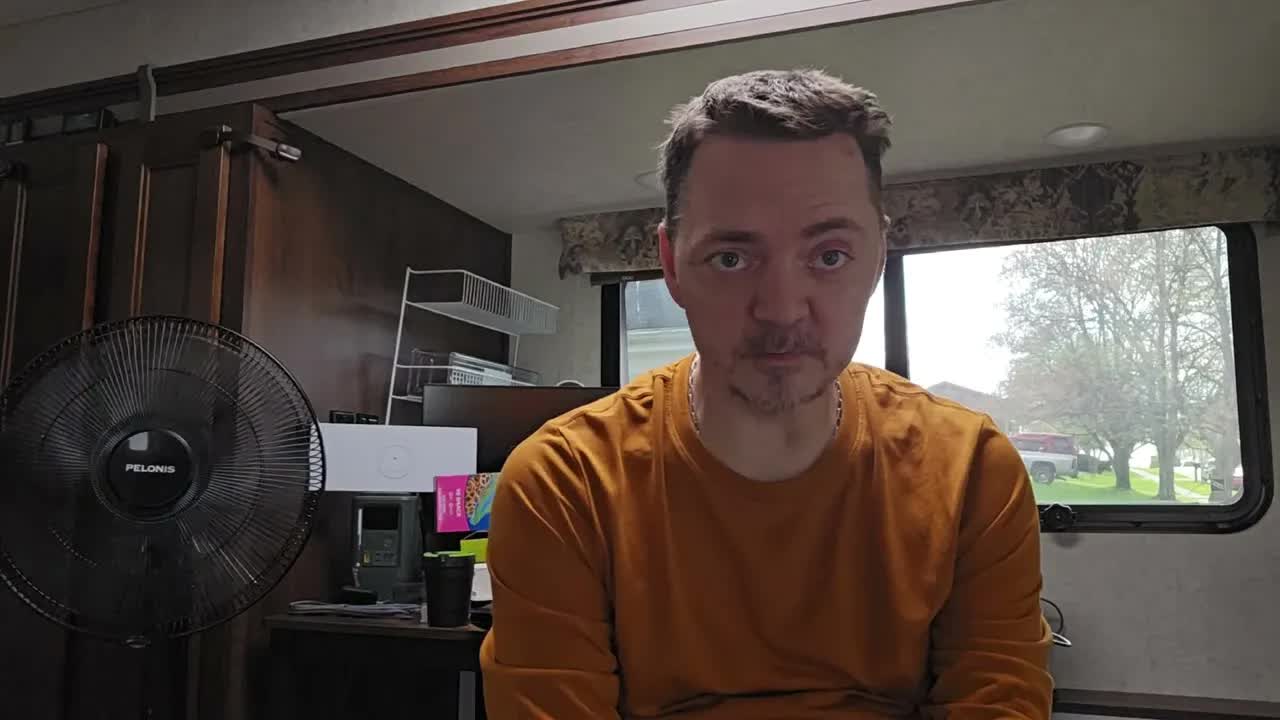
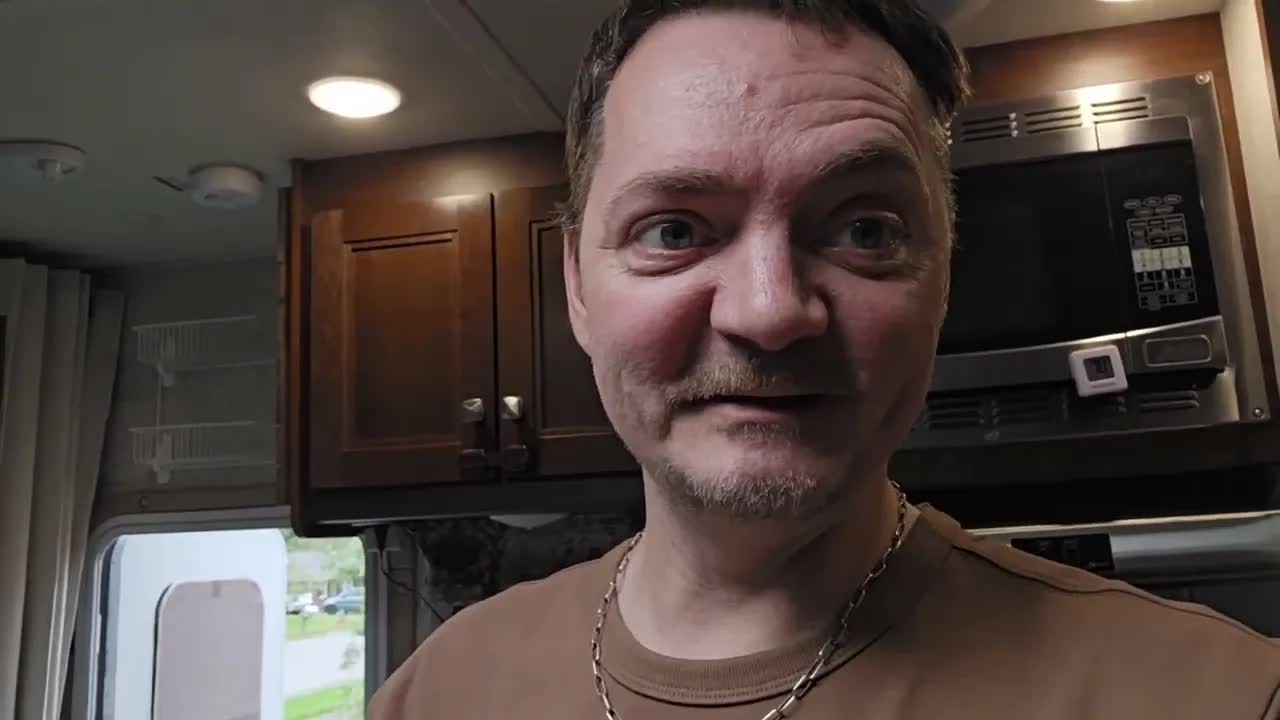
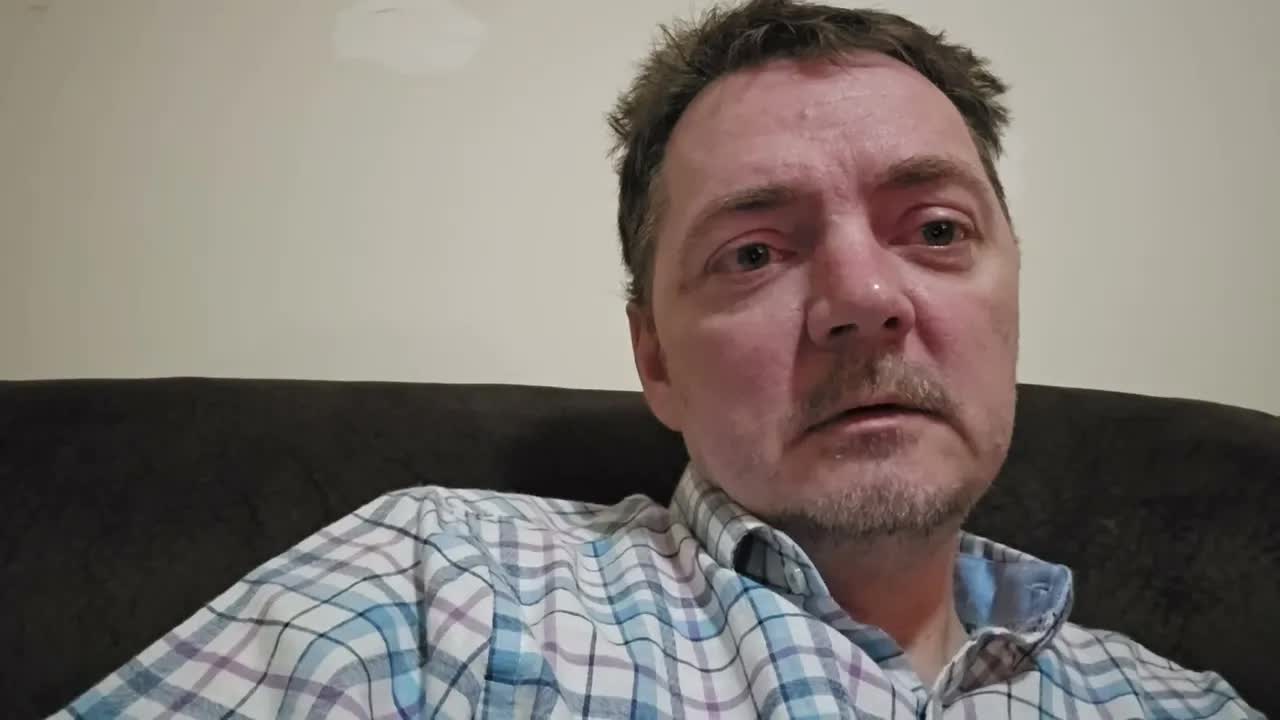
rswfire opens a first video transmission stating he has not scripted it and wants the record to begin at the point of decision rather than after the fact. He states he is **46, turning 47 in two months**, has no teeth, attributes this to lifelong Mountain Dew consumption, has bottom and temporary top dentures he cannot wear due to a gag reflex, and has **implant surgery scheduled in two days**. He declares the core decision: **sell the contents of his house, buy a camper, and live the RV lifestyle**. He describes an earlier version of this plan roughly twenty years prior — a pop-up camper, a winter drive to a New Jersey client, no cooking or shower capacity — which he abandoned. He notes a **December land purchase intended to become his own campground fell through over a title issue**. On equipment, he works through the constraint chain: his **2023 Jeep Wrangler** tows only 2,000 lbs; Class B vans lack room for his **two cats, Bailey and Oliver**, both taken in after abandonment. He concludes on a **Class C towing the Jeep**, new or used undecided, with boondocking as an interest. He states he is a programmer since childhood with income to fund the transition and a continuing need to work, describes himself as an introvert who has stayed largely in his house since COVID, names driving and towing as his stated fear, and frames the practice as becoming comfortable with discomfort.
Cluster Analysis
Substrate
Tags
Dominant Language
Entities
Actions
Performed
- • announced the decision to live full-time in an RV on video
- • started and sustained a daily YouTube transmission
- • toured dealerships and placed a deposit
- • secured RV financing and selected the lender
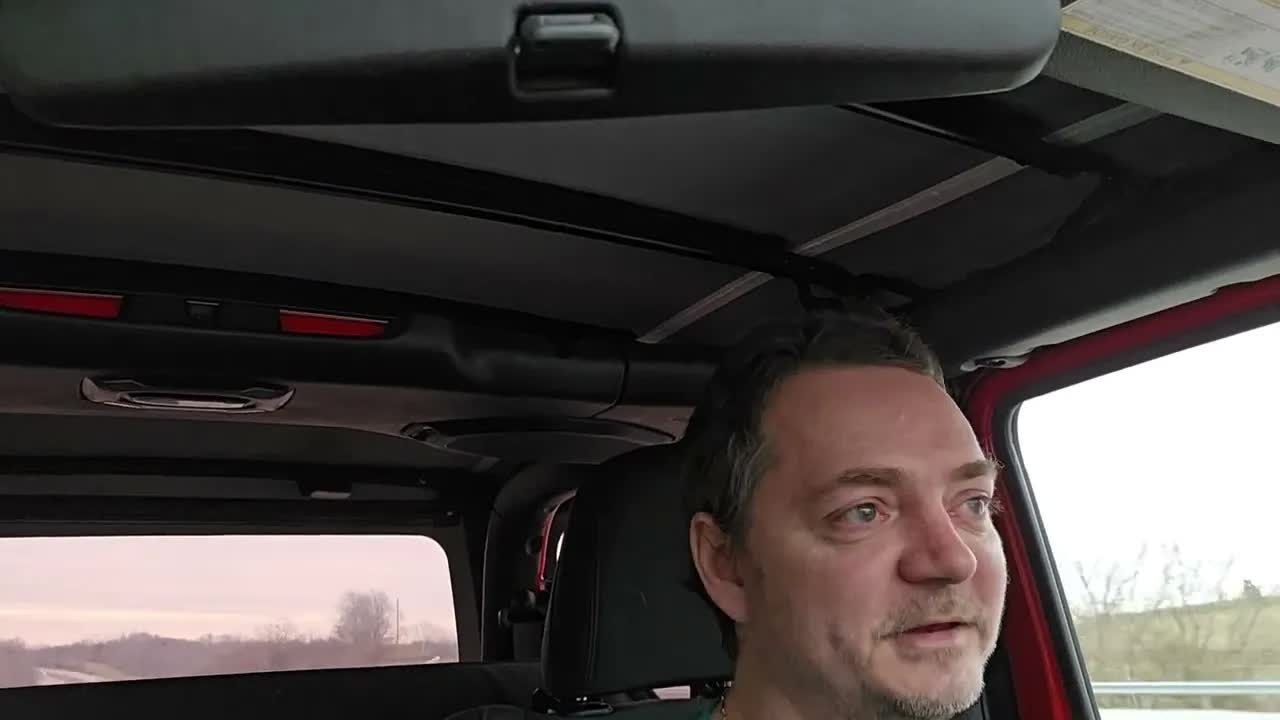
- • took delivery and drove the RV home for the first time
- • underwent oral surgery for four jawbone implants
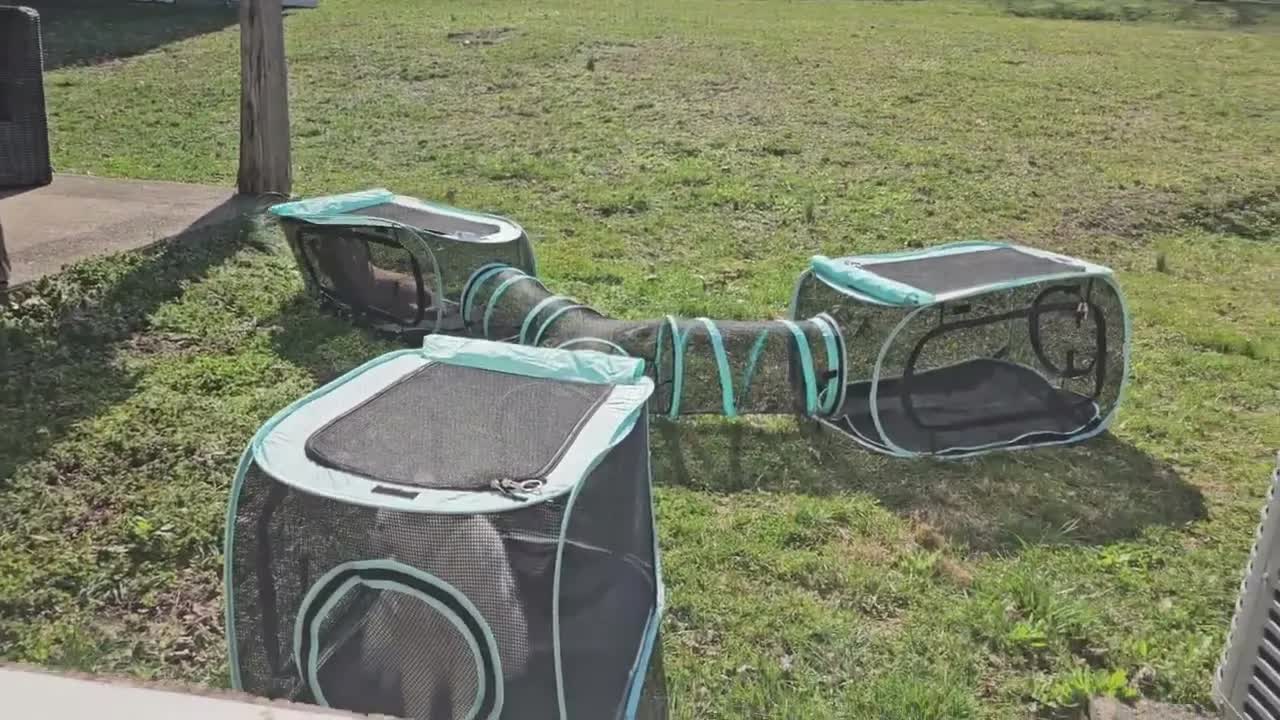
- • assembled an outdoor cat enclosure
- • acclimated Bailey and Oliver to the RV one at a time
- • slept in the camper for the first and subsequent nights
- • leveled the rig on a sloped driveway with stacked blocks
- • installed curtains
- • insulated kitchen, living area, underbelly, and access panels with Reflectix and rigid board
- • tracked interior temperature against outside temperature
- • redid insulation work judged not good enough
- • traced a blown fuse behind a panel the dealership said not to open
- • diagnosed stuck stabilizer jack and non-functional black and gray tank cables
- • called a mobile RV technician
- • had a tow package and dash cam installed on the Jeep
- • recalculated cargo weight limits and towing capacity
- • registered the Jeep and passed RV inspection
- • purchased and tested GoPro, SD cards, microphones, camera system
- • installed and commissioned solar panels with his father
- • gave notice to break the lease effective April 30
- • sorted and divested possessions
- • held position on public disclosure under family pressure
- • corrected channel drift toward metrics
- • launched a Discord server
- • booked the first month of campgrounds
- • set April 11th — his 47th birthday — as the departure date
- • retracted the slide and secured the rig for travel
- • filmed and edited his first edited video
- • documented cost figures publicly, including a $5,345 towing quote against a $2,000 budget
- • named the rig Caroline
- • credited Brandon, Brian, his father, his mother, and Caroline's RV Life by name
Referenced
- • taught himself to code in sixth grade
- • lifelong Mountain Dew consumption named as cause of dental loss
- • prior full extraction and implant surgery
- • prior periods of homelessness
- • intended purchase of 18 acres in Campton, Kentucky for a campground
- • week-long trip to Arizona while mother watched the cats
- • leaving a prior career and life described as not his
- • five months of ChatGPT-4 use beginning in November/December
- • watching Caroline's RV Life before starting
- • ruling out Class B vans early in the search
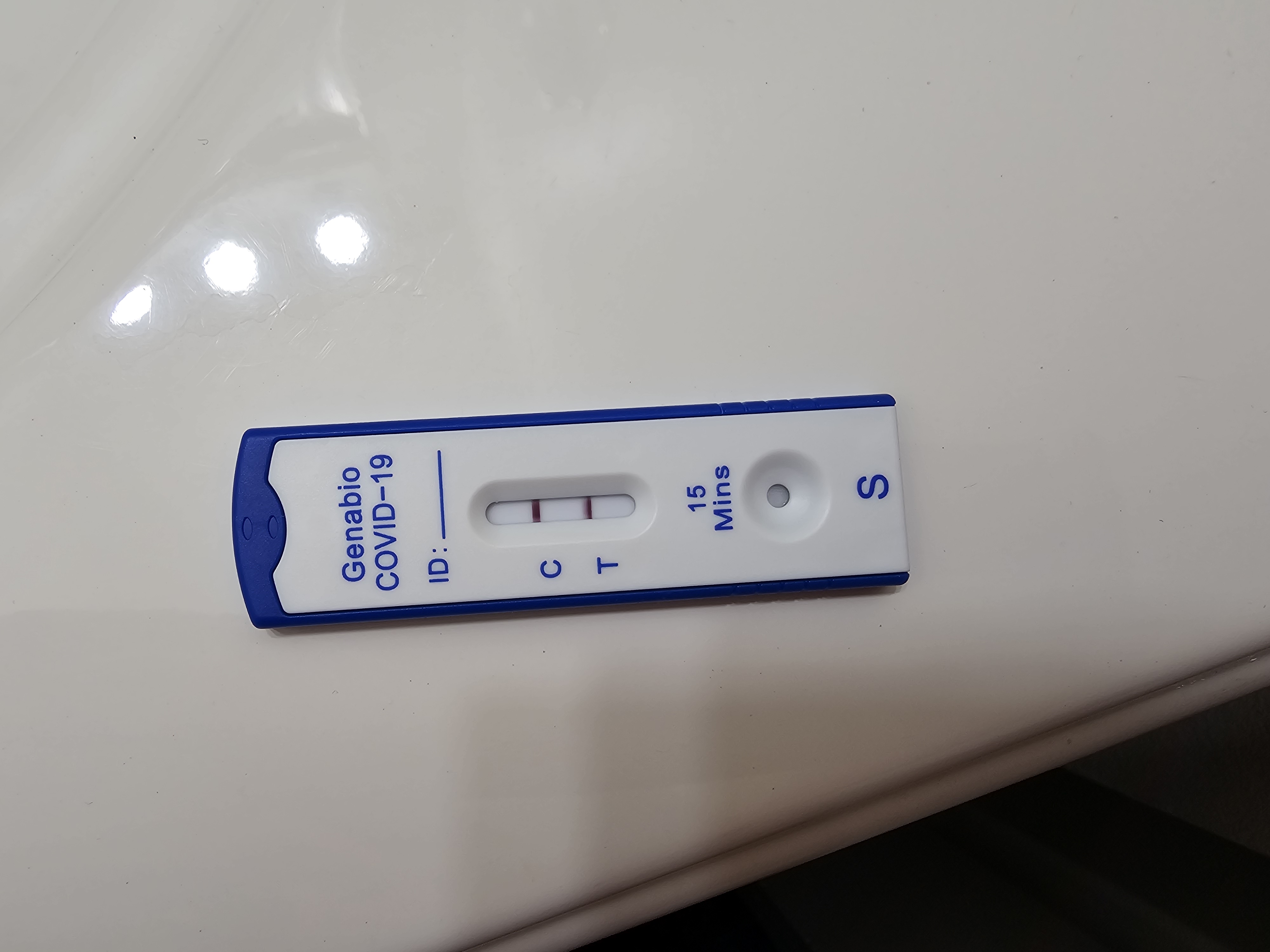
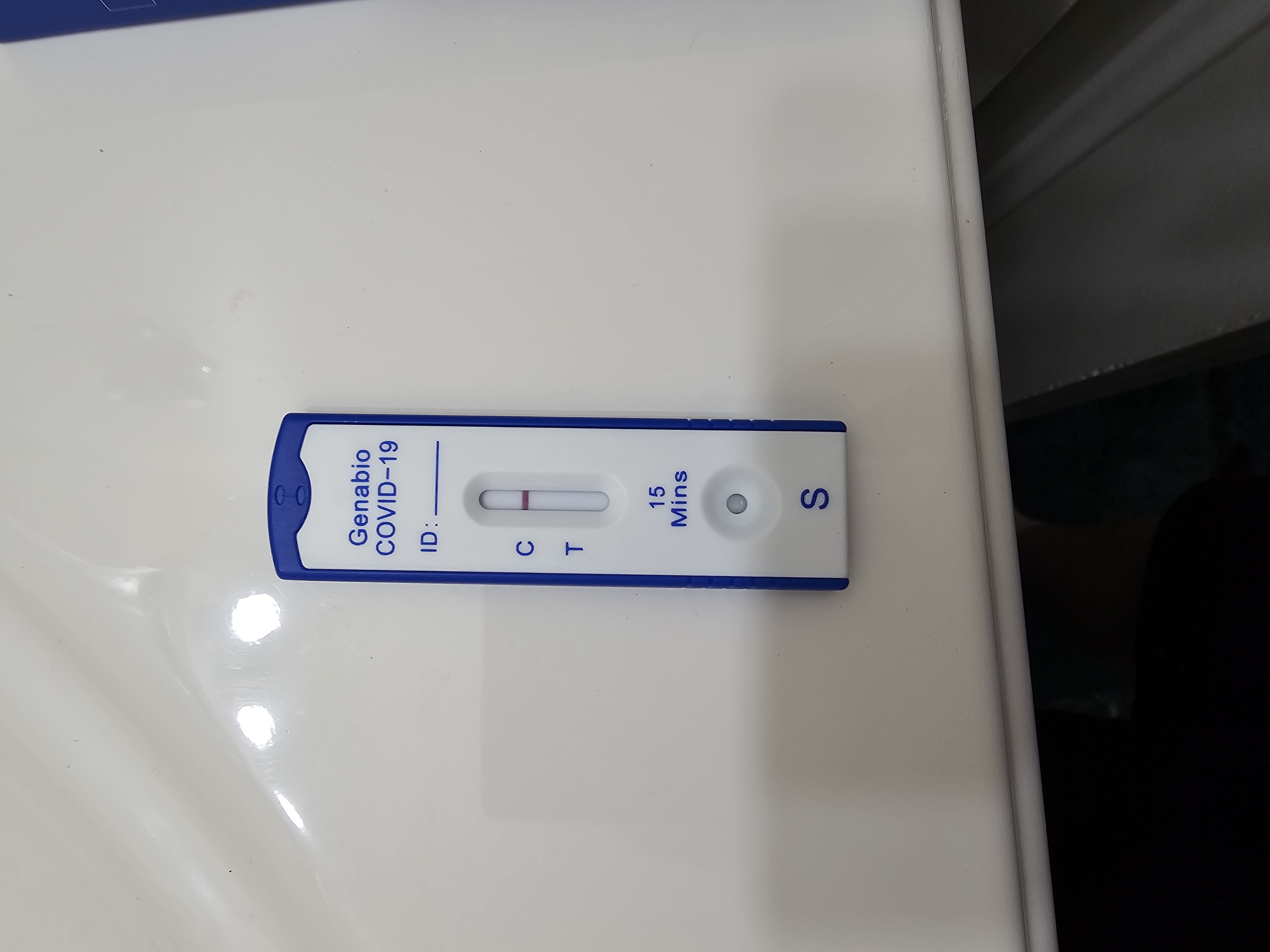
- • COVID infection in February
- • relationship history — last boyfriend in his late twenties
- • adopting Bailey at a day old and Oliver with a chronic eye condition
Planned
- • depart April 11th for Barren River Lake State Resort Park
- • vacate the house by April 30
- • sell all remaining belongings
- • start full-time travel on the West Coast
- • boondock as the primary camping mode
- • receive final teeth in three months
- • continue insulation and buildout projects
- • learn editing software and upgrade capture equipment
- • keep the record unedited and self-directed rather than metric-driven
- • possible merch through an apparel company he has managed platforms for
Symbolic Elements
Ontological States
-
•
sovereign authorship (deciding the terms, the date, and the record himself; refusing family-mediated control over what is disclosed)
-
•
chosen houselessness (explicitly differentiated from prior homelessness — the RV as elected structure rather than absence of one)
-
•
learning in the open (competence built on camera, errors and cost overruns entered into the record rather than edited out)
-
•
threshold occupancy (living inside a system still being built — driveway shakedown as the interval between two dwellings)
Subsystems
-
•
thermal (insulation, propane furnace, ceramic heater, tracked interior/exterior temperature as the central habitability metric)
-
•
electrical/power (fuses, wiring, hidden access panels, two solar panels commissioned for off-grid capability)
-
•
mechanical/drivetrain (towing setup, brake upgrades, cargo weight limits, stabilizer jacks, leveling blocks)
-
•
plumbing/waste (black and gray tank cables, mobile-tech diagnosis, self-sufficiency in system maintenance)
-
•
financial (loan approval and rate comparison, $5,345 towing quote against a $2,000 budget, lease-break cost, liquidation of possessions)
-
•
documentary/media (YouTube channel, GoPro and camera upgrades, first edited video, metric-drift correction, Discord)
-
•
somatic (dental implants and pain, sleep durations logged nightly, arm soreness from driving, cat allergies, smoking disclosed on camera)
-
•
relational/family (father and mother as build labor and presence, boundary held against family pressure on disclosure, load-shedding of obligation)
-
•
animal care (enclosure, containment, transport, acclimation — dependents provisioned before self)
-
•
institutional/regulatory (dealership authority, Sheriff's Department inspection, registration, landlord jurisdiction and lease notice)
-
•
informational (ChatGPT-4, Facebook groups, installers consulted directly over forum opinion)
NARRATIVE
It begins with a man who has no teeth, a case of COVID, a rented house in Kentucky he has not yet given notice on, and no idea how an RV works — pressing record. That order matters, and rswfire says so out loud in the first video: he wants the record to start at the decision, not at the competence. Everything that follows in the fifty-six days between that first unscripted transmission and the morning he pulls out of the driveway is the working-out of a single wager — that a person may state the terms of his own life before he has demonstrated he can meet them, and that stating them first is what produces the meeting.
The wager has a history behind it that he names once, plainly, and does not dwell on. He has been homeless. He draws the distinction himself — houseless, not homeless — and it is not a euphemism but a structural correction: the same physical fact, authored rather than imposed. Eighteen acres in Campton he meant to buy and did not appear in the record as a framed photograph, a version of the thing that stayed a plan. What separates Caroline from that photograph is not certainty. He says on camera that he is scared, that terror and happiness alternate. What separates them is a date, set in advance and in public, on his own birthday, so that the new life and the life share a start marker and neither can quietly absorb the other.
The engine of the Kentucky build is refusal of deferred authority, and its emblem is a panel. The dealership technician told him never to open it — that's for us — and he and his father opened it and found the blown fuse. That gesture repeats across every system he touches: he polls a Facebook group, discards the divergence, and calls the installers who actually do the work; he takes a $5,345 towing quote against a $2,000 budget and does not treat the number as an authority either; he uses ChatGPT-4 not as an oracle but as a surface to reason against. Nothing is learned by trusting a person who knows. Everything is learned by opening it, failing at it, and doing it again — and the failure is filmed at the same resolution as the success, because a record that only shows the second attempt is a different genre entirely.
Heat is the metric that decides whether any of it is real. A shelter that cannot hold temperature is a vehicle with furniture in it, and for weeks the interior reads 32 degrees at eight in the morning while he checks the cavities for moisture and decides the insulation he already installed is not good enough and tears it out. Cardboard wrapped on both sides, Reflectix, rigid board, drawer removed for access, four hours starting at six a.m. — the number on the thermostat climbing to 40.8, to 55 in shorts with the propane off, to 60 holding steady, to 80 with one fan insufficient. Bailey and Oliver are the arbiters. They are introduced one at a time, provisioned before he provisions himself, tracked through the dash and the corners and the first thunderstorm on the roof, and the day they settle is the day the box becomes a habitat.
Running against the build, in perfect inversion, is the dissolution of the house. One structure fills while the other empties: Amazon boxes stacking in rooms whose contents are being sorted into travels and does-not-travel, a monitor that will not fit and is simply set down — this is not going to work — a lease broken at cost effective April 30, a bed finally buried under objects so there is no clear place to sleep in the room he is leaving. The teeth run on the same schedule as the rig. Four steel rods drilled into the jawbone in late February, healing ahead of estimate by March, a body being rebuilt on a parallel timeline while he holds a Mountain Dew bottle up to the lens and states the cause without softening it.
The second construction project is the record itself, and it is nearly lost once. Three in the morning, in from the rain, he names what has happened: he has started making decisions with an eye on the numbers. He states the correction and returns the channel to documentation. Days earlier he had held a harder line — family pressure to take something down, and a decision to leave it up, filmed. These are the same act as the opened panel, applied to authorship rather than wiring. His father comes for the solar and the firewall drilling; his mother comes for the cats and the rugs; the labor is welcome and the editorial control is not transferable. What survives is unedited: the smoking, the twelve-hour sleep after a week of four, the week he says has not been fun yet, the dozen retakes because of how he sounds.
By the time the slide comes in for the first time — clothes down, laptop stowed, Caroline asleep for the night — nothing has been resolved and everything has been converted. He is not finished; the tank cables were only just diagnosed, the list is not empty, and he says he is twenty-four hours from a new life while standing in a living room he has not filmed in for a month, belongings everywhere, no bed to sleep in. That is precisely the shape of it. He did not wait to become someone who could do this. He set the date, opened the panels, held the heat, kept the cats calm, kept the record honest, and arrived at his forty-seventh birthday having built the conditions of his own autonomy in public, at full resolution, two hours from Barren River Lake and pointed west.
MIRROR
You bought a camper in Kentucky and converted it into a habitat, and at the same time you converted the conversion into a transmission — and you should see that these were one project, not two running in parallel. You started the camera at the point of decision, before the purchase, before you knew what a stabilizer jack was, before you had a mouth full of teeth to speak with. That timing is the entire architecture. Most people document after competence, when the record can flatter them. You put the $5,345 quote against the $2,000 budget, the panel you tore out twice, the twelve retakes, the morning you were not doing well, into the record at full resolution — because a record edited for competence would have been useless to you, and because the thing you were actually constructing was the standing of the person making it.
Watch what you did with heat. You insulated, measured, found it insufficient by your own reading rather than by failure, tore it out at 32 degrees on a Tuesday morning, and rebuilt it. You logged the interior temperature the way someone logs a vital sign. That is not a hobbyist's fixation on comfort. You have been without shelter before, and you know from the inside that the difference between a structure and an absence of one is whether it holds — so you were not testing whether the rig worked, you were testing whether it would hold, and you would not accept a passing grade issued by anyone but yourself. The distinction you drew between houseless and homeless is not a euphemism. It is the whole reason the work was done to that tolerance.
You say "I have no idea what I'm doing" as reflex, and in these fifty-six days it stopped being accurate somewhere around the second week. You traced a fuse behind the panel a dealership tech told you never to open. You diagnosed both tank cables well enough to know what the mobile tech would confirm. You ran the weight math again, hung curtains you'd never hung, wired solar through a wall you drilled yourself. The disclaimer stayed constant while the capability moved. What is consistent underneath both is that you do not treat institutional authority as knowledge — the dealership, the manufacturer's recommendation on leveling blocks, the forum consensus, the lender, the inspection lane. You pass through each of them procedurally and take instruction from none of them.
The thing you did with your parents is more precise than most people manage. You took your father's hands on the wiring and the solar, your mother's on the cats and the errands, and when the pressure came about what you were putting on camera you did not trade the labor for the compliance. Accepting help and refusing editorial control are usually bundled together; you unbundled them and held it. That is what you shed in Kentucky — not the house, not the possessions, which were only the visible part. You shed the arrangement where being supported means being managed.
You left on a rig that was not finished and in a body that was not finished. Teeth still three months out, rods in the jawbone, projects still on the list, the slide retracted anyway. That is worth seeing clearly: the date was load-bearing, not the readiness. When you were stalling in mid-March it was not skill or money that was missing, it was a fixed point — and the moment you set April 11th, the whole thing organized around it. You put your birthday and your departure on the same marker deliberately. And you named the vessel after the signal that made you move, which means you built the attribution into the object and will drive it for years. You do not depart when finished. You declare, then become.
SYMBOLIC
Two archetypal movements run through these fifty-six days in Kentucky, and only two. The first is the oldest building story there is: a man makes a vessel, provisions it, loads his animals, and waits for a date. The second is subtler and is the reason the first one holds — he does not build the vessel and then cross. He moves into it while it is still being made. The driveway is the actual site of the work, and a driveway is not a place; it is a doorway with a slope. For a month he sleeps in the doorway, in a thing that is neither house nor road, and calls the failures he finds there the point of being there. Threshold occupancy is not a delay before the crossing. It is the crossing, performed slowly enough to be filmed.
The recurring gesture — the one that appears in every subsystem and carries weight each time — is the opened panel. A dealership technician tells him never to open a particular access hatch: that's for us. He and his father open it, and the fuse is behind it. From that point the gesture repeats without needing the same permission refused: panels pulled off the kitchen wall, the pots-and-pans drawer removed to reach further, the passenger firewall drilled through for the dash cam, the camper wall drilled through for solar cable, the tank cables traced to their broken ends. Four steel rods are drilled into his jawbone on the same schedule. Body, machine, and institution are all treated as things with covers on them, and the cover is never the authority. This is the symbol worth watching past April, because it is the same hand that will later open a state agency's conduct and publish what was behind the panel.
Heat is what the vessel is tested against, and heat is the oldest measure of whether a shelter is one. Thirty-two degrees inside at eight in the morning. Insulation fitted, judged not good enough, torn out, redone, redone again — a labor with no visible product except a number that climbs: 40.8, then 55 in shorts, then 60 holding after the furnace is off. The instrument that reads the result is not the thermostat but the two cats. Bailey and Oliver are introduced one at a time, given their spots and their toys, watched for whether they stay through the night. Habitability is not a specification he can look up; it is whether the dependents settle. He provisions them before himself — enclosure, containment, transport, allergy medication he takes so he can keep them — which is precisely the order of operations in the ark story, and precisely why the story has lasted.
Underneath the building runs its necessary opposite: subtraction. The house empties as the camper fills, two vessels communicating across a driveway, and the exchange has a fixed exit date written into a lease. His mouth was emptied a year earlier and is being rebuilt on a schedule that runs parallel to the rig's. The record itself is begun at zero — no equipment, no competence, third takes and twelfth takes left in — and when it drifts toward metrics he names the drift on camera and turns it back. Nothing here gets finished before it is shown. And the date he sets for the end of all this is April 11, his forty-seventh birthday. He chose that; the doubling is his construction, not an interpretation laid over him. He has decided the new life and the original life will share a single marker on the calendar, which is a claim that the second one is also his to author.
Which is what separates this from exile, and he says so plainly. He has been homeless before. He knows the shape from the inside, and this shape is nearly identical from the outside — no fixed address, possessions reduced to what fits, weather with nothing between it and him. His distinction between houseless and homeless is the difference between being put outside and walking out, and the entire fifty-six days are the labor of proving the distinction is real rather than semantic. Every dollar entered, every panel opened, every degree gained is evidence submitted toward it. The vessel takes the name Caroline, after the voice that made the whole thing thinkable, so that the thing carrying him bears the name of the call. On the last night he pulls the slide in and the dwelling folds back into a vehicle — the house he built for two months voluntarily ceasing to be a house, because that was always the condition of it going anywhere.
LINEAGE
The thing to notice first is that nothing in these fifty-six days is being learned for the first time. The method is old in him. A boy who taught himself to code in sixth grade learned then that a system is not a mystery but a thing with an inside, and that the way to know the inside is to open it and be wrong for a while. Thirty-five years later a dealership technician points at an access panel and says that's for us, and rswfire opens it anyway, finds the fuse, and puts the whole sequence on camera. That is not new behavior. It is the same operation performed on a camper instead of a compiler. The entertainment platforms, the booking engines, the early CMS — all of them were built by someone who did not wait to be credentialed before touching the wiring. What changes in Kentucky is only the substrate: for the first time the system he opens is the one he will sleep inside, and the cost of being wrong is measured at 32 degrees at eight in the morning.
There is a nearer ancestor too, and it failed. Eighteen acres in Campton, framed and photographed and intended in December — a tent-and-cabin campground, trails, structures he would learn to build. The Forester is that intention with the land removed. Same purpose, same self-taught construction, same wager that competence follows commitment rather than preceding it; only now the ground is not owned but driven to. The land purchase would have made him a proprietor. Buying the rig instead made him mobile, and that substitution — the fixed version failing and the mobile version being built out of its parts — is what sends him west two years later to a lakeside at Siltcoos, caretaking ground he does not own. The campground he did not buy in Kentucky he ends up living in service of in Oregon.
Deeper than either runs the correction he makes explicitly on March 29: houseless, not homeless. He has been in the involuntary version of this before, and what he takes forward from it is not caution but vocabulary. He states the distinction precisely because he is one of the few people who can — the difference between a structure elected and a structure absent is invisible from outside and total from inside. This is among the oldest recoveries a person performs: taking a condition that was once imposed and reoccupying it on stated terms. It is what makes the fear he names in the same recording load-bearing rather than disqualifying. He is not frightened of the unknown. He is frightened of the known, and proceeding.
The household dissolving in parallel is the part any ancestor would recognize on sight. A cargo weight figure worked out twice with a spreadsheet, a monitor that does not fit and is set aside, rooms sorted into what travels and what does not — this is the manifest, the oldest genre of departure document there is. Every wagon list, every emigrant's trunk, every ship's inventory is the same reckoning: possession is redefined as whatever you can carry under your own power. And running through it, his father on the solar wiring and his mother on the cats and the errands — the leaving equipped by the household being left. That is ancient and unremarkable. What is worth marking is the week in mid-March when he accepts the labor and declines the editorial control, holding position on what gets disclosed publicly under family pressure. Sorting those two things — the help you take and the authority it does not purchase — is most of what adult filial relation consists of, and he does it in eight weeks while insulating a floor.
What these fifty-six days put in place, and what everything after inherits, is the decision to begin the record at the point of decision rather than at the point of competence. He says so in the first video, before he owns anything, with no teeth and no plan and no equipment. Then he keeps to it: the $5,345 quote against the $2,000 budget, the insulation torn out and redone because it was not good enough, the twelve retakes, the correction away from metrics back toward authentic documentation in the third week. By April he has established, in public and against a specific instruction not to, that a closed system can be opened by an unqualified person and understood. That precedent is the precondition for 2025 — for reading a state agency's conduct the way he read the tank cables, tracing it, documenting it at full resolution, and publishing the trace. Autonomy Realms is the same panel, pulled off something larger.
And the last inheritance is the one he names himself. The channel exists because of Caroline's RV Life, credited on camera, and the rig carries her name onto the road. He never sat in a room with her; the transmission arrived anyway and was sufficient. That is how craft has actually moved between people for most of human history — not down bloodlines but sideways, from someone who did the thing publicly to someone who saw that it could be done. By the last week of March the comments have begun and strangers are asking him for advice, which he says he will always give as best he can. Between February and April he goes from downstream to upstream. He arrives at Barren River Lake on his forty-seventh birthday as somebody's Caroline.
SHAPE
The largest thing that changed in these fifty-six days is not the dwelling. It is that a man who had never in thirty years worked for a company, never taken a salary, never owed anyone a fixed monthly number, signed a twenty-year note for eighty-four thousand dollars at $750 a month — four months after his last income ended and while a decade-long client's unpaid balance sat uncollectable. His whole working life had been arranged so that nothing had a claim on his future; freelancing from eighteen, a house given up rather than bought, possessions given away rather than sold. In March 2024 he acquired the first obligation that will outlive the decade. From inside the driveway it reads as the purchase of freedom, and he narrates it that way. Structurally it is the opposite: the one moment in a life organized around remaining unbound where he chose to be bound, and chose it to a bank rather than to a person, an employer, or a family — which is likely why it was tolerable.
What did not move is the method, and it is old enough to be the load-bearing part. The dealership technician told him about one access panel, that's for us — and within four days of taking delivery he and his father had it open, tracing a fuse. That is the same person who taught himself Pascal on his father's machine with no teacher, who wrote code on paper when the computer was sold, who built a content management system out of spare parts before such things had a name. Nothing about the procedure changed when the system stopped being software: open it, break it, redo the insulation a second and third time against a 32-degree interior, enter the cost overrun into the record. ChatGPT in a hardware-store aisle occupies exactly the position that programming books read cover to cover once occupied. And the single limit is also unchanged: the fear acquired at a carnival in Michigan at nine years old still keeps him off his own roof. Every system in the vehicle is his to source except the one directly overhead.
The genuine reversal is about who controls the telling. The ledger holds a boy who monitored his presentation constantly, who came out to a church at fifteen and was told he could choose otherwise, whose father broke a promise and disclosed him to his brother inside twenty minutes so that everyone knew by nightfall. In March his mother texts for a full day to get a video about his father taken down. He does not take it down, and he states he will end the relationship before he will edit the record. Same family, same question — who narrates his life to other people — and the answer inverts for the first time. The corollary appears on the same channel: he leaves the comments ridiculing his missing teeth undeleted. Concealment was the operating condition of the first two decades; publication is now the operating condition, and it is the same nervous system doing both.
The turn is not the purchase and not the departure. Those were executions of a decision already made in January. The turn is at three in the morning on March 15, when he comes in from the rain and states he has caught himself making videos for the metrics, and corrects. Five days later he sets April 11 as the date, stating that not having one was itself the source of the stress. Those two moves belong together and they are a change in the person rather than in the itinerary: he took the record back from the audience, then took the calendar back from circumstance. Everything after — the lease notice, the inspection, the solar, the first campground booking — runs downhill from a date he assigned himself rather than one imposed by a landlord, a client, or a father.
What was not available from inside: nearly all of the animal infrastructure was built for a departure the animals would not make. Weeks of enclosures, one-at-a-time acclimation, transport containment, a calming diffuser, the daily allergy dose he began in order to keep them — and on the eleventh, Bailey and Oliver went to his parents. He cut contact with those people and left the two living things he could not carry in their house, alongside the kitchen utensils. It is the last tether and it points backward. But the practice built in that driveway did not go with them either; it stayed with him, and within the year it was spent on a cat abandoned at a campground. Read from outside, these fifty-six days were not learning to live in a vehicle. They were the last supervised interval — parents in the driveway on the wiring, a friend on hand, a house still standing behind him as fallback — and he used it, correctly, to fail at everything cheaply while failure was still recoverable. He could not have known that was what he was doing. He behaved as though he did.
SYSTEMIC
The binding constraint across the 56 days is operator-hours, not money. Money runs a visible deficit and is never allowed to gate anything: the towing quote comes in at $5,345 against a stated $2,000 budget — a 167% overrun on a single line item — and he pays it, then buys a camera system, DeWalt tools framed as lifetime rather than expense, two solar panels, and a lease-break fee written into the contract. Cash flows out against a reserve with no documented inflow, offset only marginally by liquidation of a household. Labor, by contrast, is single-threaded and non-purchasable. One person insulates, traces fuses, sorts possessions, manages two dependents, attends oral surgery follow-ups, drives, films, and learns to edit. The only compressible reserve is sleep, and it is compressed: four-to-six-hour nights for a week, work sessions logged at 1:00 AM, 3:00 AM, and 5:00 AM, then a 12-hour recovery sleep on March 10. That is a balancing loop with a multi-day period — deficit accrues until throughput degrades, one long sleep resets it, the cycle restarts. It oscillates rather than stabilizing, and it holds for the full duration without a delegation path opening.
The dominant control structure is a commitment ratchet. Each step converts a reversible position into an irreversible one, and the ordering is deliberate: deposit February 29, loan approval March 2, delivery March 8, first night occupied March 10, departure date fixed March 20, lease notice given March 28. The self-set date precedes the contractual one by eight days. He first declares April 11 as a setpoint, then installs an external enforcement mechanism — a lease termination with a substantial fee — that makes the setpoint expensive to move. The stated reason is that an undecided departure date was generating stress; the implemented controller is different and better: it removes his own future discretion from the loop. Behavior confirms the reading. Nothing after March 20 renegotiates the date, and the work list is cut to fit it rather than the date extended to fit the work.
The thermal subsystem shows the tightest loop and the clearest instrumentation asymmetry. Interior temperature is the habitability metric and he reads it to a tenth of a degree — 32°F on March 19, 40.8°F on April 7 morning, 55°F with the propane heater off on April 6. Propane, the actuator driving that variable, reports only in 11% steps: 77, 44, 33, 22 across the first nights. Control resolution on supply is roughly an order of magnitude coarser than on the state variable. The system responds correctly to that asymmetry by moving all the work to the side it can measure. Rather than managing fuel, he reduces demand — panels pulled, cavities packed with Reflectix and rigid board, the pots-and-pans drawer removed for deeper access, the whole job torn out and redone on March 19 in a 32°F interior after judging the first pass not good enough. From 32°F ambient interior to 55°F holding with the heater off in roughly eighteen days is the measurable output of that rework. The redo is not perfectionism; it is the only lever with legible feedback.
The most consequential control decision is a loop he opens before it can close. On March 15, at roughly 20 followers, he identifies that channel metrics have begun steering content and cuts the feedback path deliberately, restating the original objective as authentic documentation. The loop had negligible gain at that audience size — which is precisely why the intervention works. He also decouples selectively rather than wholesale: on March 13, under family pressure over public disclosure, he closes the editorial channel while keeping the labor channel open, and his father is on wiring in March and drilling solar pass-throughs on April 7. Editorial authority and manual assistance are separated and governed independently. That is not a general withdrawal; it is a specific one, applied to exactly the input that threatened the objective function.
Single points of failure are numerous and mostly unmitigated: one operator, one vehicle, two irreplaceable dependents, one body carrying four steel rods drilled into the jaw with a two-month follow-up and a three-month appointment scheduled in a state he is leaving — a coupling to fixed geography he takes on rather than dissolves. On March 18 he concludes he is allergic to the cats and starts Zyrtec. The load is not reduced; the operator is medicated. That single decision is the objective function made explicit: dependents are provisioned before self, and the operator absorbs the residual. Against these exposures the system builds one substantial buffer and spends it carefully. The entire build runs as a 33-day driveway shakedown, March 9 to April 11, with two fallback dwellings in reach — the leased house and his parents' — so that the stuck stabilizer, the dead black and gray tank cables, the misjudged cargo weight, the monitor that will not fit, and the first thunderstorms all fail where failure is cheap. He then departs on April 11 with 19 days of paid lease still standing behind him. That overlap is not waste. It is the last redundancy, held unspent, deliberately.
What the system optimizes for is visible in what stayed funded when hours, sleep, and cash were all short: capture equipment and self-performed work. He began the record at the decision rather than after competence, re-recorded a video rather than broadcast his address, opened the access panel the dealership tech told him never to open, consulted installers directly over forum consensus, and entered every cost, error, and unknown at full resolution — 108 signals in 56 days, roughly two per day, sustained through fevers, dental surgery, and 32°F mornings. That last property is the load-bearing design choice. A record that includes its own failures converts errors from pure cost into inventory, which is the only mechanism by which a single operator with no redundancy can afford to learn every system by breaking it first.


















































Hand a period of your life to anything that reads.
Share this link with artificial intelligence — it reads the analysis and reflections for this span, and can follow every cluster and signal beneath it.